 Netwrck
Fantasy.
The City of Borrowed Shapes
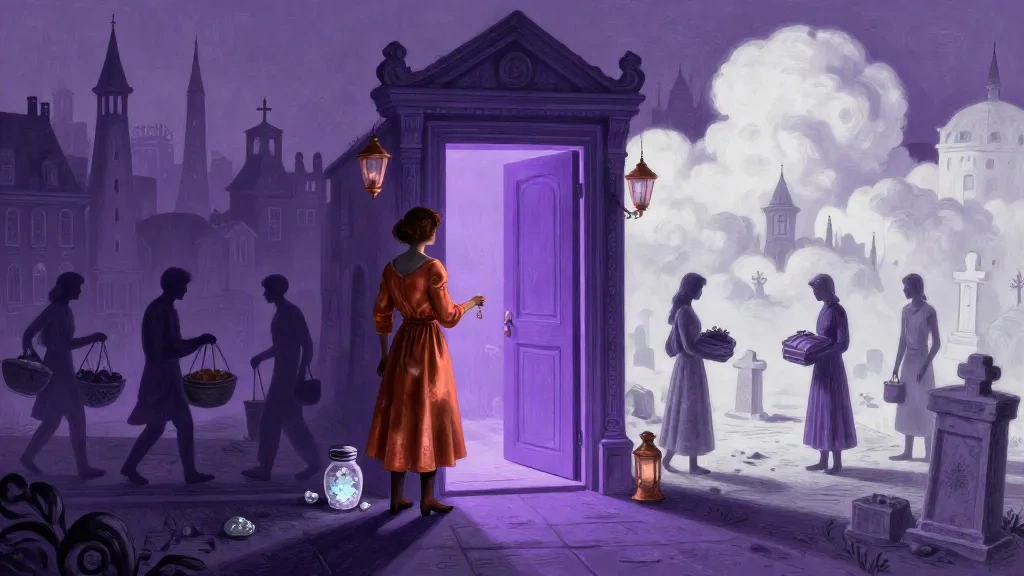
At violet dusk, the city of Vesperfold became two cities occupying the same streets. The first was made of people: warm-blooded, hurried, carrying bread, ledgers, and complaints. The second was made of their shadows, which stepped away beneath the copper lamps and went about their own errands.
Shadow vendors arranged glass buttons in trays. Shadow children waited beneath chimneys for bread that their bodies could no longer taste. On the broad square, shadow citizens raised their hands and voted on questions their owners had never heard of. Only the dead cast no shadow, and they were ignored by both crowds.
Orla Venn was a seamstress who mended what distance made useless. A torn cuff could be closed across a year. A glove could be repaired between two people who had stopped speaking. She had once sewn a bridge from a daughter’s grief to her mother’s doorway, though the bridge had carried only tears.
Her workroom stood beneath the old customs house, between a salt warehouse and a locksmith’s cellar. There she kept a squat salt jar and, beside it, a glass seed clouded with white. The seed had been given to her by a woman who claimed it contained the first silence. Orla had never opened it.
The Dead Tongue
On the evening the council announced its newest law, the city’s shadows began arriving before their owners.
The law concerned a narrow alley between the north ward and the cemetery. The council wished to close it with an iron gate. Above the arch they carved a notice in a language no living person could read: Two may enter when both are willing; one may not command the other.
Orla read the first word by accident. It looked like a door opening in stone. Before she could look at the second, the letters dissolved into a procession of pale figures. They walked out of the inscription, crossed the square, and vanished into the cemetery.
That night the council sent its shadow clerk to her workroom. The clerk was a tall man-shaped absence with a silver seal hanging from one hand.
“You are to mend the boundary,” he said. “The north ward has refused the cemetery. The cemetery has refused the north ward. Their disagreement is creating a wound.”
Orla turned the salt jar in her hands. “Mending a boundary is not the same as making a door.”
“The gate will be a door,” the clerk replied. “But who may cross it?”
Orla looked at the glass seed. Inside it, a tiny cloud stirred.
A Door With No Handles
She designed the door without a handle on either side. Its frame would be stitched from the sleeves of twelve deceased witnesses, their names hidden in the seams. The hinges would be made from agreement rather than metal.
The dead-language agreement had to be copied exactly. Orla descended into the cemetery after midnight with a lantern, a needle, and the salt jar. She scattered salt over the oldest grave. The ground opened into a chamber filled with empty chairs.
At the far wall, the agreement was written in black fire. Living eyes saw nothing. When Orla placed her ear against the stone, the dead voices came.
“Consent is not permission,” they told her. “Consent is the moment both remain themselves.”
She stitched the inscription onto linen, one word at a time. The needle grew warm. Each completed word cost her a memory: her mother’s face, the smell of bread, the sound of rain on her childhood roof. She kept stitching until the door’s sentence was whole.
At dawn, the council fastened the cloth to an empty arch beside the cemetery. There was no gate, only a seam of violet light.
The first person to approach was a shadow with a baker’s cap. He asked permission to enter the cemetery. The living baker stood on the other side, clutching a parcel addressed to someone long dead.
“May I come in?” the baker asked.
The shadow bowed its head. “May I?”
Only then did the light part.
The Distance Between
Orla watched the baker cross. He placed the parcel in the shadow’s hands, and for a moment their outlines overlapped. The city held its breath.
Then the council ordered the gate removed.
Orla climbed onto the customs steps and announced that the door could not be governed because it had no owner. The shadows had not consented to the law, and the living had not consented to the shadows’ votes. She drove the needle through the cloth at the exact center of the inscription.
The dead-language agreement tore in two.
Not a violent tear. A clean opening.
Salt poured from the jar and became cloud-white stones across the square. The glass seed cracked, releasing the silence it had carried. In that silence, every citizen and every shadow heard the other clearly: the dead among them, the grief, the hunger, the names.
No one moved.
Orra stitched the last inch by hand.
The door opened inward. Beyond it was not the cemetery, nor the north ward, but the narrow distance between them, kept clear because both sides had agreed to remain.
When the council asked who had granted permission, Orla pointed to the door.
“It did,” she said. “That is what we made.”
At violet dusk, the city began to pass through.





