 Netwrck
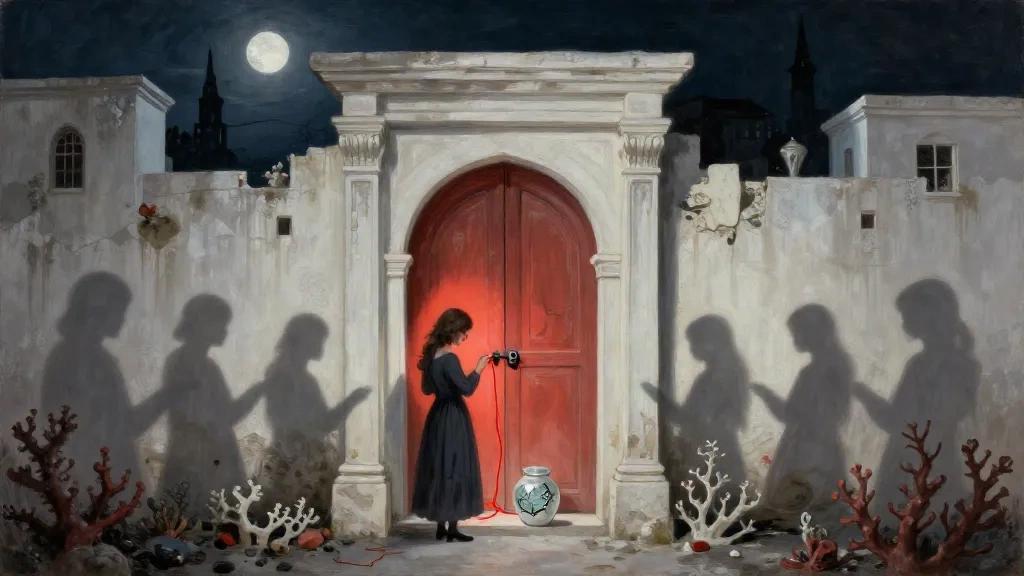
Gothic Fantasy.
The Citizens Beneath
At noon, the bells of Vesper-under-Glass rang without tongues. Across the white coral avenues, people stepped aside for their shadows, which voted at the council, kept shops, and whispered behind them in ink-black voices.
Mara Vale kept her needle threaded with a strand of red. She did not mend cloth. Her gift took hold when two people had drawn too far apart: a daughter on one bank of the Cut, her mother on the other, their voices reduced to wind. Mara could close the space between them until, for one breath, neither could bear the silence.
She wanted that gift for a door.
Not a room door, nor the cellar hatch where her father had disappeared. She wanted a door in the old necropolis wall, dividing the city of the living from the low country of the dead. Every night the dead pressed their pale hands against the mortar. Every night the living pretended not to see.
Her worktable faced a round window. On it stood a salt jar clouded by damp and a glass seed containing one drop of winter. The seed had come from her mother’s grave. The salt had come from a kitchen where, thirty years ago, two siblings had agreed never to speak again. Mara still remembered the exact pinch placed between their plates.
The Agreement of Ashes
The door’s condition was written on a strip of bark from the necropolis gate.
No one living could read it. Locksmiths stared until their eyes watered. Priests declared it decoration. Mara carried the bark to the night market, where shadows sold memories by the thimbleful.
“That script belongs to the dead,” said a shadow wearing the silhouette of a woman with antlers. “They are the only citizens who cannot revise what they have agreed.”
Mara set the bark beside her red thread. The writing tightened. Letters rose in black ink.
IT MAY OPEN ONLY WHERE BOTH SIDES HAVE CONSENTED. A DOOR IS NOT A WALL. A WALL HAS NO WILL.
“Then tell the dead I consent,” Mara said.
“You may consent to the dead,” the antlered shadow replied. “You cannot consent for the city. Every shadow, every citizen, every grave must answer.”
Mara understood too late. A door between two people could mend distance, but a door between a city and its dead required the agreement of every separation within it. She went home and unwound the red thread from her loom.
Where the Distance Widens
She began with the quarrel in the dye market.
The dyer’s shadow refused to deliver blue cloth. The dyer insisted her shadow was lazy. Mara pulled their red thread between wrist and wrist, stitching the distance closed. “Do you consent to enter the same market?” she asked.
They did. The dyer surrendered the cloth.
She crossed to the river barracks, then the pearl exchange, then the tram station where a living clerk had spent eleven years not forgiving his dead brother. Each repair hurt. The thread pulled until her fingers bled and the glass seed cracked along its frost-white seam.
By the third bell, the dead began answering.
From beneath the streets came the scraping of tombstones. From inside walls came knocks in unfamiliar rhythms. The living citizens looked down at their shadows; their shadows looked up. All spoke the bark-script aloud.
“We consent to remembrance, not return.”
“We consent to witness, not command.”
“We consent to one door.”
At last, only the city remained silent.
Mara’s own shadow stood apart from her by the width of a needle’s eye. Within that darkness lived the woman she had been before grief narrowed her life to needles, customers, and an unlit room.
“Do you consent to let me change?” it asked.
She crossed the distance. Her shadow rose to meet her.
A Door Is Not a Wall
Before dawn, Mara fastened red thread around the glass seed and set it in the salt jar. The salt drew grey from its walls. The seed opened like a tiny eye.
She hung the bark-script above the necropolis wall. Living letters cannot be altered by the dead, the antlered shadow had said. So she crossed out every living word.
Blank wood waited in the cold.
No one spoke.
Behind the wall, the dead waited.
Then Mara took her needle and sewed the red thread through the grain, joining the wound that must remain open to the world that must never be owned.
Salt fell like white coral. Ink gathered into a door. A red seam crossed its center.
It opened inward.
Beyond it stood no kingdom of ghosts, only the city as it had always been: crooked, crowded, unforgiving, loved beyond its deserving. Shadows moved beside their citizens. The living wept at the sight of what they had cast away.
At Mara’s feet, one red thread crossed the threshold. It did not pull her closer. It held both sides in place.
Consent, unlike grief, required no distance to mend.





