 Netwrck
Speculative Fiction.
The Seamstress of Two Streets
At first light, the shadows of Veyr came out.
They slipped from beneath doors, slid along gutters, and gathered beneath the pale winter sun. Each carried a citizen's outline, though not always the citizen's face. A baker's shadow wore the tall brim of a soldier. A child's shadow carried an adult's locked jaw. When a woman stepped into the market square, her shadow crossed the street before her and bowed to no one.
Mara watched from her sewing room, where winter light fell through a single window in thin, colorless bars. She was a seamstress of distances: the space between two enemies, the gap between a question and its answer, the long silence after someone leaves. People brought her torn sleeves, broken clocks, and letters they could not seal. She mended the invisible with black thread.
Her own shadow sat beside her loom, needle and thread in hand.
For years Mara had wanted a door that opened only when both sides consented. She had seen too many thresholds that swallowed the unwilling: doors between neighborhoods, doors in the old walls, doors that admitted shadows while rejecting citizens.
One morning, a delegation came from the Low Quarter. They brought a village agreement written on bark in a language she did not recognize. Its characters were small, angular marks, all of them closed like sealed doors. The village elder said the agreement had been dead for eighty years, yet it still governed the border.
“The dead wrote it,” he said. “Only the dead can read it.”
He placed a salt jar on Mara's table. Beside it lay a glass seed, bright as a winter sunrise.
The Agreement Below
That night, Mara followed her shadow into the cellar.
It moved through the floorboards without opening them. She stitched a seam in the air above the well, and the darkness folded, revealing stairs that descended farther than the cellar should allow. At the bottom waited a corridor of shadows. They stood shoulder to shoulder, silent, each breathing a small cloud of pale vapor.
The village agreement hung from a rusted gate. Its marks glowed when her shadow approached.
“Read it,” commanded a voice from the wall.
“You know I cannot.”
“You have mended distances. Perhaps that is enough.”
Mara touched the bark. The language climbed into her wrists, cold and precise. She understood one condition:
A door exists only where two willing shadows meet.
The other side of the agreement had been struck away.
She climbed back to the attic with the salt jar and glass seed. The jar was heavier than stone. The seed vibrated when held near her heart. Her shadow stood at the window, holding a needle that cast no thread.
“You want a door,” it said.
“I want consent.”
“The dead cannot consent.”
“Then why are they guarding the contract?”
The shadow did not answer. Outside, the city changed shape. Citizens hurried beneath the shadows of soldiers, children, lovers, and strangers. Every silhouette was a citizen. Every citizen was a silhouette. The borders between them had begun to fray.
The Door That Refused
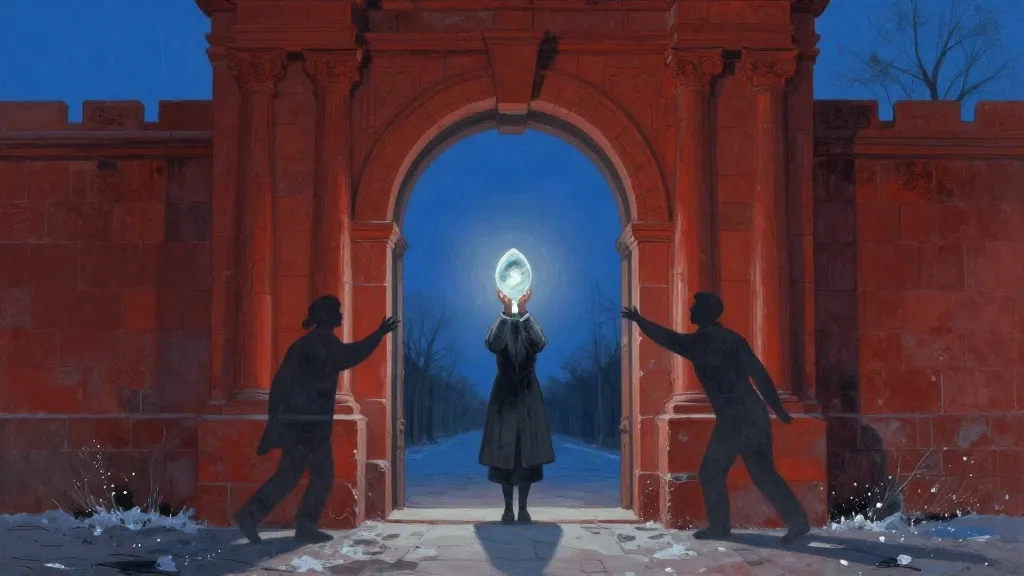
Mara built the door from salvaged thresholds: a tavern beam, a child's crib, the frame of a house demolished after a flood. She stitched the wood with rust-red thread and set the glass seed in its center.
The first opening was too eager. It opened toward the dead quarter, and shadows poured through. Mara reversed the seam, but the threshold held.
The salt jar cracked. A white line spread across the floor.
She poured the salt around the frame. It stopped at the edges, unable to make a circle. The glass seed cracked too, and inside it appeared a miniature city, its windows lit by pale winter light.
Mara understood then that consent was not permission granted by two hands. It was recognition. Each side had to see the other as a person, not a shadow, a title, a debt, a story.
She cut the final thread from her own sleeve. It had been sewn there the day her brother left and never returned. She held it over the glass seed.
“I consent to open,” she said, “if you consent to remain.”
The shadow on the floor lifted its head.
“I consent to remain,” it said, “if you consent to be seen.”
What Stayed
Mara pulled the thread free.
She felt the missing part of her sleeve close, and for one breath the city blurred. Shadows stopped at the walls. Citizens stopped beneath them. The distance between each person and their silhouette became a thin, visible thread.
The agreement unfolded. The missing clause returned in pale letters:
Neither side shall cross alone.
The old village door opened, not into the dead quarter, but into the present city. On the threshold stood the dead in transparent forms, and living citizens stood opposite them, unable to advance without consent.
No one moved.
Then the little girl in the charcoal coat reached for her dead grandmother's hand.
The grandmother bowed. The girl bowed back. They crossed together.
One by one, the others followed: soldiers and beggars, judges and children, the living and the gone. Every crossing required two voices and two willing steps.
At dawn, Mara's shadow stood beside the door, needle and thread in hand. It was smaller than before, but its edges were sharp.
She kept the salt jar, though the crack had healed. She kept the glass seed, though no city moved inside it now. On the door, she stitched a single line.
It opened only when both sides consented.





