 Netwrck
Fantasy.
The Door in the Mountain
High in the sleeping volcano, where the observatory windows looked upon violet dusk and the oxidized roofs of distant villages, Mara stitched beside a door that had no handle.
The door was set into the mountain’s black heart, its frame lined with copper gone green beneath the weather. Beyond it, a stair descended into warm darkness. Mara’s grandmother had sealed that stair with salt, then hung a glass seed over the lintel. The seed held a single cloud-white drop that never fell.
Mara was a seamstress of distances. She could mend the space between two people after an argument, after a departure, after one had become a stranger through years of silence. Her work began with a torn sleeve or a mended collar and ended when the hidden tear grew whole. She never forced the cloth closed. The people on either side had to pull together.
Now the observatory council wanted her to make a door that opened only when both sides consented. They had found their ancestors’ agreement in the volcanic archives, written in a language no living scholar could read. It promised that no settlement, marriage, or exile would remain valid unless every person involved had freely accepted it.
“A door is not a law,” Mara said.
“Then make it one,” said the councilor, whose name was still displayed on a copper mourning tablet.
Words Below the Ash
Mara began with the glass seed. She wrapped it in a strip of cloud-white linen and stitched a border around it with oxidized copper thread. The seed warmed beneath her fingers.
Each night, she visited the sealed stair and listened. The dead spoke through the stone, not as voices but as pressure behind the ear. They recited the old agreement in a language that arrived as grief: a mother’s withheld apology, a bridegroom’s silent promise, a village sentence delivered after the accused had already died.
The dead could read the writing because they had no living claim to consent. The living had forgotten how.
Mara asked the villagers to bring their broken distances. A widow brought the sleeve she had inherited from a husband who had left for the northern mine. A boy brought his sister’s shoe, its laces still knotted. A farmer brought a boundary stone split by a flood.
She mended what she could. The widow’s sleeve grew whole, but no letter appeared inside it. The boy’s shoe remained empty. The boundary stone held its crack.
“You are making doors for the dead,” a young mason told her, “not the living.”
“The dead cannot choose.”
“That is why they are dangerous.”
In the observatory’s eastern gallery, Mara found rows of names cut into slate. Beside each name stood a mark made of two lines meeting at a seam. When she touched one, she heard a living person breathing somewhere far below.
She understood then. The agreement did not bind villages to one another. It bound every person to their own silence. The dead had inherited the power to open what the living refused to ask.
Two Hands on the Threshold
On the third night, the glass seed cracked.
Cloud-white light spilled across the floor and gathered at the sealed door. Mara’s grandmother appeared in the doorway, translucent as heat above stone. Behind her stood villagers Mara had never met, all carrying the names of the departed.
“You have sewn the consent out of them,” her grandmother said.
“I have given it back.”
“No. You have made a door without a threshold.”
Mara understood. A consent door needed two sides. One side could not be the dead. She had been treating the agreement as a passage between the living and the forgotten, but the village had written it for the living alone. The dead could witness. They could not consent.
She cut the glass seed open and spilled its light across her worktable. The salt jar beneath the window began to hum.
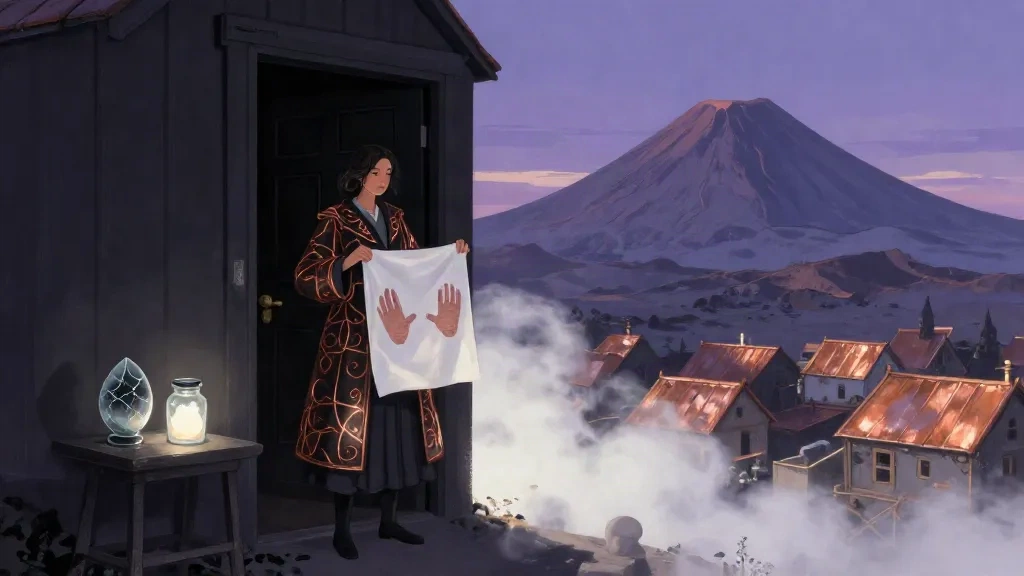
Mara filled it with the coarse salt used to season winter food, then added the silver dust gathered from the observatory instruments. She sewed the mixture into a small square of cloud-white cloth. On the copper-threaded border, she made two empty hands, palms facing outward.
At dawn, the council gathered at the sealed door. The mason brought the boy and his sister. The farmer brought his neighbor. The widow brought her husband’s sleeve, empty and mended.
Mara did not touch them. She placed the cloth on the ground and stepped back.
“Consent is not agreement,” she said. “It is permission to be heard.”
One by one, the living spoke to those they had wronged. The boy asked his sister whether she wanted to keep the shoe. The farmer asked his neighbor whether the boundary stone should remain split. The widow asked the dead whether she might finally lay the sleeve aside.
Silence gathered, but it was no longer obedience. It was a space held open by choice.
The Door Opens Both Ways
At sunset, the copper frame brightened. The mountain exhaled violet air, and the sleeping volcano’s distant heat trembled beneath the floor. A line of cloud-white appeared down the black wood.
The door did not swing inward. It opened outward, toward everyone present.
Beyond it waited not the dead, but the unwritten present: a field where the village had built its first homes, a kitchen warm with bread, a road widening where frightened people had once made it narrow. The dead stood upon the other side, but they were guests. They could not cross until the living invited them.
One by one, the living crossed. Some went to apologize. Some went to ask forgiveness. Some went to speak plainly for the first time in a lifetime. The door remained open because each step was chosen.
Mara stayed at the threshold. Her grandmother watched from the field.
“Will you come through?” Mara asked.
“No,” the old woman said. “But you have made the road.”
Mara looked back at the salt jar, clouded with fine crystals, and the glass seed, empty now but bright beneath the copper frame. The observatory windows held violet dusk, oxidized roofs, and cloud-white sky.
She understood that consent was not a lock to be opened once. It was a seam repaired and repaired again, whenever fear pulled the cloth loose.
Then Mara crossed, leaving the door open behind her.





