 Netwrck
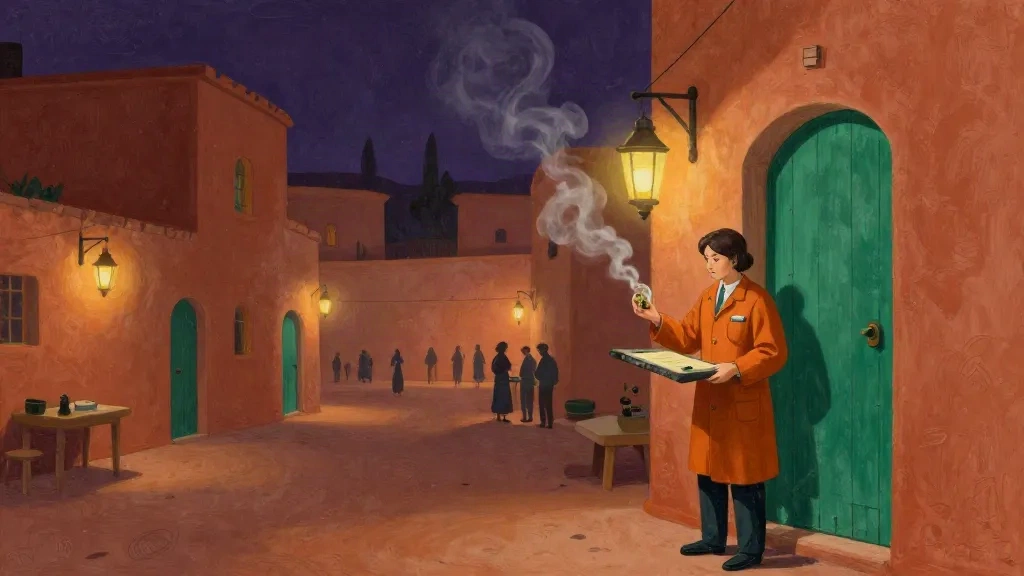
Science Fiction.
The Missing Floor
Every night, after the upper city locked its windows, Sava climbed down into the market beneath it.
There were no streets below the first floor. The city stood on a vast terracotta drum, and beneath the drum the market spread in warm, crowded rooms, where people traded salt, green herbs, copper buttons, and memories that had grown too heavy to carry. Lanterns burned in eucalyptus smoke. The ceiling shimmered the color of a sky glimpsed through bruised fruit.
Sava worked beneath an awning patched with ochre cloth. Her needle was a thin silver thorn, and her thread came from a spool she had filled herself from old greetings.
Her gift was simple to explain and impossible to describe. She could mend the distance between two people. A rift opened when words had failed: between a mother and daughter, a witness and a judge, two brothers who had inherited the same field and never spoken over its boundary. Sava sat them across from one another, stitched the torn space with careful thread, and left them with a place where a door might be built.
What she wanted was a door unlike any she had made. It would open only when both sides consented. No forced forgiveness. No secret passage. No lock that pretended to be an agreement.
The Agreement Below
The village agreement arrived on a stone tablet wrapped in black cloth.
It had been found beneath the market, where the old foundation met a seam of pale clay. The writing was neither a trade alphabet nor the dead language of the upper city. It was cut in narrow, backward strokes, each word ending in a small red mark.
Only the dead could read it, said the market’s eldest salt merchant, who had brought the tablet to Sava. The village had gone silent eighty years ago, when everyone inside its boundary died during a winter illness. The survivors had sealed the district and written a final agreement, promising never to send another person below.
Now the upper city wanted the district’s tunnels. They would widen the market, bring machinery, and let the machinery descend. Sava had seen the plans spread across a merchant’s table. Beneath them, a little girl was holding her mother’s sleeve.
“Make the door,” the girl said.
“A door cannot stop a road,” Sava answered.
“Then make one they have to ask.”
Sava turned the tablet beneath her lantern. At once, the dead language seemed to loosen in the air. Not letters, but meanings, rose behind her eyes: a field, a child, a bowl of salt, a seed, a promise made by someone no longer alive.
The agreement was binding because every dead person had spoken it together. To translate it, she needed their voices. The salt jar on her table began to tremble.
What the Dead Required
The glass seed was warm when Sava placed it beside the tablet.
Her mother had given it to her before her last breath. It contained a small, impossible tree, green leaves pressed against its inner walls. The tree grew whenever someone had told the truth.
At midnight, the market emptied. Then the dead arrived. They did not appear as bodies. They came as absences in the crowd, as cold hands passing behind Sava’s shoulders, as familiar voices calling from rooms that had no doors.
One by one, they spoke the agreement. A farmer gave back the name of a field stolen after his death. A child surrendered the last lie told about the well. A woman confessed that the village had not died by chance, but by a decision made in fear.
Sava stitched each statement into the space between the tablet and the glass seed. Her thread began to glow.
Then the dead demanded something she had not been promised: the memories of the living.
They asked for her mother’s last words. For the reason Sava had left the upper city. For the name of the person she still wanted to find.
She understood then that the door would not be neutral. Consent required truth, and truth required surrender. To build it, she must offer something of the life she wanted to return to.
She placed the salt jar between the dead. Its rim filled with small white crystals. When she opened her hand over it, the salt fell upward, joining the red marks in the writing.
A Door That Asks
Dawn found the market intact.
Only the tablet was gone, and in its place stood a narrow door of stitched shadow. Its frame was terracotta. Its handle was eucalyptus-shaped. A glass seed glowed at its center.
Sava tried it herself. The door remained shut.
The engineers arrived with crowbars. The village representatives brought lawyers, maps, and old grievances. The dead hovered unseen, waiting for the living to choose.
Sava stepped away.
Then the little girl approached. Her mother stood behind her, separated by the intended new road.
“May I open this?” the girl asked.
“That is the question,” Sava said.
The mother stepped forward. “I consent to speak. I do not consent to return to the past unchanged.”
The girl nodded. “I consent to hear her. I do not promise to forgive her.”
“Is that enough?” the mother asked.
“It is a beginning,” Sava said.
The girl touched the handle.
The dead had left enough room for the living. The door opened onto neither wall nor tunnel, but onto a narrow path where the two women could walk side by side. It was not a road. It was an agreement to take one step, then another.
Behind them, the market remained open. Above them, the city had no street, only the promise of a floor.
Whenever someone asked Sava to make the door serve her, she pointed to the glass seed. Its leaves were still growing, but never beyond the glass. Consent, she had learned, was not a lock opening from the outside.
It was a door remembering that both hands belonged to the people who chose it.





