 Netwrck
Science Fiction.
The Last Reel
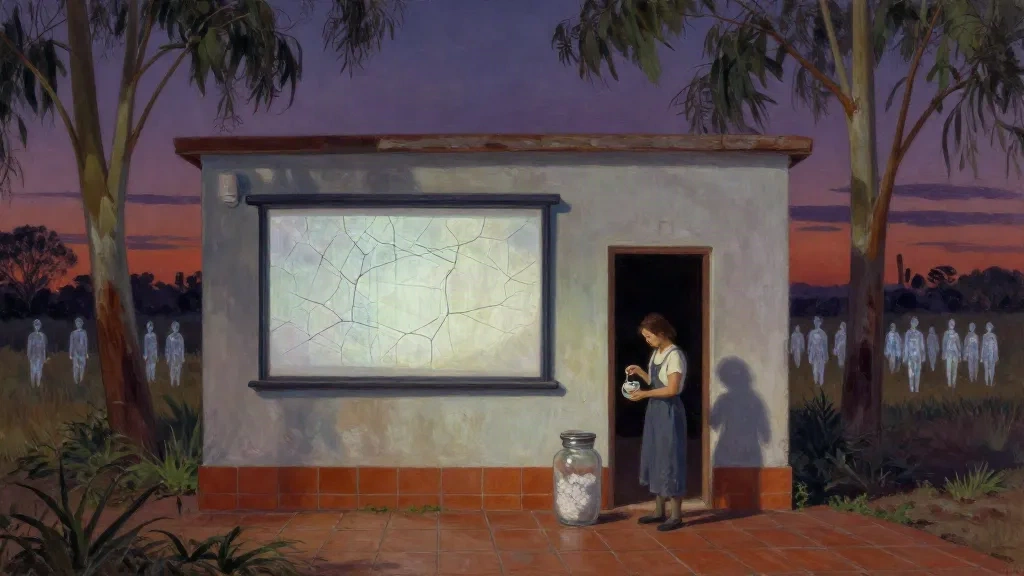
The abandoned cinema sat behind the eucalyptus depot, its roof patched with terracotta tiles and its ticket window nailed shut. Every night at moonrise, the building showed a film no one had requested. The images were clear. The sound was not.
They showed a bridge burning between two provinces. A harvest arriving three weeks early. A child walking into the sea with a red scarf tied around her wrist. Beneath each disaster, a caption appeared: THIS FUTURE ALMOST HAPPENED.
Mara Senn repaired the films by hand. She was a seamstress with a needle fine enough to stitch torn skies, though the closest she came to magic was listening.
On the final evening, the screen displayed a door.
It stood in a white wall, neither locked nor open. Two figures waited on opposite sides. One wore the copper coat of the village council. The other was a man Mara had buried six years earlier.
Then the screen went black.
The Agreement Beneath the Floor
The village had signed a treaty with the dead during a drought, surrendering the right to remember their final words. The agreement was hidden beneath the cinema floor, written on thin sheets of bark in a language that only the dead could read.
Mara found it because the floor had begun breathing.
Each breath lifted the dust in pale rings. She pried up three boards and found a seal made from black clay, cracked by a line of white salt. Beside it rested a salt jar and a glass seed no larger than a grain of rice.
The dead had left those objects as instructions, though no one knew how to read them. Mara knew. When she held the glass seed to the bark, letters appeared in reverse. The village had agreed to forget the dead, but the dead had not agreed to be forgotten. Their silence had been counted as consent.
The distinction mattered.
At the next council meeting, Mayor Oran demanded she destroy the document before harvest. The living had already paid for peace. If the dead were released, the old thirst would return with them.
Mara brought the seed. The council chamber dimmed. Outside, the sky looked like bruised fruit split by a blade of sunset.
A Door Needs Two Hands
“Build no door,” Oran said. “The dead do not choose anymore.”
Mara placed the salt jar between them.
“Then neither side chooses for them.”
She asked the council to touch the bark. The mayor refused. Others followed. When night fell, she carried the document to the cinema, where the dead gathered as faint reflections in the glass.
She mended what distance had made permanent: the six years between one grieving mother and a drowned son, the enmity between a farmer and his brother, the silence between the living and those they had buried. Each repair required two people to name what they wanted and what they were willing to lose.
At dawn, only the mayor remained.
“I do not want them back,” he said.
“That is an answer.”
“But I want the river to stop taking children.”
Mara cut the thread between his palms and wrapped it around the glass seed. The salt jar cracked. From the buried treaty rose a thin black line, and the cinema door appeared in the wall.
It opened a finger’s width.
Warm air came through, smelling of wet clay, eucalyptus, and rain that had fallen decades ago. Beyond the threshold, the dead stood in a field under the same bruised sky. None crossed until the living stepped back.
Mara sewed the final seam across the doorframe. The glass seed split into two clear halves, each no larger than a grain of rice.
What the Future Kept
The door remained. It opened only when both sides touched the frame and spoke an agreement freely.
Sometimes it revealed a child crossing safely. Sometimes a bridge standing. Once, it showed the cinema full of people watching a film in which no future had nearly happened.
Mara never asked whether that ending was certain. Futures were not contracts. A door was not a promise. It was only a place where two choices could meet without one swallowing the other.
Years later, children asked why the old cinema had no roof.
Mara pointed to the sky.
“Because the weather is still deciding,” she said, “and so are we.”





