 Netwrck
Gothic Fantasy.
The Monastery in the White Coral
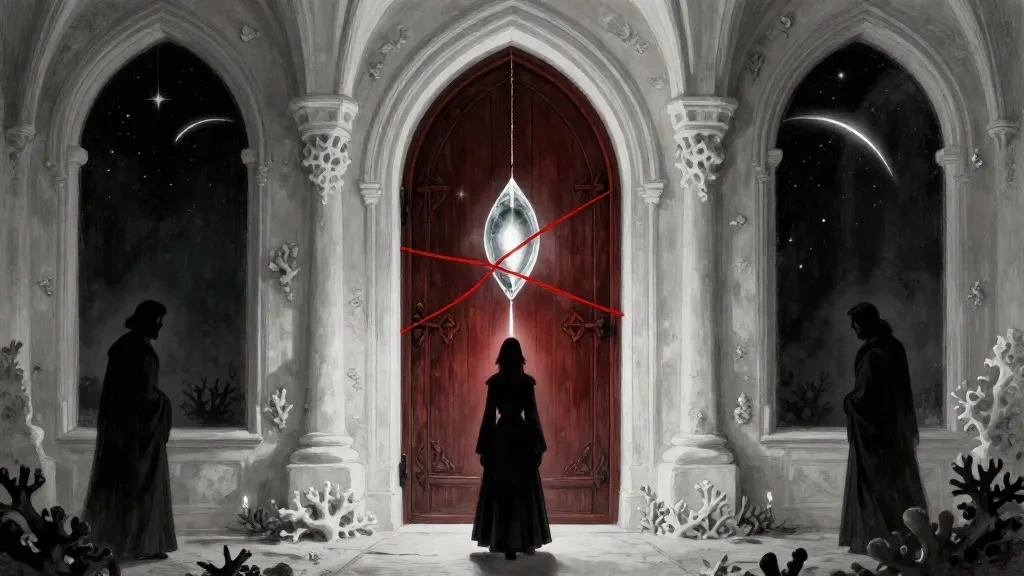
At the monastery in the comet, every corridor curved toward a vanished sun. The walls were white coral, polished by centuries of breath until their chambers shone like bone. A red thread crossed every surface: over doorframes, beneath roof beams, around the narrow windows facing the black.
There, in a room where the floorstones were stitched with brass, Sister Ilyen worked as a seamstress. Her needle did not mend cloth. It mended the distance between two people.
She could close the gulf between brothers who had not spoken for forty years, between a bride and the man waiting outside her window, between a dying child and the parent who could not bear to leave. With one careful stitch, the wound became a seam. With the next, it became something that could bear weight.
Ilyen wanted to make a door.
Not a door for punishment or escape. A door that opened only when both sides consented. She had imagined it for years: two handles at equal height, no key, no bolt, no hidden command. On the first threshold, the living would say, “I choose you.” On the second, they would answer, “I choose you.” Only then would the wood remember that it had ever been a tree and become a passage.
The Agreement of the Ash Village
Her task came from Ash Village, where the river ran beneath a bridge of frozen lightning. The villagers had not spoken to one another in nine years. They had sealed their wells, shared no bread, and left the dead unburied in the churchyard. At noon, children passed one another in silence. At night, bells rang without hands.
The village agreement was kept in the monastery archive, written on a strip of smoked hide in a language Sister Ilyen did not know. Its letters were narrow, angular marks that seemed to open and close like mouths. When she read it aloud, the page stayed silent.
When Brother Anselm read it, every candle in the room went out.
Only the dead could read it. Not as prophecy, but as testimony.
At dusk, the village’s oldest woman came to the monastery. She carried a salt jar wrapped in a red thread and, inside it, a glass seed the size of a tear.
“The agreement says the door may not be built where there is still a grievance,” she told Ilyen. “It says every refusal must be heard before the threshold is made.”
Ilyen turned the jar in her hands. The salt had grown damp.
“And the seed?”
“It came from the comet. Plant it where the door will stand. It will open once, but only after both sides have consented.”
Stitches Through Silence
Ilyen carried the salt jar to Ash Village. The red thread followed her, trailing through the white coral streets and across the mud, until the two places seemed joined by a single bright scar.
She began with Mira and her brother Tomas, who had not met since the night their father died. Ilyen stitched the distance between them. Tomas crossed three rooms, then stopped at the kitchen door.
“I do not forgive you,” he said.
“I did not mend forgiveness,” Ilyen replied. “I mended the space where it can speak.”
His refusal opened a crack in the wall. Cold air poured through it, carrying ash and the smell of rain on iron.
One by one, the villagers came. Some consented. Some refused. Some spoke lies until the red thread burned Ilyen’s fingers. The agreement remained unread to the living, but the dead spoke through its lines. A drowned boy named the well where an apology had been buried. A bride named the husband who had abandoned her. A mother named the child she had buried beneath a false name.
At last came the village itself.
Two representatives stood on either side of the empty threshing floor. Neither would consent.
The salt jar cracked.
The glass seed lifted itself from the broken clay and hovered between them.
The Door That Chose
That night, Ilyen stitched the seed into the wooden door. The glass darkened, then filled with a tiny white coral sky.
She placed one handle east and one west. The red thread crossed the threshold.
The representatives stared at each other.
“I choose you,” one said.
Silence.
Then the other answered, “I choose you.”
The door opened inward.
No thunder. No blast. Beyond it was not another room, but the space between hearts where anger had been hiding. Every villager saw what had been lost there: the well, the bridge, the years of silence, the names beneath the stones.They stepped through one by one. Some wept. Some struck one another. Some knelt.
Ilyen watched the salt stain the comet-white floor. It had preserved the dead language long enough to bring the living back to the door.
When the last villager passed, the glass seed split open. A red thread emerged, thin as blood, and stitched itself into the door forever.
From then on, the door did not ask whether people had forgiven one another. It asked only whether they were willing to enter the same distance together.
And on dark nights, when the monastery turned through the black, the door listened for two voices, one on either side, saying yes.





