 Netwrck
Adventure.
The Bell That Remembered Tomorrow
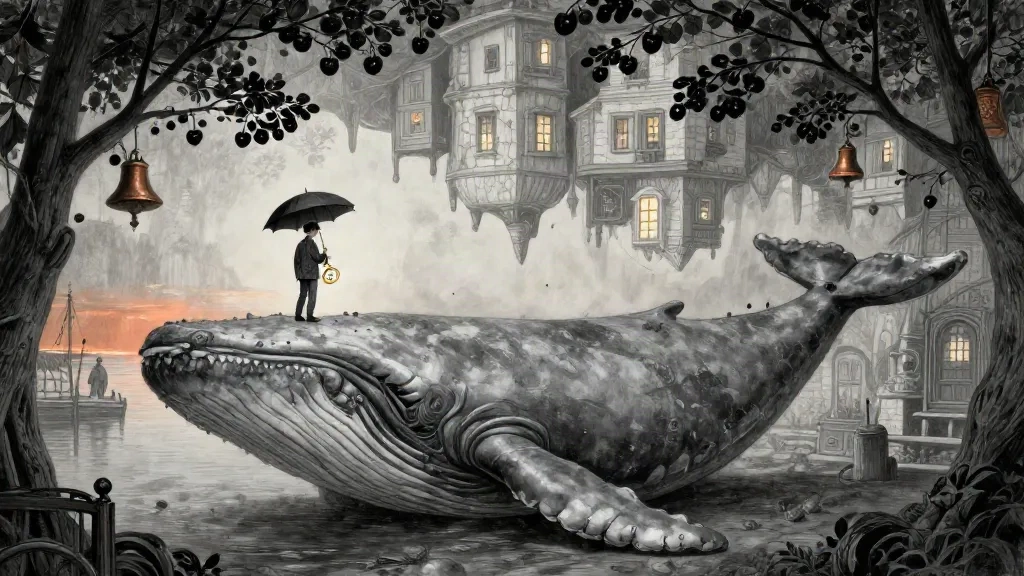
On the back of the sleeping mechanical whale, Mara Quell kept a workshop made of whale-glass, copper wire, and old ship bells. The whale lay beneath the mouth of the harbor, its ribs rising and falling with the tide, and above them Lantern Street clattered with boots, trams, and the bright complaint of a city going to work. Mara felt the street's weight through the soles of her feet. Everyone in Lantern Quarter felt it. It was the sort of thing the city had agreed to stop mentioning, the way it had stopped mentioning the fourteen yards that had once been yards.
She was seventeen and made bells for memories people had not yet owned. A bell for the day you left home. A bell for the name you would choose at twenty-five. A bell for the face you met in a mirror after becoming someone new. The smallest rang inward. The largest announced a future so distant that it had not happened yet.
The trade had one law and the law was clean. A bell cast for a thing you do not own yet must be paid for in a thing you do. You spend what you have to hold what you might. The yard masters taught it the way they taught hand placement, without softness, and then they let the trade explain itself, which was how Mara understood that the trade would explain anything to anyone, clearly, and never the same way twice.
At fifteen she had paid her mother's face for a bell about a name she did not choose for three more years. What she kept instead was the black umbrella's handle, worn to a soft oval by a hand that no longer belonged to anyone, and she kept it the way other people keep a grudge, out of proportion to the inconvenience.
Oren came down the ladder at ten with his coat full of chalk.
“Forty-one again,” he said. “And the Vantree door is lying to itself, which means the Kell woman has started over.”
He had been making the rounds since he was nine, in the season when he was small enough to be forgiven for knocking. During the Quiet Day he went from door to door with his slate, and if a household had not put an umbrella out, he wrote the number of their dead on the doorframe in chalk, so the city would at least know the shape of what it had agreed to forget for a day. Nell was the eighth of the forty-one. He had never said her name out loud on the Quiet Day, because the slate did not hold names, only counts, and because he was afraid of being the man who broke the rule on purpose.
“The Inspector's men took my last two slates,” Oren said. “He says the count is a municipal matter now.”
That morning, a brass compass appeared beneath Mara's workbench, wrapped in oilcloth and addressed to no one at all. It did not point north. Its needle trembled toward a crack in the whale's back where a square iron hatch sat under salt-black tar, tarred shut before Mara was born. Around the hinge, older than the tar, someone had scratched a number and then filed it away. The compasses passed off that hinge in the city records, she had heard the yard talk, were instruments of the glassworks, made of whale-glass like her own stock, and they went to men who had forgotten something on purpose to make them work.
Mara knew the street above by heart. She knew the bakery where the floor dipped, the theater with the blue door, the alley where rain collected around a crooked milestone. She wanted to know its true shape. She took the compass, the black umbrella, and a chisel, and she did not tell Oren, which she thought about for a long time afterward.
The Holiday Without a Name
At noon the trams stopped, and the city fell silent.
Not for a festival and not for a victory. The Quiet Day began on the same gray morning every year, and the calendar admitted only that it was old, older than the brickwork on the street above and older than the whale, which was old in the way a cistern is old. Shops closed. Black umbrellas went up outside every door, standing in the rain that did not fall, until Lantern Street looked like a second street built out of posts. Nobody spoke until dusk, not in the quarrelsome way of a held breath but in the obedience of people who had all been told the same thing by the same voice and had never once asked what the voice was paid for.
In the plazas the Inspectors of the Quiet walked their line with their hands behind their backs, and the founders' statues stood in the corners wearing chiselled names that had been recut so many times that the letters no longer spelled anything at all. Nobody complained. Complaining required remembering what had been written first.
Mara went down the ladder at half past twelve, with the tar cracking under the chisel and the compass needle steady as a held breath. The rungs went down forty feet through the whale's hide, and the temperature rose, and the smell changed from salt to salt and hot iron, the way a foundry smells at night. The compass got warmer in her hand with every rung, which was the first dishonest thing it did.
The City Under the City
Below Lantern Street lay another street, pale stone and black cherry trees, its buildings hanging upside down beneath a copper horizon, windows lit in rooms that no house above ground possessed. At every corner stood a small brass marker, and under each marker lay a bell.
She pried one up to see what the city was keeping down here, and found a very small bell with an ordinary thing inside it. A man describing the exact green of a door he had walked past every morning for nine years. A girl losing a tooth behind a shed. A woman deciding, twice, not to say a word to her sister. The archives would have called these records. They were not records. They were the harvest, one household at a time, the way a farmer keeps the best seed back.
The compass pulled her toward the theater with the blue door. Inside, the seats were full and nobody had raised their head. Their grief moved through the room in separate streams, and the streams did not mix, which was the detail that frightened her. One man had lost a daughter. Another had lost the ability to recognize his brother and had come to sit beside the brother's grave anyway. A woman held both hands flat over her ears while the child beside her wept for a city that had never been built and was going to be, one block at a time, in the child's head.
At the center of the stage stood a keeper wrapped in a mourning shawl, with a ledger under one arm and a lamp turned down low.
“You brought the umbrella,” the keeper said.
“I brought what I found.”
“That is not the same thing.” She looked at Mara for a long moment, the way you look at a bell you might have to ring. “Say what you are, girl, and I will stop calling you a child.”
“I cast for futures.”
“Then you are the only instrument in this city that has ever worked.” The keeper nodded at the bell beneath the floorboards, enormous, black, unstruck. “I am Aveline. I keep the bell and the name, and the name is the reason the bell exists, and the bell is the reason the day exists. I am paid a wage, and the wage is not secret, and neither is the wage, which is the part nobody upstairs can get through their heads. Every year they are spared. Ask them, once, whether they would choose it.”
“Choose what?”
“The forgetting.” She set the lamp on the lip of the stage. “In the flood year this city took a district and signed it away, and the name that stood over it did not survive the paperwork. A woman would not sign. A woman drowned holding the doorframe of a shop with a child in it. Whether she was murdered by the water or killed a month later by the men who paid for the plots is not mine to say. Both records ring true. Both are down here, in two bells, because this city could not afford to throw either away and could not afford to admit both.”
Mara looked at the compass. Its needle had settled on the black bell like a nail on a board.
The Inspector of the Quiet
The hatch was open behind her, and Inspector Ferrant came down the ladder with rain still on his coat, as though he had walked through the tar to get here.
“That is municipal property,” he said, without offering to take it. “And so, at the moment, are you, girl. Give me the compass and I will write your name in the book and you will have done something you cannot undo.”
“You put it under my bench.”
“I did.” He took out a folded sheet, and it was not a warrant. It was a ledger page, and the numbers on it were three columns deep. “Two hundred and thirteen of these. I had the first one made when I was twenty-six, and I buried the maker in the ballast with it, and every one after that, until a woman on the Watersteps paid for the needle with a face and it worked. I have watched instruments fail for nine years. They fail because their makers are careless, or because the makers are strong, and being strong is a kind of carelessness. I put yours under your bench because I am tired, and because you have already paid something and I am permitted to know that.”
“The whale is asleep,” he said. “It is not asleep. It is full. Everything this city has agreed not to feel is in that animal's hold, and the animal is a machine, and a machine that is full eventually comes up. If you ring that bell, it comes up. The harbor will empty to the mole and come back wrong. The west end of Lantern Street will lift and will not come down again, and I have already written down the number of people who sleep within four hundred yards of it, and the number is nine hundred and six, and I have a woman at the casualty desk who will find that number in her sleep.”
Mara thought about the ledger. “Then why does the name have to be forgotten?”
“Because you do not bury a name, girl. You bury what people may do with a name.” He put the page away. “Bring the name up yourself. To one room, to a closed committee, to a ledger with a lock on it, the way it was done for a hundred and eighty years, and no one loses a house. Nine hundred and six people go home tonight.”
“And nobody knows who the woman was.”
“Nobody knows which woman,” Ferrant said. “That is not the same as nobody knowing, and you will find out how much worse it is.” Then he said, with the air of a man setting down something heavy: “Your mother came down the ladder on the eleventh of the Quiet Day, seven years ago. I signed her through myself. I signed forty-one names out of the Watersteps in the flood year, and I was nine when I signed them, and the eighth of them was a girl called Nell who used to bring me a pear when the Vantree orchard was still standing. I have never once said her name. Ask the boy whether that makes me better or worse than the city.”
The Shape Underneath
The Ballast
Mara went back down to the stage alone and put her hand on the black bell. It was warmer than the room, and it was not hot in the way metal is hot, but in the way a person is hot who has been holding something for a long time.
She rang it.
The sound did not travel outward. It dropped through the stage, through the pale stone, through the whale's vast sleeping body, and the whale took it the way a lung takes air. She felt the answer come up through her knees. The theater cracked into layers, the copper horizon peeling back to show a second city and then a third, each built from the same pale stone and arranged differently, streets curved toward gardens that had been cut down, rooms opening into seasons, a bakery she knew standing beside an ocean that had never held water.
Then the harbor drained.
It went out to the mole in a long sucking slope, and the whale came up under Lantern Street, and the west end of the street lifted three feet and stayed lifted, a dead flat of broken brick with a tram stranded nose down in it and the black umbrellas still standing in rows, unbroken, because the umbrellas had been the only things down there that never belonged to the city.
The hold opened along its seams. Brass rained into the streets: two hundred and thirteen compasses, in a spreading wave, ringing as they struck the cobbles, each one a needle finally permitted to arrive. The bells in Mara's own rack rang without being touched, all at once, and every memory she had spent to cast them went out of the glass and into the air of a city that had forgotten it owned them.
What came back was uneven, and that was the part she would not forgive anyone for later. The people of Lantern Quarter lost a holiday. The people of the Watersteps, whose houses the ballast had been quietly crushing for a century, lost the years the archive had rewritten about them. A man stood in the middle of the ruined street bleeding from a cut he could not account for, because the fight that had given it to him had been a story the Watersteps had been told instead of the truth. A woman woke holding a boy who was looking up at her, startled, and the name she had called him for seventeen years had gone, and he answered to it anyway, because the boy did not care where he had been named.
The Bellmaker's Street
Forty-one
It cost Mara the voice.
Not the face, which she had spent at fifteen, but the voice, which she had been guarding for three years by casting nothing at all, on purpose, for the first time in her life, and had told herself it was discipline. The small inward bell went off on its own when the ballast opened, and the voice went out of it with everything else, and she knew it the way you know a room has been rearranged in the dark. She still had the handle. She still had the way a hand fits around it. The rest was gone, and no bell she owned could get it back, because a bell for a thing you do not own yet cannot be cast to buy a thing you have already lost.
They came for Oren that evening. Word had gone around the queues that the forty-one on the slate were the reason the whale was up, which was not true, and which was the only useful thing the city had to give itself, and so it was said loudly. Mara found them at the Watersteps with their hands on him, and Ferrant got there first, and took the slate, and did not read from it. He read the names out instead, all forty-one, from his own book, with the drowned district's name at the top, which was the first time anyone had said it in a hundred and eighty years, and the crowd went quiet, and the quiet was not obedience, and it did not last, and it was enough.
What came after was not a triumph. It was a schedule. The city kept the day, and it kept the name, and it began to argue, which is what happens when a thing that was stored in one voice gets distributed to a hundred thousand. Some of them held that Wren Aldis was murdered by the water. Some of them held that she signed, and took the money, and that the district drowned by flood and not by argument. Aelvin kept both records, one bell to a version, and the city spent the next eleven months deciding which it would strike.
And every week, Mara went up the ladder with her kit and came down it again, house by house, ringing the small bells for the memories that had gone out with the ballast. It was slow work. It was the slowest work she has ever done. Some households took the memory back and did not want it. A man in Lantern Quarter had invented nine good years with a brother who had never existed, and when the year came back to him he sat on the step and said, thank you, and went inside, and closed the door, and she left the bell on the step, ringing very softly, out of respect for the thing he had chosen.
On the morning of the next Quiet Day, they asked her to ring the first bell, the inward one, because the inward one was the one nobody had heard in a hundred and eighty years and the city wanted a sound to stand inside of while it argued with itself.
Mara cast her hand around the smooth oval of the handle and struck it once, lightly, the way you strike a bell at the end of a night when you are not sure anyone is still listening.
The note went down. It found the buried avenue, and the buried avenue answered with one deep, bright note, and for a moment under the stage of the theater with the blue door it was not possible to tell whether the sound coming back was the drowned district remembering its own name or a woman with a smooth handle in her hand, seven years gone, saying something she had not come back to say.
Mara did not need to know. She took the kit down the ladder, because there were four hundred and six houses left on the list, and the west end of Lantern Street was still up, and the street was going to have to learn to live at an angle, and the bells for a bellmaker's street do not ring themselves.





