 Netwrck
Mystery.
The Last Recipe
The monastery was cut into the comet in seven slow centuries, its corridors shining with wet blue stone. From the kitchen window, Sister Ilyra could see only one warm amber light below: the observatory, where Brother Anselm measured the sky and waited for the comet to return.
She had been cooking since she was six. Her grandmother taught her to grind bitter roots before sunrise, to stir broth clockwise when the mountain wind shifted, and to leave one empty bowl at the north end of the table. The family legend said the recipe summoned the people who had once eaten there. Ilyra believed it because her grandmother had seen her own mother return from a kitchen doorway, blue sleeves wet with rain, carrying a black umbrella that had not existed anywhere in the village.
That was the proof she wanted. Not a story. Not a saint's relic. Her mother, vanished before Ilyra's birth, coming home for a meal.
The Door in the Pantry
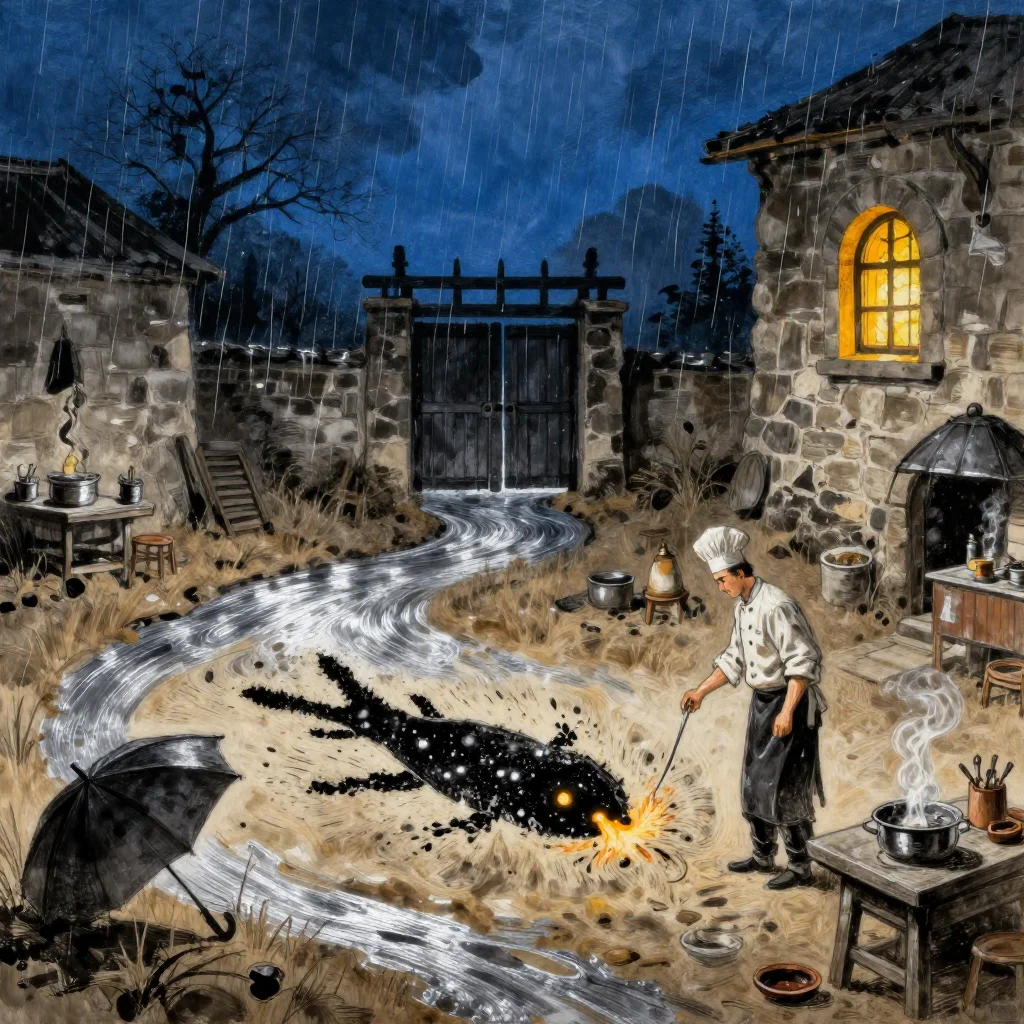
On the night of the first frost, Ilyra prepared her grandmother's final dish: river fish, although the river had been dry for eighty years. She found the fish in the monastery stores, wrapped in silver paper and smelling faintly of rain. She set the black umbrella beside the stove, though she had never owned one.
When the broth began to boil, the pantry door opened by itself.
Beyond it was a narrow passage where no passage had been. Water ran along the floor without wetting the stone. On the other side stood a gate of black wood, its lintel carved with a single amber star. A bell waited beside it, and the bell rope ended in a child's hand.
Ilyra knew the child. She had seen the portrait in the western chapel: a girl with her grandmother's sharp nose, holding the same umbrella beneath a starless sky.
The gate opened only when someone paid the toll. A brass plaque on the wall named it: one true memory, surrendered freely. It could not be paid twice. Once the gate accepted the price, the memory would be gone even if the crossing failed.
Ilyra remembered her mother's face. She remembered the red scarf, the cough before the fever, the last song sung badly in the dark. She placed her palm on the gate.
The bell rang.
What the River Kept
No memory left her. Instead, the dry riverbed outside filled with silver rain. It ran beneath the monastery walls, carrying leaves, cups, and small bones. The black umbrella lifted from the pantry and opened over Ilyra's head.
On the far side of the gate stood a woman in a kitchen that had burned. Her face was hidden by steam, but her hands were steady.
“You are late,” the woman said.
Ilyra reached for her. The gate slammed halfway shut. The plaque split, revealing a second line in smaller letters: the dead may enter; the living may not return unpaid.
Anselm appeared on the other side, soaked and furious. He had followed the rain, but the toll had bound the gate to one life. He struck the wood with an iron staff. The woman turned.
She was Ilyra's mother.
“The recipe summons the people who once ate at the table,” she said. “It does not summon them for you. It summons them home.”
Ilyra understood then. Her grandmother's empty bowl had not been for a guest. It had been a place setting left for the family. Every meal had been a map, and every guest had paid with a memory of the road they had abandoned.
The Empty Bowl
At dawn, the rain stopped. The riverbed was dry again, scattered with silver cups that shone like fish scales. The gate remained in the pantry, closed and ordinary. Anselm found only a scorch mark on the floor and one black umbrella hanging from a hook.
Ilyra cooked breakfast for one. She set the empty bowl at the north end of the table, then cut the first onion.
Outside, the comet turned in the ink-blue sky. One by one, windows along the monastery cliffs went dark. Only the kitchen remained amber.
At midnight, someone knocked from the other side of the pantry door. Three slow knocks, then two, the old signal her mother had used when she returned from the well.
Ilyra left the bowl where it was. She opened the door.
No one stood there. On the threshold lay a wet black umbrella, folded around a single strand of red wool.
She did not call for Anselm. She did not light another lamp. She returned to the broth, added one more portion, and waited for the dead to finish their meal.





