 Netwrck
Fairy-Tale Fiction.
The House That Missed Her
Elian Vey arrived at the monastery of clockmakers on the night the moon lost its agreement.
Not vanished. The moon was there, a cold coin above the black peaks, but the country had stopped agreeing on its shape. Some saw a hare. Others saw a widow. A man in the lower village swore he had watched it become an open door, and would not be moved on the point. The valley had no reliable time for three generations; the river kept the only calendar anyone trusted, rising when it meant to, and the people measured their days by the water’s moods. The monastery of Saint Orra kept its clocks beneath black lacquer anyway, nine hundred of them, their faces dusted with gold leaf so that even in the dark the hour looked rich.
Elian did not treat the body. She treated the ache that arrived when a person stood in a familiar room and felt a stranger living inside them. Her dispensary in the low country was three rooms and a stubborn stove, and her patients were millers, ferrymen, a luthier who had not slept in his own bed in nine years. They came to her saying I miss my house, and she taught them, slowly, to say instead I miss what I was like in that house. It was slower work. It also worked.
Brother Hale met her at the gate with a ledger under one arm, and she disliked him on sight, which she attributed to the hour and the dust. He was perhaps fifty, with a face like a folded map and ink to the second knuckle.
“We keep records,” he said. “Departures. Returns. Time of day, condition of health at leaving, name of the person who witnessed the going.”
“Why?”
“Because the valley has no clocks that agree, Mistress Vey, and men are clocks that agree very easily on their own.” He held the ledger against his chest like a child. “Nine years I have kept this book. In nine years it has never been wrong.”
“Books do not lie to be kind.”
“No,” he said. “That is why I trust them.”
The Boy Beside the Cistern
Her first patient in the valley was a boy of eleven named Ansel, who had left his village without his shoes and had walked forty miles over broken glass to reach the monastery because a clockmaker there had, he said, promised to make time behave.
He sat beside the western cistern, turning a small music box in his hands. Its melody had only seven notes, and after the seventh there was a silence shaped exactly like a door: a hinge, a gap, a closing.
“I miss my house,” he said.
“Then you are homesick.”
“No.” He frowned at the lid. “My house misses me.”
Elian felt the old vertigo of it. She set her bag down and sat on the wet stone, and told him about the copper star she carried, which had belonged to her mother, who had believed that every lost thing went on casting a shadow even after it was gone. Her mother had left a town called Kell with a troupe of glassblowers and had written for two years and then stopped, not because she was dead, as far as anyone knew, but because the letters had begun arriving in her own hand, describing weather she had not yet lived through. Elian had spent a year convincing herself that this was grief’s arithmetic: the dead go on performing. It did not console her. Nothing had ever been able to.
“So put it in the box,” Ansel said.
“No. The shadow is not the same as the hand, and the hand is not the same as the person.” She closed his fingers around the star. “Your house is not missing you. It is a shape you left. You may go back to it, or you may be missed by it, or you may find that the person you left there is not the person you are. All three are permitted.”
“Then it doesn’t help.”
“No,” she said. “It is not a help. It is a floor.”
That night the music box played by itself, and across the monastery courtyard the doors of houses sealed for years stood open, hinges turning in the dark, each one exhaling the cold breath of a cellar no one had entered in a generation.
The Ledger and the Governor
By morning the river had climbed over its banks and broken through the lower wall. Water rushed through the clockwork cells, turning wheels beneath the floor; monks shouted as the brass hands spun backward at different speeds, each wheel insisting on its own hour. The black lacquer cracked and flaked away in sheets, and for a moment the whole buried city shone like something drowned in a well of coins.
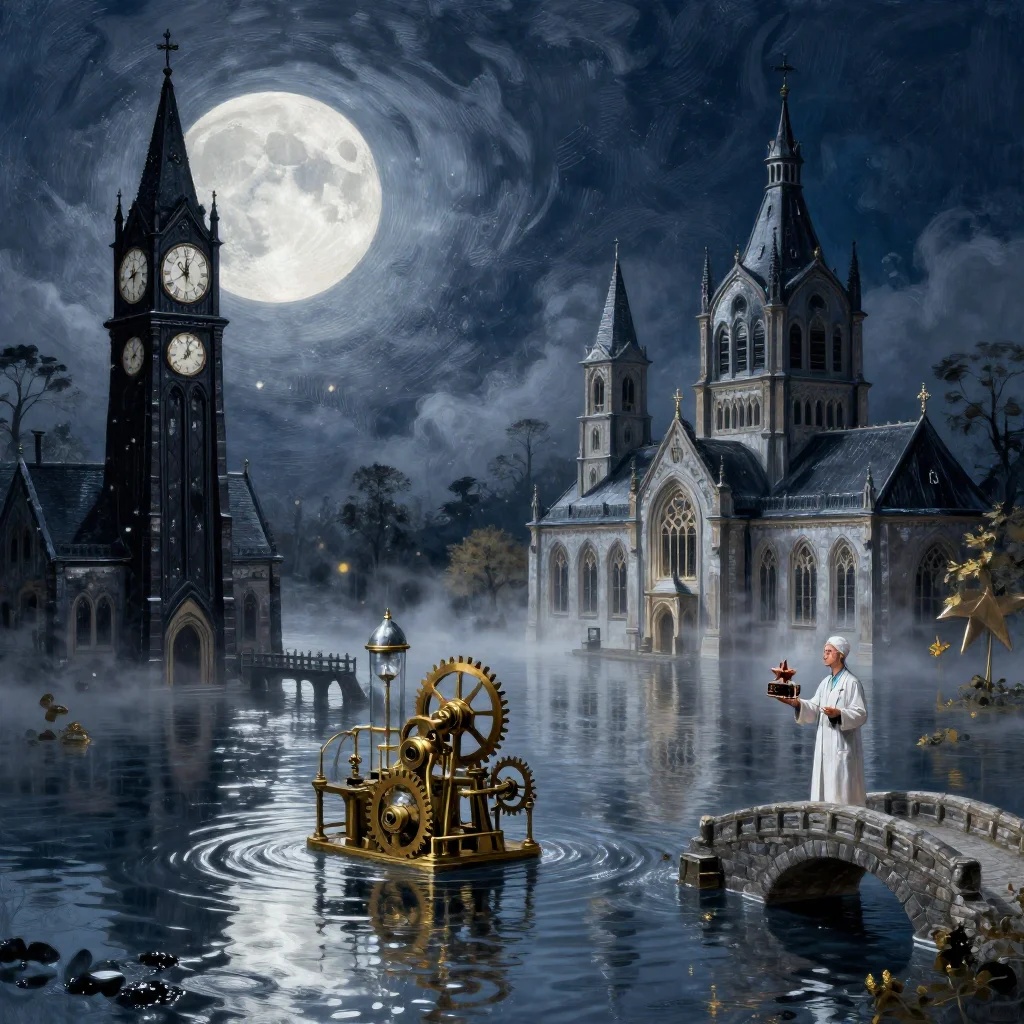
Elian climbed to the bell tower. From there the valley lay below her: dark fields, white water, scattered roofs, and beneath the flood, plainly visible for the first time in a century, a second city. Its streets formed an enormous dial. Twelve quarters, each the width of a boulevard, laid out as the numerals of a face. In its center, where the spindle would have been, stood a raised structure shaped rather like a heart with a door on it.
As the water receded through the week, arches emerged, each carved with a doorway. She went down with the copper star in her fist and Brother Hale at her heels, and found the drowned chamber, and found the machine: interlocking mirrors, silver pipes, glass governors the length of a forearm, all of it packed in silt with the patience of a thing that expected to be needed.
“It was built to measure every home in the country,” Hale said, with the terrible gentleness of a man showing off a child. “Not the hour. The home. Who entered, who departed, who returned. A common hour, a shared calendar, a public record of grief. The valley is not missing time, Mistress Vey. It is missing a witness.”
“Who built it?”
“The clockmakers of Vell, under Queen Astrid.” He watched the water drip from a governor. “They were sent here because their first commission had failed.”
Elian said nothing, and let him keep going, because she already knew the shape of what came next and would rather he say it than have to guess.
“Queen Astrid could not sleep,” he said. “Not illness. She was simply awake, forever, at the exact same depth of night. The clockmakers offered her one flawless hour, repeated until morning. A copy, perfectly kept, with no consequence and no dawn to follow it.” Elian’s hands had gone cold. She had been twenty-three. She had refused, and had thought about it for years afterward in the way you touch a tooth you know is loose. “I denied her rest, and she is the one who had to do without it. Your guilt, Doctor.”
“My guilt is mine. Is the queen still awake?”
“The queen is dead. She is not asleep.” Hale’s mouth thinned. “And you are right, my guilt is mine, so I will spend the rest of it doing what you would not do for her.”
He carried up a glass governor in a cloth, and inside the silt, loosened from its housing, he carried a small brass needle, and the two of them went home like a man carrying a tooth he meant to plant.
What the Flood Remembered
On the fourth day they set the governor on a table in the drying room and wound it, and the mirrors began, in their small way, to work.
A woman kneading bread. A fisherman mending nets. A child asleep under a blue blanket. A house with a red door, and inside it the shape of a person standing in a room, and beside the shape a number, a number beside the shape.
“It does not show the future,” Hale said, unnecessarily.
“It shows an assignment,” Elian said.
She named the patient to him then, because a physician is only as honest as her ledger. Marda Ilk, of the red-door house on the western levee, whose husband had drowned nine years ago in the same month her brother had gone to Vell and never written. Marda had walked back down the levee on the morning the village was certain she would not, and had stood in her own doorway since, unable to cross it.
“The governor knows she came home,” Elian said. “It has entered her. The moment she steps in, it is already recorded as done, and a thing that is already done cannot be repeated, and so it cannot be chosen. She is frozen in the only act anyone granted her.”
“And if you cut her free of it?”
“Then she is a woman in a doorway at noon, deciding.” Elian watched Marda’s number stand in the glass, patient and exact. “Deciding badly, possibly. Deciding twice. Deciding differently on a Tuesday.”
“You would trade a certainty for a mess.”
“I would trade a lock for a door,” she said. “Do not tell me which of those is the kinder word. I have been arguing with myself about it for eleven years and I have not improved.”
That night the valley sent up a sound she had not expected: not the monastery bells, which had gone wild and were now being kept under blankets, but the town’s own voices, arguing about what hour it was. Two farmers, a groom, the ferryman’s wife, all certain, all wrong by a season. The dark was not frightening. What frightened her was how quickly they had all learned to be certain, once there was something to be certain about.
The Engine Wakes
She put the music box on the governor’s housing and the copper star inside the music box, and the seven notes went round and round until the eighth arrived, and the engine came up out of the silt the way a diver comes up.
She had not meant to wake it. She had meant to look at it. The distinction, it turned out, was a courtesy the machine had not observed.
The mirrors filled. Not with the few — with the valley, room by room, wall by wall, in a light that had no sun in it. And at the center, where the spindle should have been, a woman stood with her back turned, in a town neither of them had seen in thirty years, winding a length of wire into a shape that was almost a star.
Elian sat down on the flooded floor. She had carried the real star in her pocket since she was fourteen years old, and she had spent all her working life on the theory that a person is not obliged to be a reliable witness to their own history.
“Mother,” she said, and the word came out of her like a stone down a well.
The wire bent, unbent, bent.
“I could make her stay,” said Hale. He was beside her and she had not heard him come, and his face was wet, and she did not know from what. “One recorded witness. She is in there, she came home, she is in the right to come home.”
“She is in a room I have never stood in, at an hour nobody has lived.”
“Then let us make the hour.” Elian heard how cruel she sounded and did not soften it, because softening it would have been a way of losing. “That is what you have been building for nine years, Brother. Not a witness. An editor.”
“I am building a floor!” he shouted, and immediately, quietly, after: “I had a sister. Wren. She went to Vell to learn the engines, and she wrote that the machines were good, and then she stopped writing, and I do not know if that is the same as a machine.”
“No,” Elian said. “It is not.” She stood. “Give me the governor.”
“You will take it to the axle. I know where you are going.”
“Yes,” she said, ashamed, and not pretending otherwise. “You have known since the cistern.”
A Door Without a Keeper
She did not break the engine. She had been tempted to, the way one is tempted to throw a child’s fever down a stairwell, and she knew the shape of the argument: that a lock is only a kindness to the thief, that freedom taken by violence is still taken, that a single broken mirror would be a command and she had come here to refuse commands.
So she went to the central governor and set her hand flat against the glass, which was warm, and which hummed at a pitch she felt in her teeth, and she asked the engine the only question worth asking a thing built to answer.
Not what is the hour. It had a hundred answers to that, and every one of them was a leash.
Who is holding this door open?
And the needle, which had trembled for three days between keeping and releasing, went slack, and showed her the one thing it could not compute: that a door can be a door.
She loosened the hands. One by one, the brass pointers fell away and lay in the silt like fish. The mirrors clouded until the valley in them was only a guess of a valley. The recorded doors swung open all along the levee, and out of them stepped nothing at all, which was the point: the engine had been holding doors open for eleven years so that no one would have to, and the entrances had filled with a fine powder that smelled of brass and kept time.
She walked out. The rain had stopped. Down in the street, Marda Ilk was standing in her own doorway at a quarter past two in the afternoon, and she went in, and came out, and went in again, and after the third time she laughed, an awful, private sound, and began to sweep.
What Came After
Freedom in the valley took the shape of a very bad year, and Elian stayed through all of it, which was the part nobody had sent for.
There were households where the two of them had gone together, one to Vell and one to the ferry landing, and now, with the ledger unstruck, both came home, and neither house had a spare room, and neither of them had ever asked the other to leave. Two families in the lower village had built their lives around a schedule, a shared hour borrowed from the monks’ good sense, and now the sense was gone and the borrowing came due: a man who had mended nets at dawn and would not be found mending them at dusk, and a woman who had kept a fire lit for a specific hour and had let it go out, and neither of them, in the end, wanted what the fire had been for.
The ferryman drowned, though Elian thinks of him whenever the word choice comes up in her mouth. Two boats had been traveling by the monks’ count, safe and apart, and now they were traveling by the river’s, which is a thing that knows its business better than any man with a book. He went in after the second one. It was not a bad decision. It was only a decision, and the river does not distinguish.
Brother Hale read the loose hands out of the silt for three weeks, and then he burned the ledger, page by page, in the drying room, and kept the cover, because a man may discard the sentences and not the fact that he once thought them worth writing down. He was never sick again, and he was never quite well either. He and Elian did not become friends. Twice a year he sent her a line: Wren’s name, in the town book. Not mine. I wanted you to know it is only the town’s.
Ansel went home in the spring and then left again in the summer, and came back in the autumn with a boat’s crew, and nobody in the valley could say precisely when he had decided, because he had decided eleven times. His mother kept the fire lit. His shoes were never the point.
The copper star she put back in her pocket, warmer than the air. The clockmakers uncovered a new panel beneath the black lacquer, and inside it lay a small blue mechanism with no hands at all, no numerals, no governor, no mirror, and on its face two words engraved in gold dust: Begin Again. It did nothing. It measured nothing. She believed she knew what it was, and could not prove it, and so she left it there, and did not wind it.
At dawn the monastery bells rang, and everyone in the valley heard them, and no two heard them at the same moment, and no one in the valley claimed to know the hour.
What she had learned, and could not write down in any ledger, was that a home is not a place that keeps you. It is a door left unlatched, and the whole labor, the whole terror, is that whoever walks through it will be a person you did not predict.





