 Netwrck
Fantasy.
The Physician’s Rounds
Every morning, Dr. Seralin walked through the monastery carrying a leather case of medicines and a smaller case of excuses. The first held tinctures for grief, fever, and the white trembling that settled in children when their voices began to sound like strangers. The second held words for the families who could not bear to hear the truth: that homesickness was not merely absence, but a misplaced weight in the blood.
The monastery of clockmakers rose above the country’s unreliable borders, its towers crowded with copper moons, silver birds, and mechanisms calibrated to tides no map admitted. The bells rang at unequal hours. Dawn sometimes arrived twice. Seralin had learned to diagnose time by pressure beneath the patient’s ears.
That evening, a novice brought her a woman who had arrived without luggage, carrying only a music box and a copper star polished by years of handling.
“She says the box remembers her daughter,” the novice whispered.
“Boxes do not remember.”
“This one does.”
Seralin opened the lid. A thin melody escaped, assembled from notes that seemed to belong to different years. The woman began to weep. When Seralin touched her wrist, she found the same slow ticking beneath the skin.
What the Water Uncovered
The next morning, the river burst through its western embankment. It did not flood the monastery first. It filled the old market, the ruined granaries, and the fields beyond them, pouring into trenches that had been sealed beneath the village for two centuries.
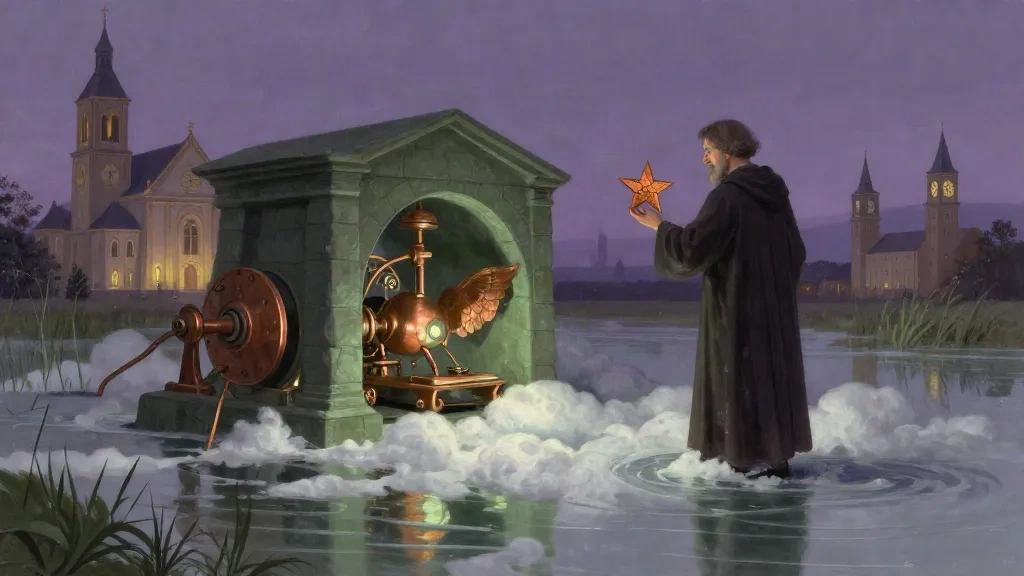
As the water sank, it revealed a civic project: a vast stone arcade, tiled in violet and cloud-white, with rooms marked by official brass numbers. In its center stood a machine. It was beautiful. Copper wings unfolded from its body, each one carrying a tiny bell, while a glass sphere held a pale flame that leaned toward the copper star in the woman’s hand.
At the machine’s controls stood a notice: THE MUNICIPAL HOUSE OF EVERY PLACE. Beneath it, smaller letters read, ALL RESIDENTS MUST ARRIVE BY THE PREFERRED HOUR.
Seralin understood at once. The hidden project had been commissioned to solve homesickness by replacing the lost place with an official one. Families would enter, receive numbered rooms, and live inside a perfect copy of whatever they believed they had lost. The machine would preserve their memories by pruning away everything inconvenient.
“A beautiful prison,” she said.
The music box clicked open in the woman’s hands. Its melody joined the machine’s bells. Doors locked across the arcade, one after another.
The Star’s Wrong Direction
Seralin needed the machine’s key. She found it inside the music box, beneath a tiny drum stamped with the date of the flood. When she inserted it, the glass sphere brightened and displayed the village above: kitchens, river stones, quarrelling children, crooked orchard trees, a husband repairing a fence badly but faithfully.
“Turn the star,” the machine said.
The copper star was a compass. It pointed not toward the lost home, but toward the place where the owner had been changed by leaving it. Seralin pressed it into the sphere.
Every room appeared at once. A boy remembered his father’s voice, but not the silences around it. A widow found a daughter who had grown old in a single imagined year. The rooms were flawless, and the people inside them had stopped looking outward.
Seralin reversed the machine’s mechanism. The bells struck in frantic sequence. The machine tried to return each person to their preferred hour, but the flood had shifted the river, and time no longer accepted the old lie.
Home is not where you are preserved. It is where you remain changeable.
The copper star cracked under her hand. The woman seized Seralin’s wrist, pressing the broken halves into her palm.
Returning the Hours
At dawn, the monastery’s clocks began to disagree again, each ringing a different measure. The arcade stood open. Its residents emerged blinking, carrying useless furniture, duplicate keys, and recipes for meals no one remembered eating.
Some cursed Seralin. Some embraced her. The woman held the copper star’s two halves together, though they would never become whole.
Seralin returned to her rounds. The country still had no reliable time. Patients still carried the wrong weight beneath their ribs. Yet no longer did she prescribe restoration.
When the youngest novice asked what the music box was for, she placed it on the windowsill where violet dusk entered and struck the monastery’s copper towers.
“For reminding us,” she said, “that nothing worth keeping arrives on schedule.”
The box played three notes, then stopped. Seralin listened until the silence became a place she could bear to leave.





