 Netwrck
Mythic Fiction.
The Theatre Beneath the Sand
Every night, when the cobalt shadow of the city fell across the dunes, the theatre opened its doors and performed tomorrow’s discarded endings. Actors wore the costumes of lives that might have been: crowns sinking beneath black water, wedding veils turning to ash, old houses collapsing into flowers. The audience knew none of it was real, though they applauded as if it were grief.
Orin stood behind the clockmaker’s booth beneath the western balcony. His clocks did not measure hours. One chimed only when sand shifted, another rang at the first green shoot after rain, a third kept time for the long blue dusk between summer and winter. He had made them for travelers, shepherds, and children who feared the wrong season.
That morning he had found a paper lantern beneath the last row of seats. It was small, folded from salt-whitened paper, with a torn place along one side. Inside was a moth wing, pale as a sliver of moon. Orin recognized the lantern at once. Six summers earlier, his daughter Lio had made it for him.
She had been seven then, impatient with his work. “You make clocks for things that have no names,” she had told him. So she had given him a season with a name: June, the month of warm doors and green evenings. The lantern had vanished from his workshop before the next dawn.
The Choir That Remembered Differently
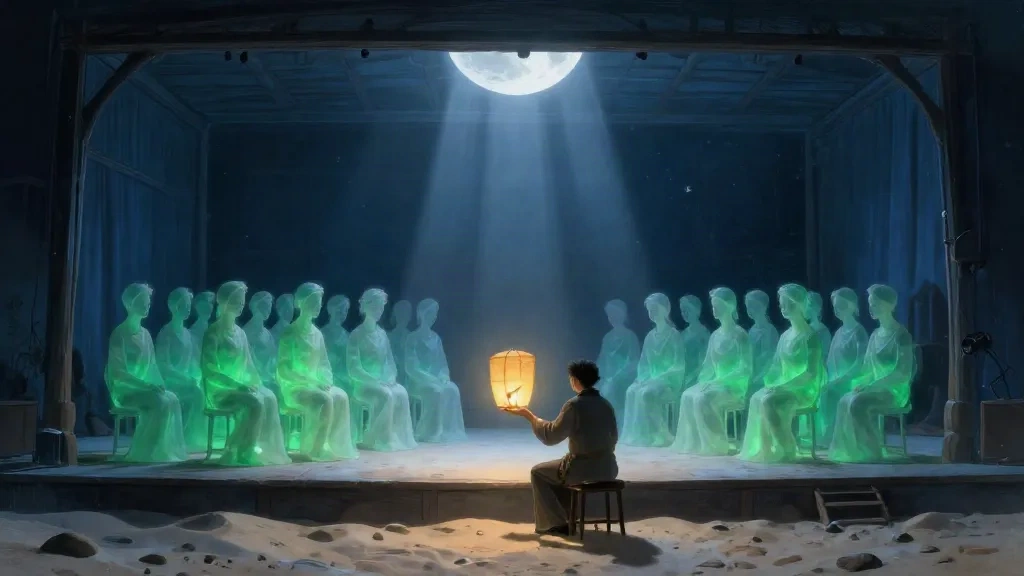
Orin carried the lantern to the stage. Behind it, the choir waited in rows of blue chairs.
They were not people. Their voices were memories given shape and pitch.
“He took the lantern because June was dying,” said the first voice.
“He took it because his daughter needed a season to live in,” said another.
The choir argued without moving. One memory insisted the lantern had been a gift. Another insisted it had been a promise. A third remembered Lio laughing, but that laugh belonged to a different Lio, one who had grown tall and forgotten her father. Their interests crossed like knives over a map.
“I only want to return it,” Orin said.
“To whom?”
The theatre answered from beneath the floorboards. “To the one who made it.”
At once the stage filled with discarded mornings. A woman opened a door and found winter inside. A boy planted an apple seed and grew old beneath its shadow. A girl named Lio climbed into a lantern-shaped sky. Each ending had torn the paper lantern apart, and each fragment had become a piece of Orin’s life.
He searched among the actors, the wings, and the painted forests. The choir followed, their voices changing shape. His daughter’s laughter urged him toward the left. His wife’s silence warned him away. The moth wing glowed warmer whenever Orin remembered her hands.
The Ending That Refused to Be Performed
Near dawn, the theatre revealed its final unplayed scene: a small room in the old workshop, where a child was drawing a sun on the floor. In the drawing stood a lantern. Beside it knelt a younger Orin, promising to make whatever she asked.
But the memory of that promise was false. He had not promised then. He had merely smiled.
The choir demanded corrections. One voice wanted the lantern returned to the workshop. Another wanted it given to the woman who had waited beneath the theatre. A third wanted June restored, even if the lost winter returned with it.
Orin understood then that the lantern had never contained a season. It contained the choice he had refused to make: to believe that love was enough, or that time could be repaired by skill. The wing in his palm began to crumble.
He stepped into the scene and placed the lantern in the child’s hands. The theatre shuddered. The choir’s conflicting memories rose, each demanding the final line.
Orin did not give them one. He took the moth wing and released it into the painted dawn. It flew above the stage, carrying pieces of every discarded ending at once.
What the Morning Kept
At sunrise, the theatre stood empty except for the choir’s chairs. The lantern lay on the clockmaker’s bench, whole again, its paper unmarked. Orin’s seasonal clocks began to run, but none of them rang.
Then, somewhere beyond the cobalt shadow, a child laughed—not the borrowed laugh of the choir, but a new one, bright and imperfect.
Orin picked up the lantern and followed the sound into morning. He did not know whether his daughter had waited for him. He knew only that a thing returned to its maker need not come back unchanged.





