 Netwrck
Romance.
The Bones Beneath the Market
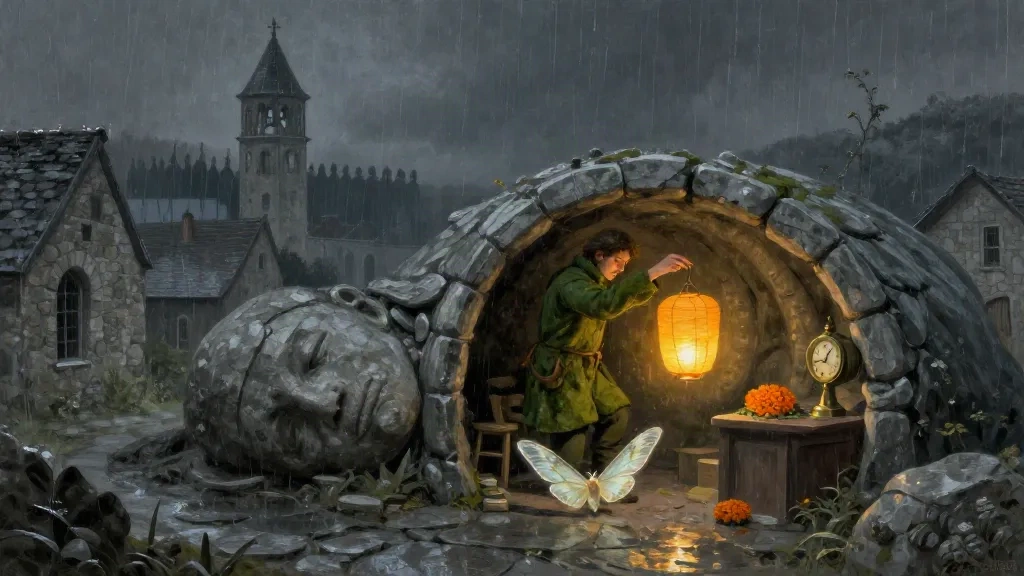
Elian kept his workshop in the hollow where the giant's seventh rib met the village square. Rain ticked through the bone above him, and every drop landed with the soft authority of a clock striking an hour that did not exist.
He made clocks for seasons rather than hours. His finest was a brass dial set with seven stones, each one breathing at a different rate. It opened the first thaw, softened the harvest, and released winter only when the mountain streams began to sing. The villagers called it the Marigold Minute. Elian had never used the name aloud.
That morning, the Minute stopped beside a paper lantern.
The lantern was wet, its paper wrinkled, its flame a steady amber bead. Beside it lay a moth wing, pale as old moonlight. Elian did not touch either object. He had spent thirty years repairing what people lost, and he knew that some losses arrived with teeth.
The Choir of Useful Lies
When he drew the curtains, the choir began.
It lived in the bell tower beneath the village, where the giant's breath pressed against the stone. The first voice belonged to Mara, his childhood friend, who had vanished during the winter her mother was supposed to return.
“He made the lantern for me,” the voice said.
Another voice rose, warm and dry: “He made it for the village.”
Elian stared at the wing. “Who made this?”
The choir disagreed. One voice remembered a festival, another remembered a funeral. A third insisted the lantern had never been lit. Their memories tangled around the room, bright with incompatible details. Elian held the brass Minute against his palm and felt its gears straining against one another.
He had promised Mara he would return the lost thing to the person who made it. The promise had been made before her disappearance, when neither of them understood that a memory could be inherited, altered, or hidden inside a song.
A Minute for Returning
The choir gave him one cycle of the season clock. If he could restore the lantern's first flame, they said, they would surrender the memory that belonged to it. If he failed, winter would remain locked in the village until Marigold's next bloom.
Elian took the lantern into the rain. He followed the narrow streets between the ribs, past houses built from moss and wet stone, toward the old kiln where Mara had spent her nights making paper ornaments. The moth wing rested inside his coat, fragile as a vow.
At the kiln, he found a carving on the wall: two children beneath a paper sun. One child held the lantern. The other held a moth.
“You remember this?” he asked.
No one answered. The kiln filled with voices. Mara's mother said the lantern had been lost in the flood. The choir insisted Mara had taken it north. Elian opened the Minute and placed the moth wing inside its brass heart.
Instead of spring, the mechanism released a flash of marigold light.
The Thing Returned
For one breath, Elian heard Mara clearly.
She was not beneath the ribs, nor beyond the village. She was inside the song itself, the first warmth the choir had taken when the flood buried her path. She had left the lantern for him and the wing for the choir, hoping the two objects would force the memories to speak instead of conspire.
“I made them both,” she said. “But I needed you to make the choice.”
Elian returned the lantern to the kiln wall and set the wing beneath it. The paper opened like a flower. Marigold flame rose through the wet stone, illuminating the entire village at once.
The choir fell silent except for one voice.
He did not ask whether it was Mara. He knew the sound of her laughter hidden beneath grief, and she knew he had kept his promise.
They met in the spring rain, beneath the giant's ribs, where every season clock began to turn again. The lantern burned between them. The moth wing was gone, carried off on a wind that smelled of moss and newly turned earth.
Some things are returned not by finding where they went, but by remembering who had the courage to send them away.





