 Netwrck
Fairy-Tale Fiction.
The Monastery Without Morning
At the Monastery of Clockmakers, the sun rose whenever the bells agreed to ring it.
On ordinary days, this happened at dawn. But in the country beyond the monastery walls, time had become unreliable. It wandered behind the mountains, paused inside kitchens, and sometimes returned years late wearing a child’s face. The monks kept their clocks beneath black lacquer and polished them with cloths dusted in gold. At noon, cold moonlight entered the high windows even when the sky was bright.
Physician Elian arrived with a brass case, a black coat, and the quiet certainty that most illnesses were mistaken for inconveniences.
His patients did not complain of pain. They complained of doors.
A door left open in another house. A door missing from a childhood home. A door they could remember closing, though no memory explained why the sound had frightened them.
“Homesickness,” the monks called it. Elian called it the body’s memory disagreeing with the world.
His work was to make the body agree again.
Every evening, beneath the clock room, Elian listened to the patients’ accounts. He asked where they had left a music box, who had taught them to fold a handkerchief into a bird, and whether the house still had a kitchen or merely remembered one.
On the night the flood came, a beautiful machine began to ring.
The Machine in the Cistern
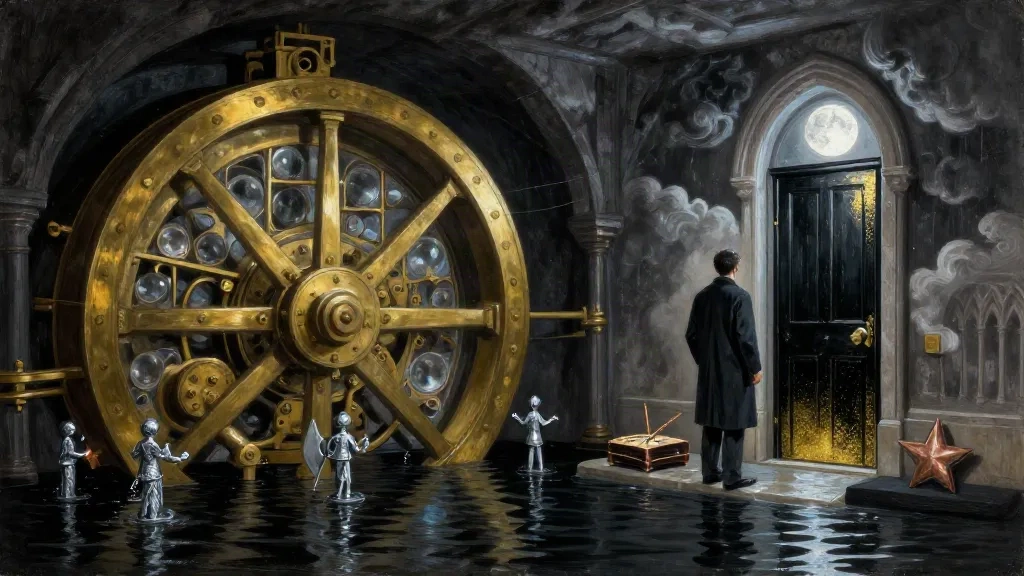
It stood in the monastery’s old cistern, sheltered by a stone arch and surrounded by black water. The machine was a theater of brass wheels, crystal windows, and tiny silver figures carrying lamps between painted houses.
Each figure held a small door.
When a wheel turned, the figures placed the doors onto streets that no longer existed. A child of silver stepped into a bakery that had burned. A woman of gold carried a gate into a courtyard swallowed by a river.
It was beautiful enough to make the monks avert their eyes.
Elian recognized its work. The machine was not merely playing. It was assembling a city from remembered rooms.
He had seen its plans in a patient’s drawing. Civic engineers had intended to build a machine that would preserve every home lost to time. Residents would give it one room, one room, and another until it contained the entire country. No one would need to grieve a vanished place. No one would need to leave.
The project had been buried beneath the monastery after the first flood.
Now the second flood had opened the cistern wall.
“It is a prison,” Elian said.
The chief clockmaker, Sister Vey, rested one hand on the machine. “It is a promise.”
“Promises that remove every exit are prisons.”
Inside the machine, a miniature house appeared. Elian recognized it at once. It was the house where his father had died. The porch light burned. A cup waited on the table. His father sat by the window, turning a copper star between his fingers.
Elian reached into the machine to take the star.
The silver child placed a door around his wrist.
What the Water Remembered
The flood moved through the monastery with the patience of a clockmaker. It filled the lower corridors, lifted tables, and carried papers into the air. In the cistern, the machine grew brighter. Its crystal windows reflected streets under dark water.
Patients began hearing doors again. Some wept. Some laughed. One woman asked for the house where her mother had always kept the music box.
Elian climbed into the machine.
Inside were rooms without ceilings. His father’s house opened onto a field of blue glass. His mother’s kitchen floated above a sea of clocks. A music box sat on every table, playing one unfinished melody.
The melody was the melody of his childhood.
“You can restore the house,” said a voice from the walls. “You can restore anyone.”
“Not without their consent.”
“They left. That is consent enough.”
Elian opened the music box. Inside its mechanism lay the copper star.
He recognized the star from the machine’s design. It was the civic project’s key: a small piece of a house capable of making every other piece obey.
Behind him, the water rose.
Sister Vey climbed into the machine and handed him the monastery’s last key. It was a narrow black sliver, lacquered with gold dust.
“The machine was built for the city,” she said. “The city was built for the people who remained.”
“Then give them the choice.”
He took the copper star from the music box and struck it against the key.
Every clock in the monastery began to run backward.
A Door That Opens Outward
The beautiful machine screamed.
Its silver figures broke apart. Rooms vanished from one another, and the trapped houses spilled into the flood: brick walls, painted ceilings, garden gates, staircases, a thousand doors.
They did not disappear. They returned to the places where people had lost them.
Some patients found the doors they had been mourning. A man saw the blue door from his first house. A child heard a music box beneath a broken bed.
But the machine itself remained.
It had one chamber left: a room without a house, polished as a black mirror. Inside stood a small figure made of gold dust.
“You have freed the city,” it said. “What will you do with your own?”
Elian looked through it. Beyond the mirror stood the monastery at dusk. The clocks were silent. His patients were leaving, not toward the homes they had lost, but toward the roads they had not yet chosen.
He stepped out.
Behind him, the gold figure lifted the copper star. Elian turned once more and set the music box on the floor.
The melody finished itself in cold moonlight.
By morning, the flood had gone. The cistern was empty, and the machine’s crystal windows reflected only sky. A child found a single door in the mud, painted black, with a small copper star fixed above the handle.
When the door opened, it opened outward.
That, Elian wrote in his physician’s ledger, is the beginning of treatment.





