 Netwrck
Adventure.
Platforms Beyond the Glass
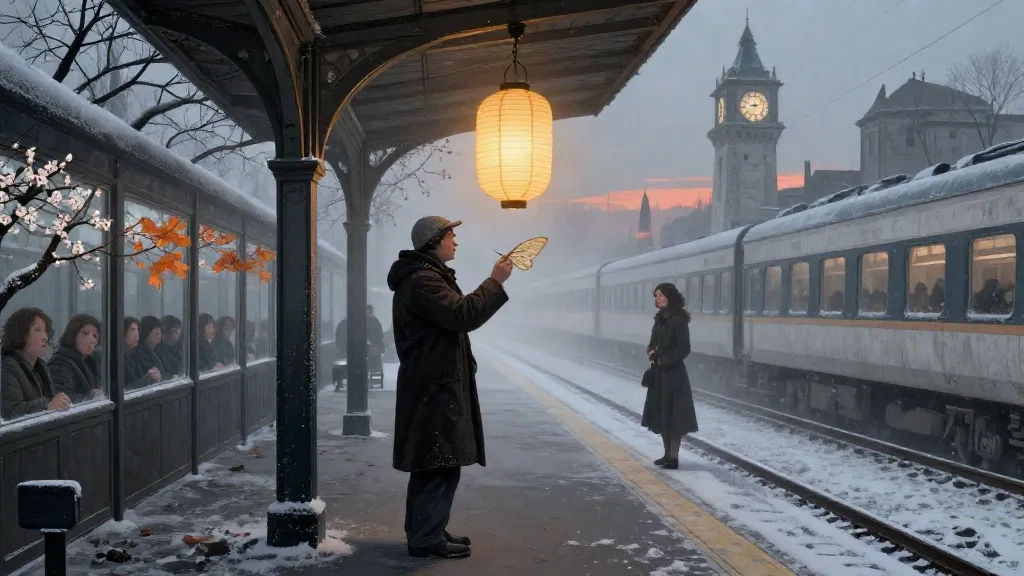
At the winter station where alternate seasons departed, every platform was a long white tooth beneath a roof of frosted iron. I went by the sound of pendulums. In the station's copper clock, second hands traveled through rain, sand, blossom, ash, and other bright intervals. Passengers stood beneath the departures board with paper tickets warming in their gloves.
My name was Orin Vale, and I made clocks for seasons rather than hours. Spring was a shallow silver movement, bright and impatient. Autumn was a heavier brass mechanism, wound until the leaves changed. Winter I reserved for people who had lost something before they were ready to name it.
Inside my coat pocket lay the thing I intended to return: a moth wing, folded as carefully as a letter. It belonged to the Lantern of First Snow, made twenty years ago by Mara Saye, the station's former keeper. The lantern had guided travelers through the wrong season, drawing them toward a memory instead of a place. Mara blamed the wing, and the wing vanished.
She had asked me to bring it back before the last train left for the copper horizon.
The Choir With No One's Mouth
The train waiting on Platform Nine had no engine. Its windows glowed amber, and inside sat a choir of passengers whose mouths were closed. When they sang, the sounds came from their pockets, their shoes, the hairline cracks in their gloves. They were memories given transit.
One voice insisted that Mara had stolen the wing and hidden it inside the lantern. Another sang that the lantern had been built to guide a lost child home. A third, thin as needlework, claimed both were false: Mara had never made the lantern at all.
I held up the wing. The choir turned toward it without turning their bodies.
“That belonged to the first winter,” said a memory in a red scarf.
“It belonged to the summer after,” said another.
“It belonged to no one,” whispered the smallest voice.
Their interests tangled until the carriage filled with conflicting seasons. Frost raced across the ceiling. Apricot blossoms opened in the corners. For a breath, the station smelled of warm stone and oranges. The passengers fought for their memories as if each were the last winter left.
“You cannot return what everyone remembers differently,” said the conductor, though no one had seen him board.
Then the paper lantern in my other hand began to glow. Not brightly. It shone with the cautious light of a room where someone had left the lamp burning for a traveler.
What the Lost Things Remember
On the copper horizon, the sun sank through a sky the color of black cherry. Beyond it, a winter tree stood with its branches full of clocks. Their faces showed hours that had never occurred.
I climbed onto the roof of the moving train and held the wing beneath the lantern. The choir's voices rose. A memory of Mara's workshop filled the carriage: rain striking the skylight, her hands covered in brass filings, a paper lantern waiting on the bench. She had made the wing herself, not for the lantern, but for a small observatory moth that lived in the clocktower. The moth had entered the lantern and carried away the memory of its maker.
That was the lost thing: not the wing alone, but the maker's memory of creating it.
“Give it to the person who made it,” I said, “and let the rest of you go.”
The choir resisted. They shouted that Mara was dead, that the wing belonged to a child, that returning it would erase the only winter in which they had mattered. Their memories clawed at the lantern. The paper began to tear.
So I did not give them the wing. I opened the lantern.
Inside was a small brass mechanism shaped like a moth, stopped at the hour when Mara had first held the living wing beneath her lamp. I placed the wing over it. The choir went silent. In the silence, Mara's remembered hands closed around mine.
At the next platform, a woman in a winter coat stepped from the snow. Mara was younger than the station remembered, and older than the photographs. The wing had returned itself to her, leaving only pale dust along my fingertips.
The Hour That Belongs to Her
“I made it to forget,” Mara said.
“Then it remembers for you.”
She placed the dust in the lantern's blue heart. The mechanism stirred. Across the station, alternate seasons opened in every clock face. Spring hurried toward the city. Autumn released a red wind. Winter settled gently on the tracks.
The choir boarded the train carrying different memories now. None of them possessed the wing. None of them possessed the maker.
As the copper horizon brightened, Mara repaired the lantern with a tool from her pocket. Her first motion was clumsy. The second was certain. I watched the paper brighten, and understood that a lost thing does not always need to return unchanged. Sometimes it must be given to the hands that know how to make it whole again.





