 Netwrck
Adventure.
The Season That Would Not Wind
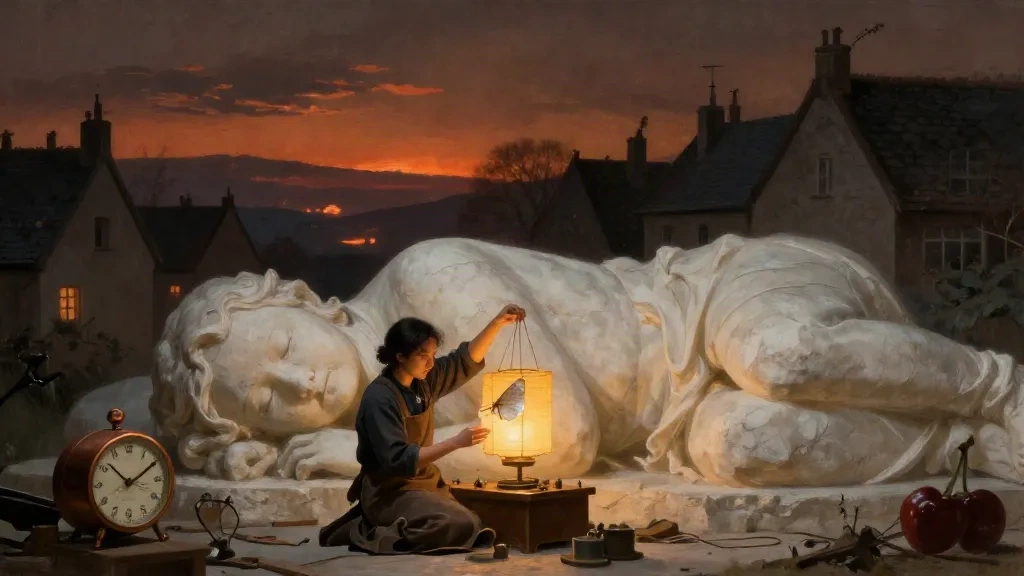
Every morning, Mara climbed the ladder inside her workshop and wound the village's seasons by hand.
Her clocks did not count hours. The blue one measured the depth of winter, the red one counted the days until planting, and the little silver clock beside the western rib chimed only when the wind changed direction. Each was shaped from pale stone, black cherry wood, or copper salvaged from the horizon.
On the morning the red clock stopped, Mara found a crack through its face. Inside the hollow case, where the spring should have been, lay only a pale moth wing.
She held it to the lantern beside her door. The paper lantern was ordinarily unlit, but the wing made it glow with the color of old cherries. Beneath the glow appeared a thread of copper light, leading down through the floorboards and into the dark between the giant's ribs.
The choir began before she reached the third landing.
It came from the walls: Give it back, whispered a voice like her mother's.
Another voice answered, It was never yours.
Others joined, layering over one another until the village trembled.
The Choir Under the Floorboards
The village had been built inside the giant for three hundred years, though no one knew whether the giant slept or merely dreamed slowly. The ribs arched above the lanes like black cherry vaults. Pale stone houses nestled between them, and beyond the eastern rib, a copper horizon burned without setting.
Mara descended into the space beneath the market, carrying the lantern in one hand and the moth wing in the other. The memory choir lived there, gathered around a stone basin filled with black water.
One memory showed Mara as a child, stealing winter from a neighbor's garden because her own harvest had failed. Another showed the neighbor giving her the winter freely, then regretting it. A third showed the giant opening one eye and closing it around a small copper key.
They all claimed the same missing thing: the spring that had once turned Mara's red clock.
“It belongs to the one who suffered,” said the child's memory.
“It belongs to the one who forgave,” said the regretful memory.
“It belongs to no one,” said the giant's dream. “It belongs where it was hidden.”
Mara lifted the moth wing. The lantern flared. In its paper glow, the black water showed a workshop above the clouds, where an old woman shaped clockworks from starlight and bone.
Mara recognized the hands in the reflection. They were her own.
What the Maker Lost
The giant's dream showed the truth.
Years ago, Mara had made a clock for the sleeping giant, a clock to measure the season when he would wake. Its spring was not ordinary metal. It was the first spring ever noticed by the world, preserved inside a lantern of folded paper. The giant had carried it carefully, but a storm had torn the lantern apart.
Mara had lost a wing of the moth that guided the spring home. Without it, the spring wandered between seasons. The giant continued sleeping because he could not feel the year approaching.
She had never known she had made the clock. The memory choir had hidden the fact from her because they feared she would take back the season and spend it on her own village.
“I only want to return it,” Mara said.
“Returning it may wake him,” whispered the choir.
“Then he will know it was lost.”
“If he wakes, winter enters every house.”
“If he sleeps, nothing planted this year will grow.”
Mara looked at the red clock in her hand. Its stopped hands trembled. She understood then that the lost thing was not merely a spring. It was the measure by which the giant's life had been held together.
She placed the moth wing over the black water. The choir screamed in every memory at once.
The Copper Morning
At dawn, Mara carried the restored spring back to the red clock.
She set the wing beneath its glass and turned the key she had found in the giant's dream. The paper lantern followed her through the streets, glowing over pale stone and black cherry beams. With every step, the choir argued inside the lantern, each voice trying to claim the turning of the season.
At the village gate, Mara held up the clock.
“I am not taking it for myself,” she said. “I am returning it to the maker.”
She placed the clock beneath the eastern rib and opened the lantern.
The spring rose as a thread of copper light. It entered the giant's chest, passing through the black cherry shadows between the houses. Far above, something enormous shifted. Dust fell like snow.
The memories quieted one by one. The mother's voice became a lullaby. The child's theft became a lesson. The giant's dream opened like a door.
Mara kept the moth wing in her palm. It had become translucent, fragile as paper, but no longer empty.
Behind her, the village clocks began to move. Winter loosened its grip. Copper light spread along the horizon, and the first new season arrived without taking anything from anyone.
When the giant slept again, Mara returned to her workshop. She set the glowing wing beneath glass beside the red clock, where it remained like a promise: even lost things can find their way home, provided someone remembers the hands that made them.





