 Netwrck
Fantasy.
The Catalogue Beneath the Market
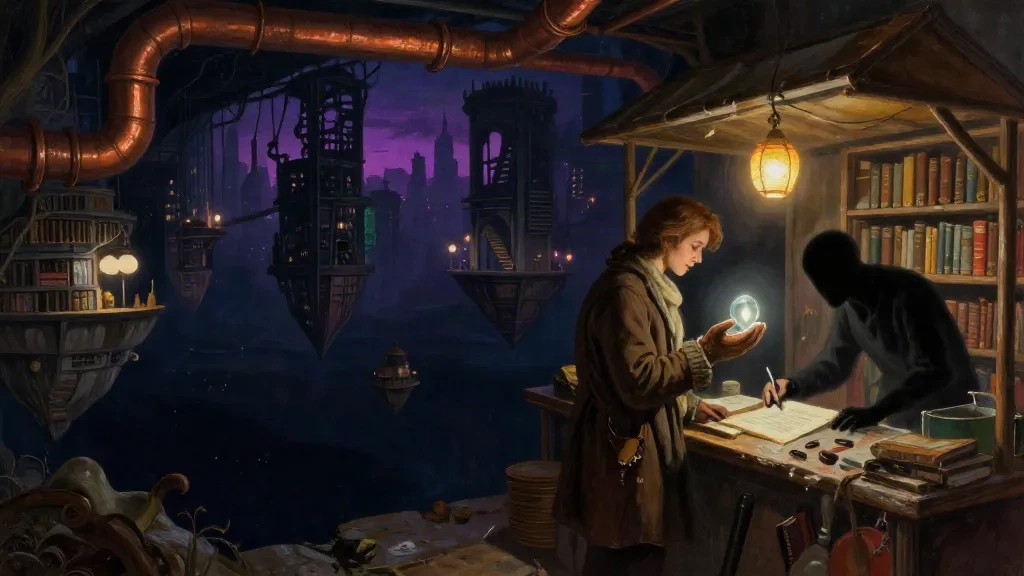
At dusk, the night market unfolded beneath the city’s first floor, where no street had ever been laid. Stalls stood on iron staircases descending into the earth, their awnings violet against the copper pipes overhead. Merchants sold bottled thunder, buttons that remembered hands, and maps of rooms no longer standing.
Elian Vey kept the municipal archive beneath the oldest stall. She catalogued every name the city had surrendered: drowned children, vanished guilds, streets renamed after forgetting. Her own work required a black glass seed, polished smooth by years of use, and a single wool glove worn on her left hand. The glove concealed ink stains. The seed remembered voices.
That evening, while the lamps came alive with cloud-white light, she found a catalogue dated eighty years ahead.
Its newest entry read:
ELIAN VEY, NAME RETURNED TO THE LAND. WITNESS: THE SHADOW THAT SIGNS.
Her fingers numbed around the glass seed. She had never been named in a future record. Worse, beneath the entry someone had pasted a torn strip of wool, white as old snow.
A Hand That Could Lie
The document waited in the registrar’s tent, where documents were traded like knives. Its owner was a shadow cast by a hanging copper lantern, though the lantern had gone out.
“You want the land to remember you,” the shadow said. “I can arrange it.”
It spoke through a clerk’s mouth on the other side of the curtain. The clerk did not move. A long pen rested in his hand.
“Return one name,” the shadow continued, “and I will sign away the claim to yours.”
Elian knew the bargain’s shape. Forgotten names were not erased. They were buried in the city’s foundation, beneath markets and drains and the sealed chambers where old foundations slept. The land remembered every word spoken over it. If a name were returned, the person who carried it would become visible to the city’s oldest records.
She placed the glass seed on the table.
The shadow leaned closer. Its face remained featureless, but its hand emerged holding a pen, and the hand was hers.
“Sign,” it said.
Elian pulled off her wool glove. The hidden ink beneath her palm formed a word she had never written: Vey.
The Price of a Name
They descended through the market after midnight. The stairs twisted between walls that sweated mineral beads. Above them, shops folded away, and the city’s weight pressed down like a sealed lid.
Elian carried the seed. The shadow carried the pen.
At the lowest landing stood a door made of packed earth. Letters had been scratched across it, thousands of them, overlapping until the wood looked black. The shadow pointed to one:
THE FIRST NAME LOST BELOW THE FIRST FLOOR.
“Give it to me,” Elian said.
“Give it to the land.”
She opened the glass seed. Inside, a small blue light trembled. The voice came from within it, young and breathless:
“My name is Iri. I was a bell ringer. They pulled me down when the street ended.”
The shadow smiled without a mouth. “That is the name your catalogue requires.”
Elian pressed the seed to the earth door. The blue light sank into the wood. Somewhere above, a bell rang once, clear and lonely.
Then the shadow signed.
It did not sign Iri’s name. It signed Elian Vey, in handwriting identical to hers, across the claim.
“You said one name,” she said.
“I said the land would remember you.”
The door opened.
What the Land Refused
Beyond it was no chamber. Only a city under the city, a field of foundations stretching beneath violet dusk. Every lost name hovered above the soil as a pale thread. They moved when Elian breathed.
One thread reached for her.
She understood then that the archive had not found her name by chance. The city had been preparing to use her as a witness. Her future catalogue was not prophecy. It was an instruction.
Elian tore the wool from the shadow’s hand and wrapped it around the glass seed. The cold of the wool tightened.
“I will give the land a name,” she said. “But I will not give it your signature.”
She spoke Iri aloud, then spoke every name she had catalogued, one after another, until the field filled with voices. The threads descended and took root. The earth drank them in.
The shadow lunged. Its pen cut across her sleeve, but Elian drove the seed into the soil. A cloud-white blossom burst from the ground, and the sign beneath her name went blank.
By morning, the market had closed permanently. The city above had gained no street, but its oldest maps now ended at an open door.
Elian kept the wool glove, though she no longer needed to hide ink. In its palm, the catalogue’s future entry had changed.
ELIAN VEY, NAME WITNESSED. WITNESS: THE LAND.
She did not look back. The city had no street below the first floor, but it had learned one way down.





