 Netwrck
Historical Fantasy.
The Catalogue of 2186
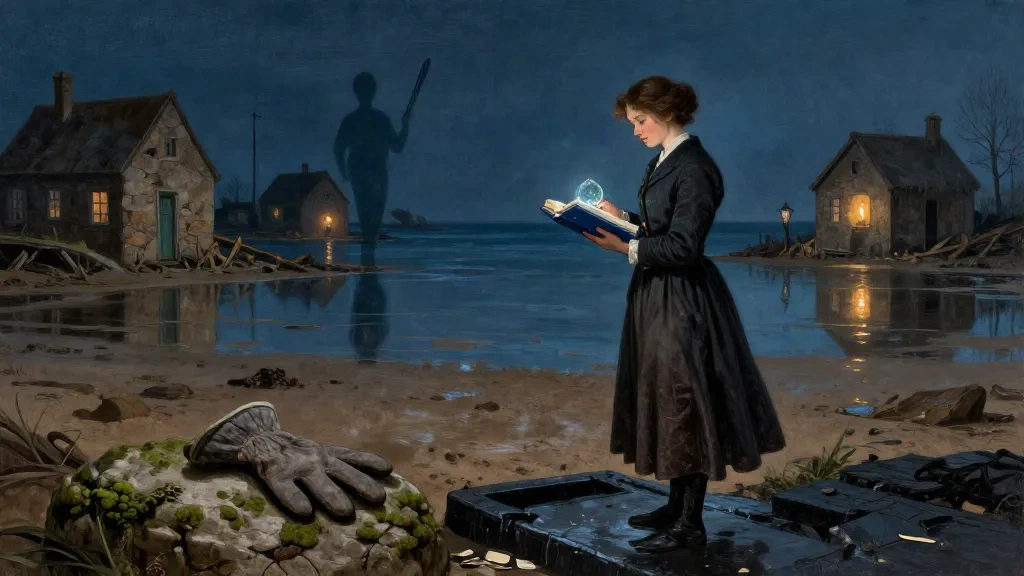
In the autumn of 1791, when the salt wind stripped yellow from Bellweather's roofs, Clerk Elian Voss found her name in a catalogue that had not yet been written.
The book was chained to the municipal reading desk, its blue boards soft as drowned cloth. Its newest leaf bore a seal dated 2186, three centuries beyond the reign of the present magistrate. Beside a column of vanished streets, a careful copperplate hand had written: Elian Voss, born beneath the Bellweather light, keeper of the returning things.
She read it twice. The letters did not shift. Above the mantel, reflected candlelight trembled across her face; below it, the harbour tide withdrew over black stones, carrying away a child's slate, a soldier's buckle, a rusted lock. Each morning the town received one forgotten thing. None came from the same forgotten place.
Elian copied the name into her ledger. The ink dried pale.
What the Water Returned
That evening, a glass seed rolled across the archive floor and stopped at her boot. It was no larger than a lentil, its clear shell enclosing a grain of grey ash. She had seen the object twice before that year: once inside a dead woman's locket, once resting beneath a judge's empty chair. Both times, the tide had brought it. Both times, the seed had opened after a name was spoken.
Inside it lay a curl of paper no wider than a fingernail.
Elian unfolded it with her bodkin. Three words survived: Low Quay, unlisted.
Bellweather's official map showed the Low Quay beneath forty feet of green water. Fishermen still lowered baskets there when storms erased the horizon, claiming cod slept in the drowned lanes. The town council denied the old quay had existed. Its foundation stones had been carried inland, the minutes said, when the sea wall was raised.
Elian knew better. She had grown up hearing bells beneath the foundations.
Her own wool glove lay beside the seed, damp with spray. A single index finger had been cut from it. She had searched for it since the previous night's storm. Now the missing finger was not the trouble. The glove had been repaired. Wool crossed the severed joint in neat brown stitches, and beneath her desk she heard the faint scratch of a pen.
The Shadow at the Sealing Table
“You cannot put the sea back where it was,” said the magistrate from the doorway.
He was not wrong. Elian laid the catalogue page, the glass seed, and her ledger across the sealing table. “I am not moving the sea. I am returning a witness.”
In the candle's reflection, a shadow detached itself from the magistrate's shoulders. It crossed the room without casting darkness. Its fingers were long, stained blue-black, and it carried a pen between them.
The catalogue had been written by that shadow. Elian understood then. It had spent generations making small corrections: removing households, shortening the low quay, converting drowned names into weather. It signed each alteration with the magistrate's seal.
“Give me your name,” she said.
The shadow bent over the catalogue. Its pen wrote Elian Voss, then paused.
“A name is only ink,” it replied. “Ink can be bought, scraped away, or drowned.”
“Not this one.”
She placed the glass seed beneath the page. The shadow's reflection split: one face remained, the other showed a quay crowded with lantern-lit houses. At the end of the vanished street stood a woman holding a wool glove to her mouth.
Elian recognised her own hands.
“It was taken from me,” she said. “I want it given back to the land.”
The magistrate leaned forward. “And if the land refuses?”
“Then it will refuse in its own name.”
The Name Beneath the Bell
At midnight, the harbour bell sounded without a rope. The water withdrew farther than anyone remembered, uncovering a stair of black steps and a row of foundations shining in the moon.
Elian walked down with the catalogue under one arm. The glass seed burned in her pocket. Her repaired glove trailed smoke from its brown stitches. Behind her, the shadow signed the magistrate's name on every emptied doorway, marking the town for removal.
At the quay's end, she found a stone tablet wrapped in weeds. The old keeper's name had been chiselled away, leaving a pale silhouette in the shape of a hand. Elian pressed the cut-finger glove into the hollow. The wool caught. The stone filled with a line of reflected candlelight.
She opened the catalogue.
The shadow's stolen words began to fade. Elian wrote beneath them: Low Quay, restored. Its keeper was Elian Voss. She is returned.
The pen shook in her grip. The shadow rushed toward the page, its pen poised to cross out the sentence. Elian drove the glass seed into the tablet. Inside the glass, ash lifted and became a black seed.
On the shore, the people of Bellweather began to cry out. Not in grief. In recognition.
Every drowned doorway surfaced at once. Windows flashed with lamplight. A child on the first stair called to a mother who had been erased ninety years before. The magistrate's shadow broke apart into a thousand harmless blue reflections.
Elian placed her palm over the new inscription. The name remained.
By dawn, the quay lay in open water, deep enough to hide its houses again. But the water was no longer forgetful. Each evening it returned one object, one bell-note, one red thread tied around a stone. The town had lost its former catalogue forever.
So Elian began a new one. She wrote every returned thing beside the name of the place that had lost it. On the final page, beneath the seal of Bellweather, she placed a small glass seed and a repaired wool glove.
Then she opened the ledger to a blank line and, with steady hand, gave the land its true date.





