 Netwrck
Hopeful Science Fiction.
The Patient Who Kept Yesterday
Every evening, the monastery admitted one person who could not agree with the present.
Dr. Ilyan Vale treated them in the damp east cloister, where rain worried the slate roof and green pharmacy light trembled through the windows. His patients suffered from homesickness without having left home. A farmer missed a kitchen that no longer existed. A child grieved a mother who was still alive but had forgotten the child’s name.
Vale prescribed routine, familiar smells, and stories about distant places. He did not prescribe clocks. In Bellwether, the government had abolished them after a century of civil hours, lawsuits, and executions scheduled to the second. Sunrise belonged to no authority. Trains left when the drivers were ready. A wedding could begin at any point before dark.
The clockmakers below the monastery still made time, but only for one another. Their master Nera carried a tiny music box wherever she went. It played twelve notes and stopped before the last could resolve. Inside its lid rested a copper star, one point polished bright by her thumb.
That evening, Nera placed both objects on Vale’s table.
My oldest patient has arrived,
she said. My oldest mistake has arrived with her.
What the Flood Left Open
The sound came from beneath the floor: three measured knocks, then seven.
Nera lifted a flagstone. Black water filled the undercroft, carrying dust, roots, and doorframes from houses upstream. Among them floated a child’s school satchel, swollen with papers no parent had been able to find.
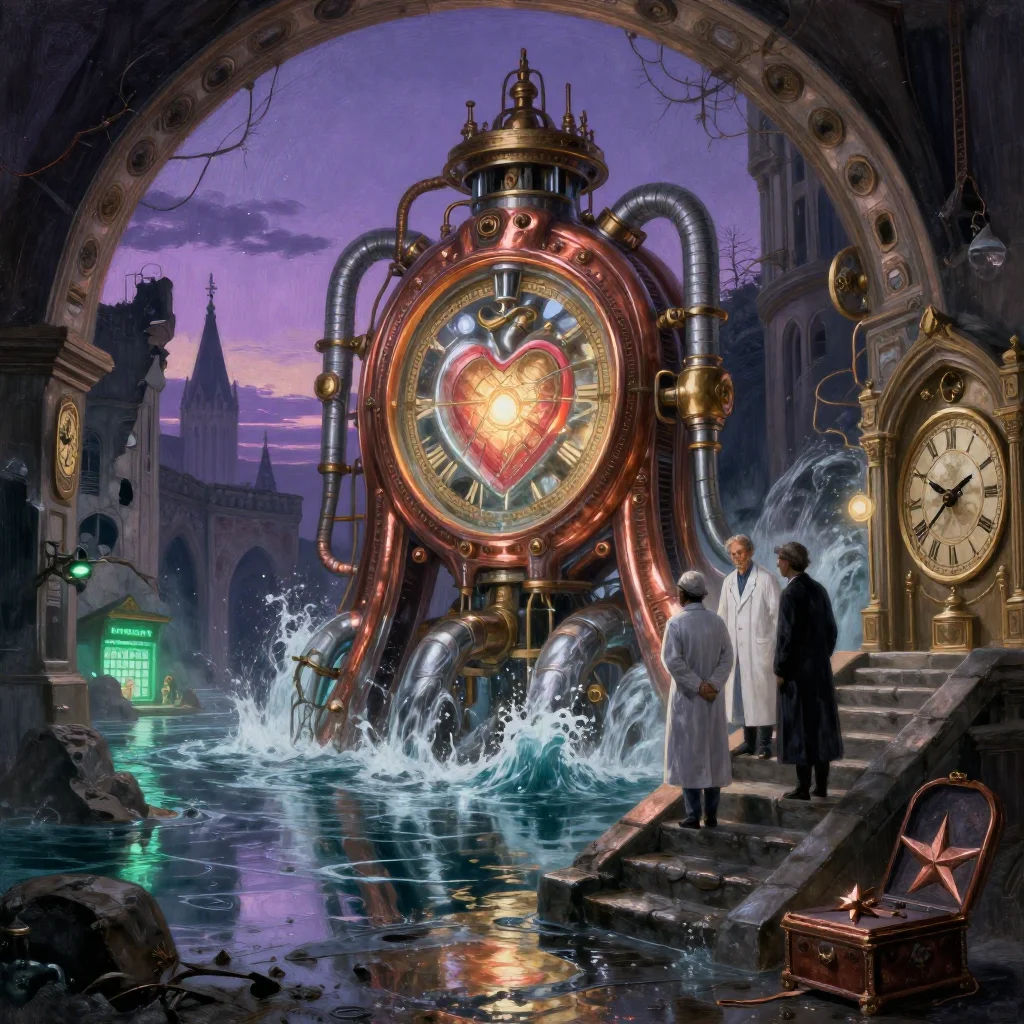
They followed the passage by lantern light. It descended farther than any cellar should. At its end stood a machine.
It was beautiful. Copper ribs curved around a motionless glass heart, and silver tubes entered every wall. Pale light traveled through them with the quiet certainty of blood. The music box trembled in Nera’s hand as the machine turned toward them.
Across its crown, newly freed from silt, letters appeared: PUBLIC INSTITUTE OF COMMON HOURS.
Nera had helped build it. Thirty years earlier, the government had commissioned a machine to standardize time and prevent any district from being governed by another. It would issue a common hour, assign public work, organize trains, and calculate when every citizen was expected to be home.
The flood had snapped its connection to the surface.
Vale saw where the glass heart connected to the monastery. Its hidden cable ran beneath the pharmacy, the clinic, and the dormitory where displaced families slept. Once reconnected, the machine could still give Bellwether a shared present. It could also know when every door should open.
Can you stop it?
Nera asked.
“I can choose what wakes next,” Vale said.
The Uses of an Hour
They returned to the east cloister at dawn. Below, the machine had begun sending messages through the pipes: lamps brightened, bells changed their tones, and water in the cistern climbed toward a predicted level. Precise. Helpful. Undeniably dangerous.
Vale understood his patients now. Homesickness was not merely memory. It was the body resisting a life arranged around obligations it had not chosen.
His patients had not lost time. They had lost the right to arrive unpredictably.
The National Hours Office sent soldiers to reconnect the machine. Nera could still stop it at the main regulator. Vale could open the municipal valves and flood the system, but then the institute and half the monastery would be destroyed.
He chose neither.
From the dispensary, Vale removed the batteries from every medicine clock. From the boarding hall, he borrowed all the wind-up alarm bells. The farmers brought hand bells. Dockworkers brought boat signals. The school satchel’s papers supplied lists of households whose doors were never locked at the same hour.
They sent those sounds through the copper network, each arriving with its small delay. The machine received no single command. It received a city refusing to become one note.
An Unfinished Measure
By sunset, Vale stood at the glass heart. Nera held the music box beside the master switch.
The institute’s light flickered between colors: the lavender of dusk, the wet black of the streets, and the green reflection from the pharmacy sign. For the first time, it did not know what came next.
Vale replaced the wire to the regulator with a length of bell cord. Nera wound the music box. Its twelve notes traveled through the machine, pause by small pause, until the copper star above them gave one final, clear chime.
Not a command. An invitation.
Outside, bells sounded from every quarter of Bellwether. Some were mechanical, some human, and one was merely a spoon struck against a tin cup. A market opened early. A delayed train announced itself. In the east cloister, a woman who had forgotten her son’s name heard him knock twice, then three times.
She opened the door herself.
The machine remained beneath the monastery, no longer a prison of common hours. The clockmakers repaired its pipes, and the city repaired its own.
Nera kept the copper star in the music box. Vale refused to wind it.
Some gifts, he told her, were most valuable when they remained unfinished.





