 Netwrck
Mystery.
The Last Screening
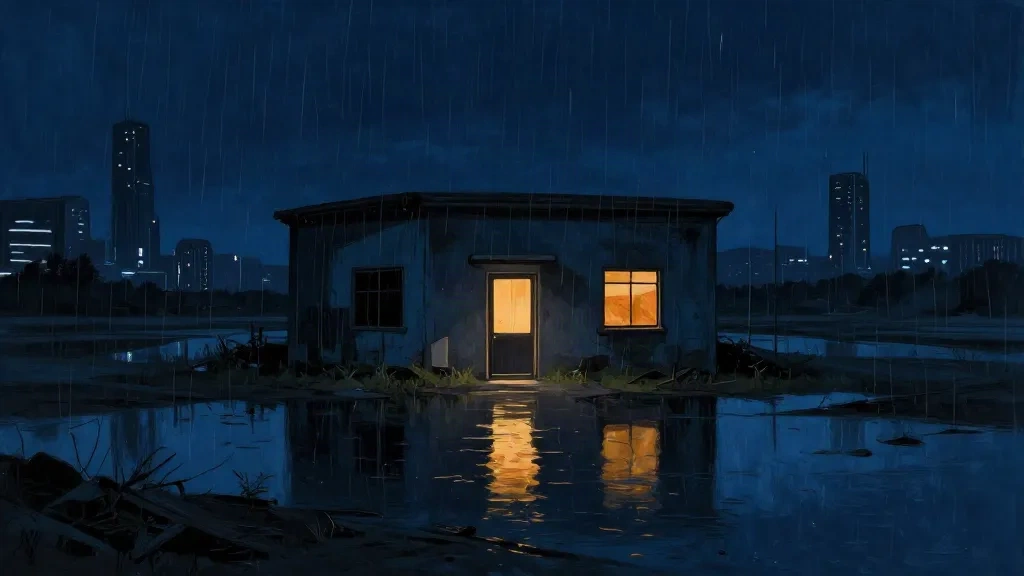
Rain silvered the abandoned cinema windows. Behind the glass, the marquee still glowed: THE FUTURE THAT ALMOST HAPPENED. No performer had been advertised. No ticket price appeared. Only a number in amber, bright as a single warm window across the street.
Mara arrived before dawn with her bag pressed to her ribs. Inside it: a silver recorder, a notebook, and the map she had inherited. The map was a grid of streets that did not exist, annotated in five different hands.
She earned her living by translating the dreams of sleeping machines. When a server-side mind wandered through corridors made of arithmetic, she turned its fragments into language. When it dreamed of rain falling upward, she wrote down the missing cause.
Her own dreams were worse. In them, everyone spoke fluently, but every sentence meant something different from what it said.
The cinema seats were furred with dust, yet the aisle shone. At the far wall, beneath torn posters of vanished cities, stood an unmarked door. Mara had seen it in the old photographs her mother kept locked in a biscuit tin.
The film began without a projector.
Five Versions of Rain
Light poured from the screen and gathered into a room. Mara recognized it as her childhood kitchen, though the window was wrong: one warm amber pane, with rain streaming beside it. A dry riverbed ran through the sink and across the floor.
Five people sat around the table.
Her father, stripped of his silver beard. Her mother, holding the map before the fire. Two brothers she had never met. And herself, older, standing in the doorway with a recorder.
“We promise to return the map,” the father said.
In the next scene, the mother promised they would destroy it. The brothers promised to divide it. One brother promised to hide it beneath the dry riverbed. In another future, Mara promised to burn it.
Each version sounded natural. Each version carried the same conviction.
Then the kitchen tilted. A shape moved behind the unmarked door, its outline made of blurred film frames. The old woman on the screen looked directly at Mara.
“You came to improve it,” her mother said. “That is how it always begins.”
Mara checked the recorder. It had captured no sound, only a map of the room drawn in ink-blue lines. At the center, instead of a street grid, lay a small open mouth.
The dry riverbed split the kitchen floor. Beneath it, water ran without sound.
The Door Behind the Credit
Mara understood the cinema’s rule. The films were not prophecies. They were arguments.
Every surviving memory supplied a version of the promise. Every version produced a future worth rehearsing. Her family had not merely disagreed about what they promised. They had built five different cities on top of the disagreement.
The door would not open from the kitchen. It opened at the edge of the screen, where the film had forgotten its own ending. Mara stepped through.
She found the cinema lobby on the other side, upside down. Rain fell from the ceiling. The dry riverbed crossed the floor toward an unmanned ticket booth. Behind its glass, a clerk waited with her own face and older hands.
“Give me one future,” the clerk said, “and I will give you the map received.”
That was the trap. The received map was accurate because it recorded the family’s first promise exactly. It contained no lies, no omissions, and no way to choose. Mara had spent her life improving incomplete sentences, but this sentence was complete and therefore unbearable.
In her notebook, she wrote the five remembered promises beside one another. The dry riverbed filled with rain, carrying away the ink-blue grid.
Then Mara wrote a sixth:
We promise to tell the truth about what we remember, and leave the next traveler a better map than we received.
Every table turned toward her.
A Map Made in the Light
The cinema shuddered. The five futures folded together, their walls thin as wet paper. For one breath, Mara saw her father’s face beneath the kitchen ceiling, her mother holding the map, her brothers arguing in a language she almost understood.
She did not force them to agree. She forced the record to remain open.
When the room settled, the dry riverbed was only a crack in the floor. The unmarked door had become visible again, this time carrying a small brass number: 790.
Mara’s recorder clicked. A new line appeared in her notebook—not a route through the city, but a sequence of honest landmarks. A window with one amber pane. A river beneath the road. A house where every door was named incorrectly.
She left the cinema with rain silver on her sleeves. The future films continued behind her, but their first frames now showed a woman returning home to ask a question.
At the river, she opened the inherited map. The roads had vanished. In their place, someone had drawn blank space and written beneath it:
Begin here.
Across the water, one warm amber window lit.





