 Netwrck
Speculative Fiction.
The Last Ticket
Mara Venn found the Astra because its ticket booth still had a light behind its dusty glass. The cinema crouched at the end of Harrow Street, its rust-red doors sealed with a chain thinner than a winter twig. Above the entrance, pale letters had lost three letters, leaving ASTRA.
She stopped playing when the venues closed. Without audiences, a musician is only a person making promises to silence. Still, Mara carried her silver tuning fork everywhere and opened her case upon the stairs, striking it whenever she needed to know whether a place deserved her music.
The note from the Astra was new: a low silver vibration beneath A.
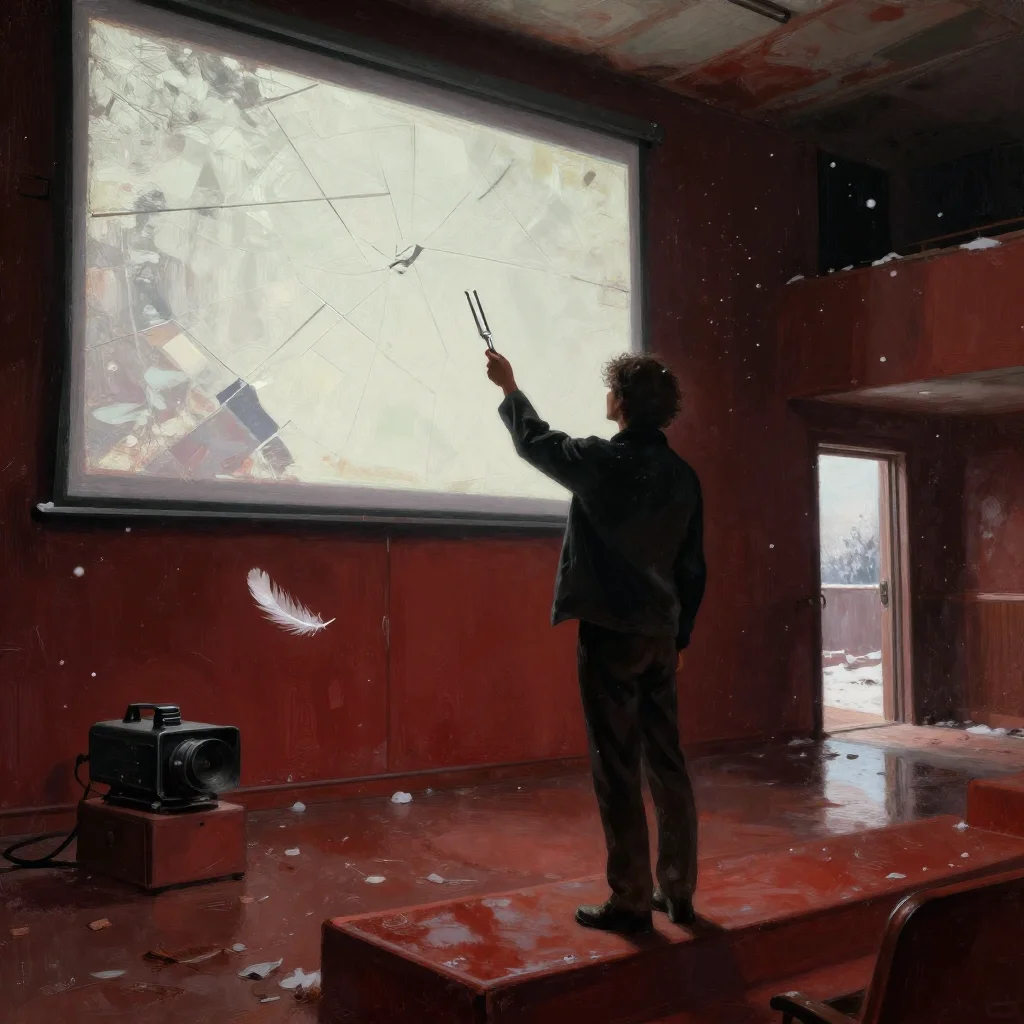
Inside, rows of seats waited beneath charcoal dust. A white feather rested against one armrest, immaculate in a dead building. Beyond the screen, dust stirred. The projector awakened by itself, and a rectangle of pale winter light spilled across the floor.
On it appeared Harrow Street as it would look after a severe flood: not water, but white roofs and a sky packed with ice. A woman in Mara's coat walked toward the Astra carrying a cello.
Mara heard the truth-note again. The image showed what might have happened. Not what would.
Futures That Almost Happened
Over three nights she watched the cinema's collection.
One future ended when her mother finally said, I was wrong about you. Another ended when a distant city surrendered a war by inventing a holiday no one had thought to name. In one, a white feather floated through the streets for forty years. In another, a silver spoon bent itself into the shape of a key and opened the doors of every prison.
Each film ended at the exact instant its choice was made. Each truth-note sounded when the people inside understood what they had lost.
On the fourth night, Mara saw herself onstage.
Behind her hung letters reading THE SONG OF WHAT REMAINS. The hall was full. She raised the silver fork, and a chord passed through her body. The sound opened outward over farms, courts, rooftops, and winter camps. Children learned it in school. Governments stored it in archives. Strangers hummed it while working. Mara lived to ninety-eight.
She leaned forward, hungry for its shape.
There was none. The film offered a life, not a melody. The truths were there, but the music had not been made.
Outside, the air had turned. Snow erased the cinema steps and hardened overnight into a white wall. Then more fell. The generator died. Harrow Street vanished beneath drifts that climbed past the ticket booth.
A full generation would pass before the thaw.
The Winter Orchard
Mara decided the future deserved to survive her.
She tore the silver tuning fork from its case. Its stem was warm from her hand, a stubborn little piece of metal. The white feather lay beside her. She thought of a tuning fork as something that stores vibration, and a feather as something built to travel.
Then she set to work.
She repaired the generator by stripping copper from the ticket booth. She copied the cinema's black-and-white films onto ceramic plates scavenged from a shuttered restaurant. With a dentist's drill, she cut grooves into the silver spoon, drawing the curve of each recorded chord.
For sound, she needed instruments. Beyond the snow lay abandoned shops: a piano with water between its keys, a music teacher's brass horn, a row of tuning forks in a pawnshop window. She tied them to a wooden sledge and dragged them home.
Every day, the cold took more.
Icomes joined the cups. Frost sealed the speaker horns. Mara's fingers cracked. On the twelfth day, she wrapped the white feather around the silver spoon, fixed them above the projector, and wound the mechanism.
The cinema's last reel began turning.
Not a film of a future: a record of their choices. Every truth she had witnessed became a note: a major chord for open hands, a falling interval for a house surrendered, a bright sustained tone for mercy accepted too late.
After the Credits
Winter proved the seasons she called false could survive time. The years compressed into weeks. The first generation learned the old music and changed the songs. Their children sang variations over extinguished furnaces. Their grandchildren made instruments from satellite dishes, bed frames, and emergency broadcast antennas.
When the thaw came, the Astra had forgotten snow. Farmers found its buried doors and opened them. Children crept onto the dusty floor while their parents stood uncertain at the entrance, afraid to be the first people to admit what they had nearly become.
The white feather was gone, carried on the first outward wind. The silver spoon remained, scarred with all the grooves she had cut. Mara held the tuning fork one last time.
Its A struck the old pitch perfectly. The cinema answered with every note it had preserved.
One of those notes belonged to the old woman sleeping in the lobby. Mara recognized it before she opened her eyes: the unfinished chord of someone who had spent a lifetime listening for a truth she had never spoken.
The future did not need its author to remain. It needed her to stop signing it alone.
Mara knelt beside the empty stage, placed the fork in another hand, and said, Begin where the sound begins.





