 Netwrck
Fairy-Tale Fiction.
The Last Screening
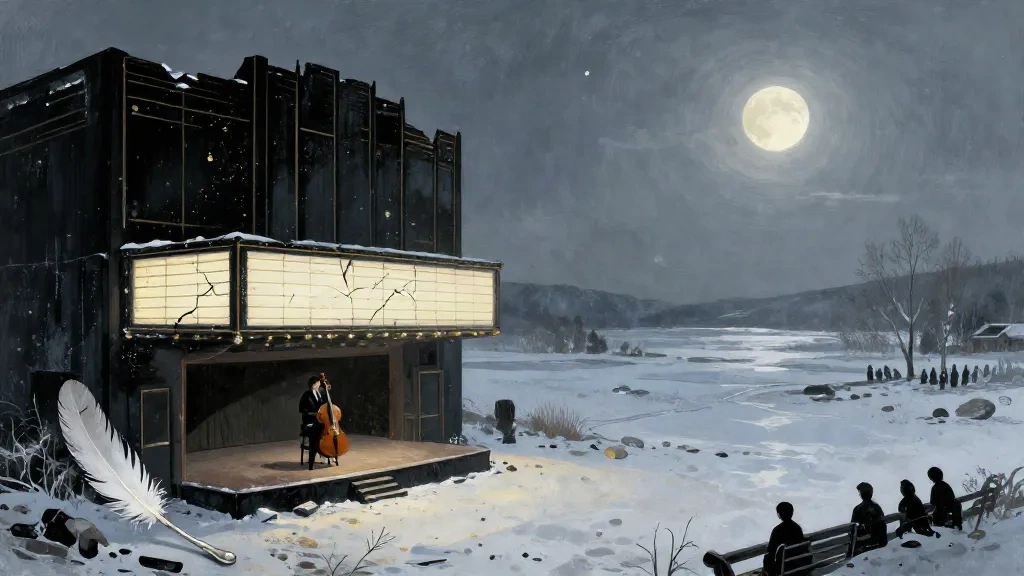
The abandoned cinema had kept one light burning beneath its cracked marquee, though no one knew why. Its doors opened only when the moon was thin enough to fit through the sky.
Inside, the seats were upholstered in black velvet, polished until they reflected the cold moonlight falling through the broken roof. Gold dust drifted across the floor whenever the projector stirred. Rows of silent figures faced the screen: a man holding a white feather, a girl with a silver spoon, a woman whose face had been erased by time.
Elian arrived with his cello wrapped in wool. He had played in the village below, but the villages no longer had songs for the winter. The frost began beneath the floorboards and climbed every object it touched. It froze wells, doors, and songs alike.
His grandmother had left him the old theatre. She had also left him a single instruction: build something that can survive the storyteller.
When the projector awakened, a note sounded beneath the music.
Elian knew it at once. It was the note his father had made when admitting he had abandoned them. A clear, low bell, warmer than the winter air.
What Almost Happened
The film showed a city beneath snow. A king raised a bridge between two cliffs, but the bridge was made from promises, and the promises were not strong enough. Then came the flood. The city drowned with all its people still smiling.
Another note answered.
Elian watched a woman admit that she had stolen the spring from the hills. The screen filled with white light. He heard a second note, higher and trembling.
The final film showed a girl planting a black tree in the centre of the square. The tree bore golden fruit. When an old man told the truth about his cruelty, the fruit opened. When a child lied, the fruit hardened into coal.
Then the girl vanished.
The winter in the film lasted fifty years.
“She was the storyteller,” Elian whispered.
The feather in the silent figure’s hand lifted from its seat. The silver spoon struck the armrest.
A voice from behind him said, “The storyteller is still telling.”
The Storyteller’s Winter
Elian climbed onto the stage. The projector turned without electricity, each frame showing the same abandoned theatre, each frame showing him older.
The child named Nera waited in the last row. She wore the white feather in her hair and held a silver spoon in one hand.
“You built the winter,” she said.
“No.”
“You told the story of a world that could survive by changing the past. Every time someone confessed, the world changed. Every change made the next truth colder.”
He looked at the motionless figures. They had been the winter’s witnesses. Their admissions had become frost.
“How do I end it?”
Nera raised the spoon. “Build something that does not need you.”
So Elian played.
He began with a melody he had heard when his father spoke the truth. He added the note from the stolen spring, then the note from the vanished girl. The melody was imperfect. It contained grief, but grief was no longer enough to freeze.
Nera dropped the white feather onto the stage. It opened like a small door.
Through it came the sound of people speaking honestly when it mattered. A baker admitting he had burned the bread. A child admitting she had broken the clock. A king admitting he had feared his own people. Each truth became a note.
Elian did not take the notes for himself. He wove them into the cello's strings.
A Future Worth Keeping
By dawn, the projector burned through its last frame. The theatre filled with gold dust, moonlight, and the warmth of breath.
The frozen figures began to move.
The winter did not vanish. It withdrew from the earth, from the roofs, from the people's tongues. It retreated to the country beyond the hills, where it would wait until the next generation had learned to carry truth without turning it into a weapon.
Elian built no monument to himself. He laid his cello on the stage and repaired the projector.
Years later, children entered the cinema carrying questions. They watched films of futures that almost happened, but at the end Elian's new score began. It taught them the truth beneath every image, and the courage to let an old story become a new one.
On the final evening, Nera returned the white feather to him.
“What survives the storyteller?” he asked.
“The one who lets another voice begin.”
She placed the silver spoon beside his bow.
Outside, the first spring wind moved through the black trees. In the dark glass, the abandoned cinema shone with a light that no winter could extinguish.





