 Netwrck
Fairy-Tale Fiction.
The Last Screening
At the end of Winterfall Street stood the Cinema of Almost, its doors sealed with black lacquer and its ticket window filled by years of dead moths. The building had not shown a film in forty years, yet on winter evenings its silver marquee flickered awake: ONE TRUE ENDING, TONIGHT.
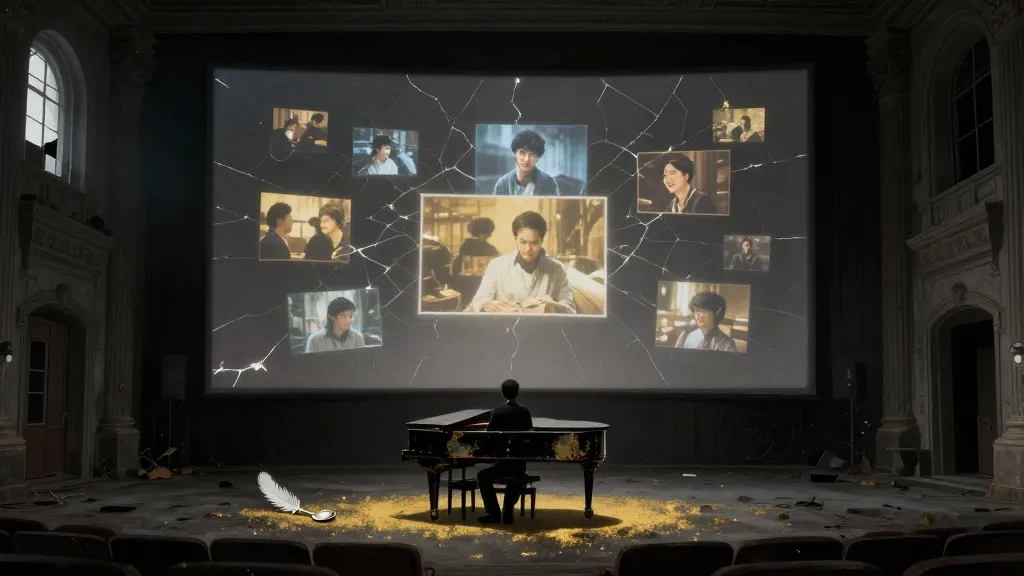
Inside, Nera found eleven rows of seats beneath a ceiling mapped with constellations. She was a musician, though her instruments had been stolen, her band dissolved, and her songs dismissed as weather without rain. In the orchestra pit stood a piano missing seven keys. Whenever someone told the truth, Nera heard a note sound inside the instrument.
Low, when a lie disguised itself as kindness. Clear, when a confession cost something.
The screen showed futures that had nearly happened. A city beneath green ice. A king surrendering his crown to a child. A meadow where every tree remembered a different name. In every scene, a white feather drifted through black lacquer doors, and every child in the audience held a silver spoon.
The Winter That Would Not End
The cinema had been empty when the last film ended, according to its caretaker, a hollow-eyed man whose name was Ilyan. He said the winter had lasted one generation. It began when the town’s people voted to abolish sorrow. They cast ballots into a furnace and watched the smoke spell a promise:
We will be safe, if we never change.
After that, the snow stopped melting. Roads froze beneath the first layer. New buildings rose only as ruins. Everyone remained exactly as useful, exactly as frightened, and exactly as grateful as before.
Nera watched Ilyan confess. He had locked the projector room so no one could see the futures they had prevented. His truth rang through the piano: a high silver note, sharp as a spoon striking a glass.
“Why did you build this place?” Nera asked.
“To prove we had choices.”
The piano answered with another note.
Then the lights failed.
A Future Made by Hand
Outside, the storm erased footprints faster than feet could make them. Nera and Ilyan carried the piano through the cinema’s broken projection room, across the frozen lobby, and onto the stage. The white feather caught in the machinery. The silver spoon, nailed to the wall, melted into a shining puddle.
“We cannot change the winter by remembering it,” Nera said. “We need to build something that can survive the storyteller.”
She began with a house. Not the theatre, not the town, but a small hall where people could enter without bringing their old selves. She used black lacquer boards, gold dust from the ruined marquee, and moonlight gathered in tin bowls. Ilyan cut projections from the abandoned film: a door opening, a child laughing, a hand releasing a bird.
Each time someone admitted what they feared losing, the piano sounded. The notes gathered in the walls. They became nails, hinges, benches, a roof. The hall had no enchanted stone and no ancient spell. It had the stubborn architecture of repeated truth.
By dawn, a woman brought her son. She confessed she had voted for the painless winter because she was afraid of losing him. The boy confessed he wanted to grow taller. Both notes sounded together, and a third note appeared between them.
One by one, the townspeople entered. Not with polished apologies, but with the ordinary ugliness of confession: jealousy, pride, hunger, regret. The hall did not forgive them. It held their words.
The Film That Could Be
The white feather was gone. The silver spoon had become a bright crack in the stage.
Nera placed one final note on the piano. It was not a truth anyone had spoken. It was the sound the future made when it ceased to be a thing on a screen and became a thing people had chosen to build.
Ilyan turned the projector. Gold dust trembled in the cold moonlight. The film showed the cinema as it would stand after the winter: shutters open, piano repaired, children arguing over whose turn it was to play.
Then the image flickered, and another future appeared—a theatre buried beneath snow, its doors still sealed.
Nera did not turn away. She struck the next note, and the next, until the darkness had a pulse.
Outside, for the first time in a generation, one snowflake fell as water.





