 Netwrck
Surrealism.
The Last Screening
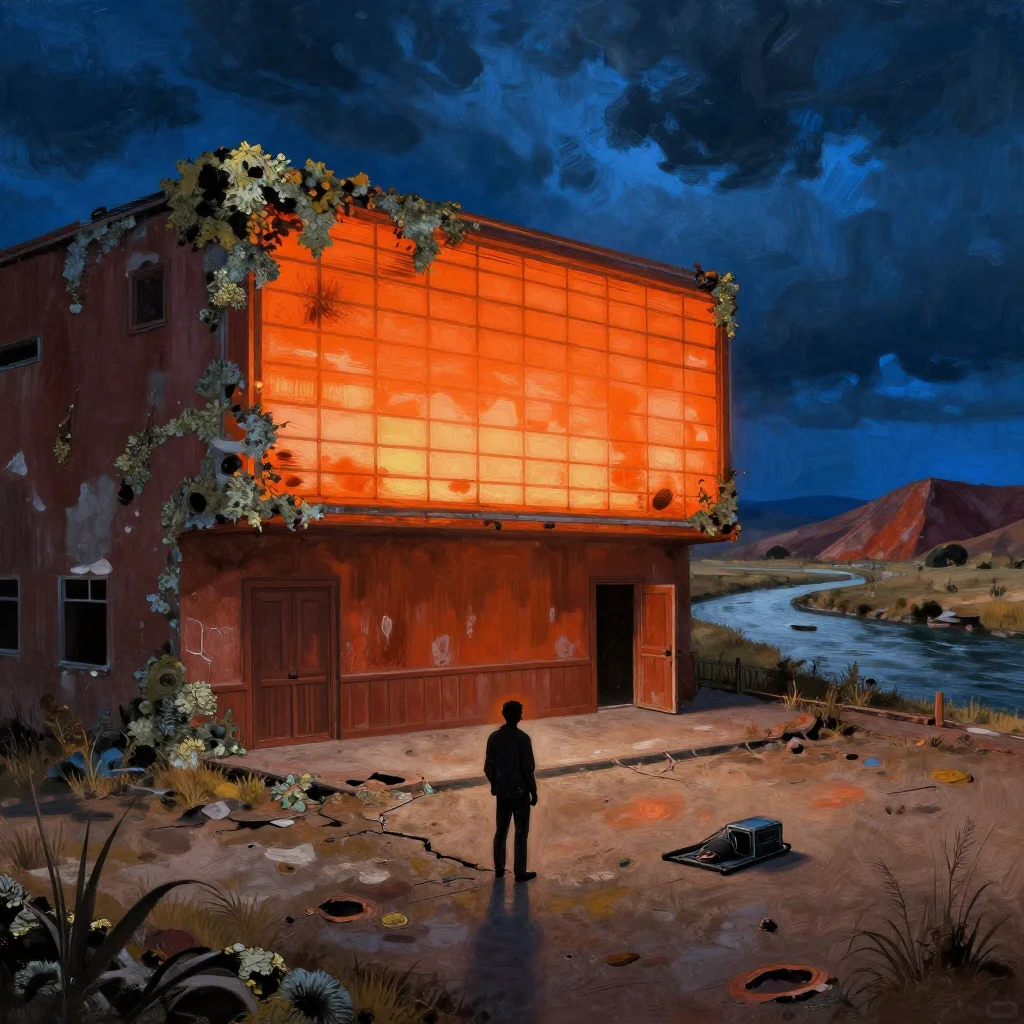
The abandoned cinema had no name on its marquee, only a strip of burnt-orange bulbs that blinked whenever the weather changed. The air smelled of dust, warm metal, and lichen growing patiently in the walls. Mara arrived before dawn with a silver case of tools and a blank map folded inside her coat.
Her work was simple in the way that dangerous things are simple. The machines slept beneath the seats, behind the screen, inside the cracked projection booths. They dreamed in voltages, colors, and images of futures that almost happened. Their dreams were not visions. They were negotiations between possibilities. Mara listened for the sentence that might become a catastrophe.
She was paid to give the machines a human tongue. The rest of the day she spent drawing maps, as if geography were a thing that could be repaired by remembering it correctly.
The Door Without a Number
On the first night, the machines spoke of a town beneath a lake. On the second, they spoke of a blue sun rising over a field of black wheat. On the third, a projection began by itself. The screen showed a woman standing beside a dry riverbed, holding an unmarked door in one hand.
Mara recognized her mother.
The image flickered. Her mother’s face changed into her father’s, then into Mara’s own, then into a stranger wearing her mother’s expression. Beneath the figures, white words appeared: THE PROMISE WAS MADE AT THE CROSSING.
That was how her family had always described the night they left their village. Her mother said they had promised to return when the river filled. Her father said they had promised never to cross the river at all. Her brother, Tomas, said the promise had been made to bring the child back, not the parents. Each version was precise. Each version had a different wound in it.
Mara had inherited none of the stories. She had inherited only the map, sent to her years earlier by a machine that had never woken. It showed the cinema, the riverbed, and the unmarked door leading nowhere. Beneath the river, someone had written a small blue X.
Every Future Has a Cost
As the screenings accumulated, the cinema filled with noises that were almost familiar. A child counting backward. A kettle boiling in a kitchen destroyed by drought. Her mother laughing in a room Mara had never seen, then refusing to answer when called.
Mara began sleeping among the machines. She placed her palm against their cold housings and translated their dreams without waking them. They showed her wars that had lasted seven minutes, marriages that had survived, a city lifted gently into the clouds. Every future that almost happened had included a promise. Every promise had required someone to break it.
When she translated the next screening, the unmarked door appeared on the screen and opened onto the dry riverbed. Behind it stood Tomas, older, holding a lantern. He said, “You came back too early.”
“You said the child was not me,” Mara answered.
He looked at the blank map in her hands. “I said the child was whoever you needed to bring back.”
The machine behind her suddenly woke. Its alarm shook dust from the ceiling. On the screen, her father crossed the river alone, carrying a small box toward a blue horizon. Her mother waited on the opposite bank, and neither of them turned back.
Mara understood then that the dream was not asking her to choose the true story. It was asking her to make a map that did not pretend the stories could agree.
A Better Map
At sunrise, she carried the blank paper into the projection room. The unmarked door waited behind the wall, exactly where the dream had shown it. She opened it and stepped through.
Beyond it was the dry riverbed. Lichen spread over the stones in green islands. Burnt-orange dust clung to the hills, while blue storm-light poured through a sky that seemed to have been folded in half. The door closed gently behind her.
On the opposite bank, a machine knelt beside the river. Its dream was shining from its open body, thin and bright.
Mara sat down and began to translate.
She no longer tried to recover the promise. She drew the places where its versions diverged: the bank, the crossing, the child, the home, the years afterward. She marked the places where one memory ended and another began. When she finished, the machine placed its cold hand over hers.
The map was not an answer. It was better than an answer. It left room for every person to arrive without becoming lost.
Far away, behind her, the cinema began playing a new film. The screen showed an empty room, an unmarked door, and a dry riverbed shining under blue light. No one appeared to cross. No one had to decide which promise was true.
Only the map remained, open in the storm.





