 Netwrck
Historical Fantasy.
The Last Reel
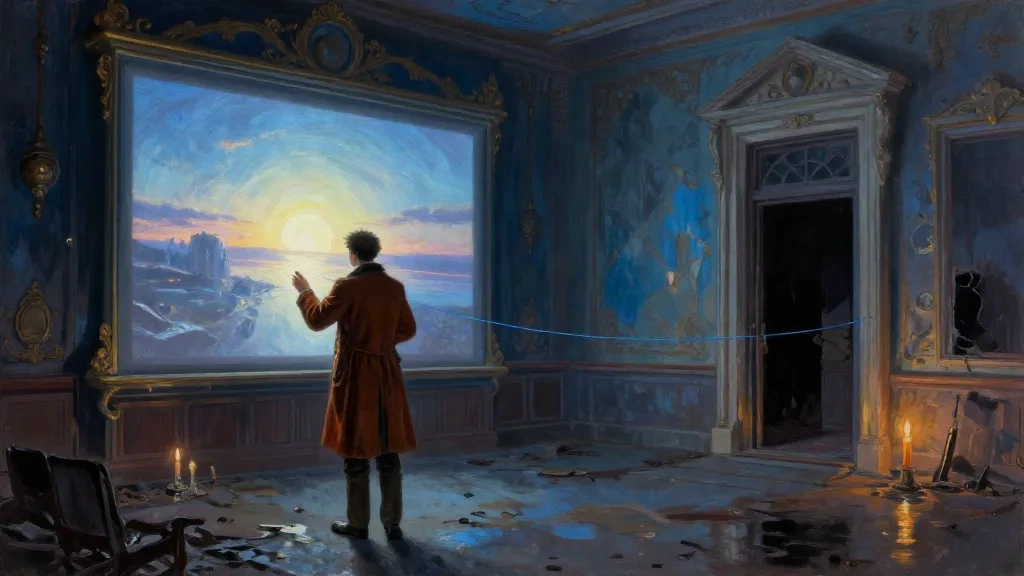
The cinema stood behind the tram depot, its roof shedding years in thin rust-colored flakes. Liora found it on the morning she finished making windows for a house in the city of Vey, each pane shaped in the blue-gray light of a winter river. The glassblower's hands were still stiff from the heat when she noticed the projection beam leaking through the boarded entrance.
Inside, the seats waited beneath a skin of dust. No one had swept them. No one had repaired the torn velvet curtains, though the air smelled of warm metal, tobacco, and candle wax. On the wall behind the screen hung a brass clock without hands.
The film began when she touched the door.
A woman in a blue thread coat stood at a crossing, holding a child's hand. A train passed behind them. A bell rang. Then the image froze, and white lettering appeared: ALMOST TUESDAY.
Liora stepped closer. The woman turned toward the camera. It was her own face, older by twenty years and marked by a scar along the jaw.
The Safe Trail
On the second night, the cinema showed a market burning while children sold bread beneath an unmoved moon. On the third, soldiers crossed a frozen river and every flag bore the same blank crest. Liora watched until dawn, waiting for the morning she knew: iron kettle, blue cup, bread warm enough to heat her hands, the tram bell at eight, and the first page of the newspaper turning by itself.
That morning was missing.
She had slept in the cinema's projection room. When she woke, the ordinary morning had been reduced to a pale square on the floor. A kettle stood cold. A cup lay unbroken. Someone had removed the sound of the tram.
On the floor lay a length of blue thread. It led through the auditorium, beneath the last row, and into a small door with no number, no paint, and no handle.
Liora followed it. The thread crossed the street, climbed a warehouse wall, and ended at a bakery where the baker was telling everyone that no bell had rung that morning. His listeners agreed. A postman agreed. A child who had heard it said he had mistaken a door slamming for the bell.
The moment they stopped insisting on the truth, the blue thread loosened. A path appeared beside the canal, paved with warm stones. The bakery door opened onto a kitchen where the kettle was already boiling.
Liora rushed inside. Her mother's table stood there. Her mother sat with her back turned. The cup was blue. The bread smelled exactly as it had smelled every winter morning of Liora's childhood.
“You are late,” her mother said.
The room trembled.
The Door Without a Name
Liora lifted the bread, but it crumbled into ash. Her mother's voice came from the wall: You kept the wrong thing.
Liora returned to the cinema and searched the projection booth. The old projector was warm. Inside its black housing lay a spool of film made from blue glass. When she threaded it through the lens, the screen filled with images that had no explanation: a funeral, a wedding, a flooded city, a man's empty chair.
Each future became safer as the audience agreed upon it. First they said the war had ended. The dead stood laughing in the street. Then they said the river had never frozen. The lost children appeared in their homes. At last they said the cinema had never existed, and the walls began to disappear.
Only Liora's disagreement kept the room solid.
She pulled the blue thread from the projector. It burned her palm, but it held. At the unmarked door, the thread passed through the wood and continued into darkness. On the other side, she heard a clock strike eight.
The future-film showed Liora's own hand opening the door. Behind her stood a city she did not recognize, bright with windows made from her glass. In that world, the ordinary morning was gone. Her mother had forgotten the kettle, the bell, and the first sip of tea.
The image offered one final choice: burn the spool and keep the room; or step through and recover the morning.
Morning, Unforged
Liora did neither. She set the blue thread inside the clock's empty face and turned the projector toward the screen.
Every future that had almost happened flickered at once. Fire, war, rain, snow, weddings, funerals, children waking in rooms they had never seen. The audience had spent decades making those futures harmless by agreeing they were impossible. Liora spoke over them.
“The bell rang,” she said. “The bread was warm. My mother turned when I called her.”
The bell began to ring. It was faint, then enormous, shaking dust from the ceiling. The clock's hands appeared, not indicating an hour, but pointing toward the exit.
Liora opened the unmarked door. Beyond it waited the ordinary morning, unchanged because someone had refused to let it be softened by a better story.
She stepped through. Behind her, the cinema folded shut.
Years later, glassblowers in Vey said that a blue thread could be found in any window made for another world. It was strongest before sunrise, when the light passed through the pane and the room remembered what it was.





