 Netwrck
Fantasy.
The Last Reel
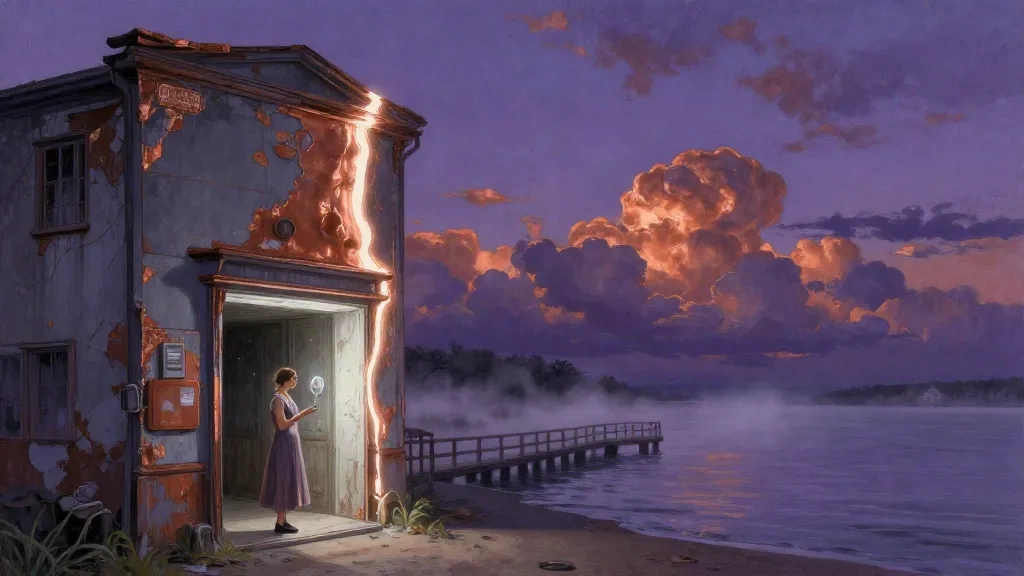
Mara found the cinema behind the salt warehouse, where the last violet light of evening settled over weeds grown through the projection room. The building leaned toward the sea as if listening for a train that had never arrived. On its marquee, three letters remained: TH.
Inside, every row faced a blank screen. Only one seat held a smooth glass bead, clouded white at its center. Mara recognized it as a glass seed. She carried the seed in her coat pocket beside a salt jar, though she had never decided which was protection and which was warning.
The films began when she threaded the bead through the old projector. They showed futures that almost happened: a bridge opening in time of flood, a child returning home before the fire, a town voting itself into silence. Faces in the pictures were strangers until they turned. Then each wore the same expression of frightened relief.
Mara was a seamstress. She could mend what distance did to people: a sleeve torn by betrayal, a glove lost at departure, a scarf stitched shut around a secret. Her needle did not close cloth so much as the gap between two lives. The smallest tear was enough to open the whole pattern.
Her wish had been simple for years: a door that opened only when both sides consented. Not a bridge forced by necessity, not a threshold paid for by blood, but a door whose hinges felt the truth of two people choosing it.
The Agreement Below
The village sent her to the cinema after its council tore down the old footbridge. The bridge had belonged to a treaty signed three generations earlier, in a language no living person could read. Without its consent, the river had begun taking one road each year.
On the council table lay a strip of bark covered in angular marks. A salt jar stood beside it, rim crusted white. Mara recognized the writing from a book of funeral customs: the dead could read it, but the living could only stare.
That night, the screen showed a woman in a green coat crossing the bridge. Behind her walked a man with cloud-white hair. Both reached the center. The woman raised her hand, and the man turned away. The film burned to ash.
Mara stitched the burned edge of the image. Her needle caught on something beneath the film. A doorway appeared, sealed with the same angular writing.
Consent of the Living and Dead
At the bridge, the village gathered with lamps and folded blankets. The mayor said the old agreement had died with its makers. The river would decide for them now.
Mara laid the bark strip across the bridge rail. The glass seed glowed in her palm.
“Consent is not possession,” she said. “It requires two living voices. The dead can only witness.”
No one moved. The river struck the pilings with a sound like a locked gate.
Then a child stepped forward. She was the ferryman's daughter, the one who had drowned six years ago. The ferryman cried out and reached for her.
“I never crossed alone,” the girl said. Her voice came from the bridge and the water at once. “I waited because both of us agreed not to go.”
The angular marks brightened. Not permission, Mara saw, but a missing truth. The dead had carried the village's consent for six years because the living had hidden it from themselves.
The ferryman took his daughter's hand. His palm opened. The girl did not vanish; she became a line of silver on the river's surface, held between his fingers and the water.
Mara stitched her door into the air above the bridge. It had no hinges, no lock, only two small seams shaped like open hands.
Both Sides
At dawn, the cinema showed one more future. The door appeared in a whitewashed wall. A woman on one side pressed her palm to the left seam. A boy on the other side waited with his palm against the right.
They did not touch immediately. They listened. The water moved below them, carrying the old writing toward the sea.
Then both chose. The door opened inward, and a wind entered carrying salt, rain, and the clean mineral smell of stone. Neither side pulled the other across. They simply became able to.
Mara left the glass seed on the cinema seat. The salt jar remained on the bridge rail, open to the weather. Each object held what it had been asked to hold: the seed the shape of a future, the salt the boundary of an oath.
Before leaving, she threaded the final film. On-screen, the abandoned cinema shone beneath violet dusk. Every empty seat faced a door that stayed closed until the people inside chose to open it.





