 Netwrck
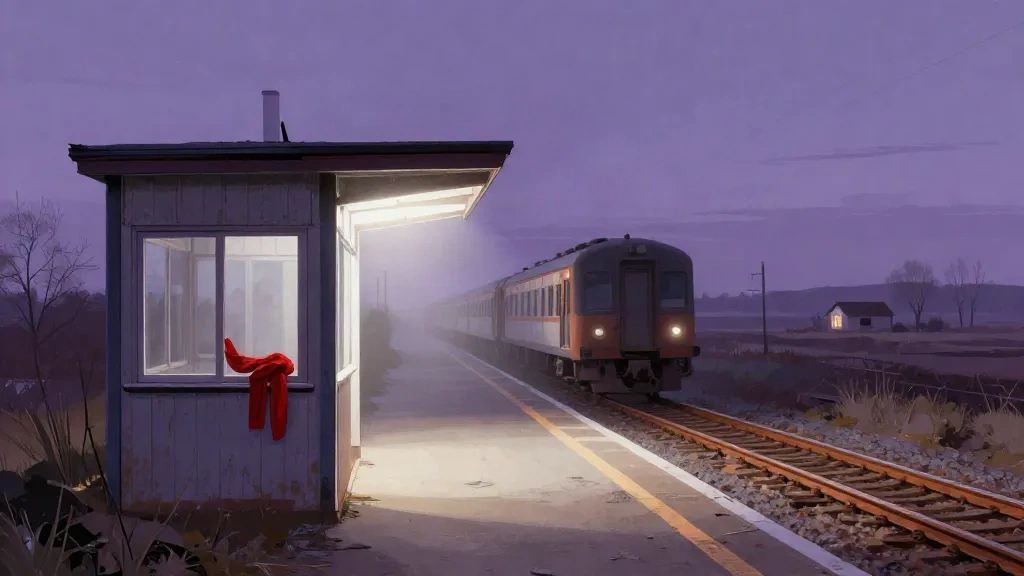
Fantasy.
The Film with No Last Reel
On the evening the cinema's roof began shedding rain, Mara Venn found a house crying in its foundations.
The house stood at the edge of Bellweather village, where the road divided and the last lamp had been dark for years. Its windows were shut. Its chimney leaned toward the marsh. When Mara set her black medical bag on the step and pressed her palm to the wood, the floorboards shuddered beneath her.
“She is homesick,” said the stationmaster from behind her.
He had arrived without sound, as if the railway had coughed him out. His coat was oxidized copper, though the air was a violet dusk. Under one arm he carried a brass lantern and a timetable swollen with rain.
“For the sea?” Mara asked.
“For whoever left her.”
Inside, the house had packed itself for a journey. Blue curtains were folded into bundles. Plates stood upside down in the cupboard. On the kitchen table rested a red scarf and a train ticket stamped for 3:17 the following morning.
Mara knew the scarf. She had wrapped it around Elian's neck on the night he told her he was leaving. She knew the ticket, too. Elian had returned it to her the next day, saying the conductor had changed the route.
“You are a nurse,” the stationmaster said. “Then mend what is speaking.”
He pointed to the walls. In the dark, two voices were arguing in alternating breaths.
Elian's said, I did not promise forever.
A woman's voice answered, You promised to tell me before you went quiet.
Mara closed her eyes. The house's pulse was the pulse of a person trying to decide whether to open a door.
Scenes the Future Almost Kept
The stationmaster led her to the abandoned cinema behind the platform. Its doors opened onto darkness, but the screen glowed cloud-white.
On it, a woman in a red scarf stood beside a railway carriage. In one version, she boarded. In another, she tore the ticket into small pieces. In a third, Elian waited on the platform and the woman never arrived.
“These are futures that almost happened,” the stationmaster said.
“Then why are they here?”
“Because someone has mistaken an ending for a final edit.”
He showed her the film canisters stacked beneath the projection booth. Each label bore a name and a year. The one marked ELIAN carried a date only three days away.
“You think I can change the ending?”
“I think you have been treating the wrong injury.”
Mara remembered Elian's last visit. He had sat in her clinic while she cleaned a boy's infected knee. He had said, “I cannot keep choosing silence just because it is quieter.” She had answered, “Then say the rest.”
He had looked at the red scarf around her shoulders, but not at her face.
“There was nothing left to say,” he told her.
The cinema flickered. For an instant, the screen showed them both: Elian at the table, Mara in the doorway, the scarf between them like a small, red fire.
Then the image shattered into white.
The 3:17 Departure
The stationmaster unlocked the projection room. Its projector was a black iron heart, warm and ticking. He threaded a reel into place.
“Every ending is a scheduling error,” he said. “A departure moved ten minutes. A platform changed. A person arrived before the other was ready to be seen.”
Mara watched the film. It showed Elian in the cinema, years older, telling her the truth. It showed the red scarf folded on a shelf, and her own hand refusing to take it. It showed him boarding, then stepping down, then boarding again.
“Which one is real?” she asked.
“None. That is why the house remains ill.”
At 3:16, bells began ringing beneath the cinema. Outside, the railway trembled. Elian stood at the far end of the platform, holding a ticket in both hands.
Mara ran.
The red scarf was around her neck when she reached him. She pulled it free and held it out. The morning had made the wool damp, or perhaps he had.
“I thought you wanted to go,” he said.
“I wanted you to stay without disappearing.”
“Those are different.”
“They are now.”
Across the tracks, the stationmaster raised his timetable. The departure board blinked, changed, and failed again.
A Future With Room in It
Elian did not board. He placed the ticket on the platform rail and stepped onto the track beside her, where the stones shone copper beneath the violet sky.
The cinema's screen flared cloud-white. For one breath, every possible ending appeared at once: a wedding, an apology, an empty kitchen, a red scarf on a different continent. Then the images narrowed into a single frame.
Their house, at dawn. Its curtains open. Two cups on the table.
The stationmaster lowered his lantern. “A film is not a prophecy,” he said. “It is only what someone has not yet said aloud.”
Mara took Elian's hand. The house behind them sighed, and one window opened.
They went home before the rain began.
Many endings followed. None arrived on time.





