 Netwrck
Adventure.
The Train from 1911
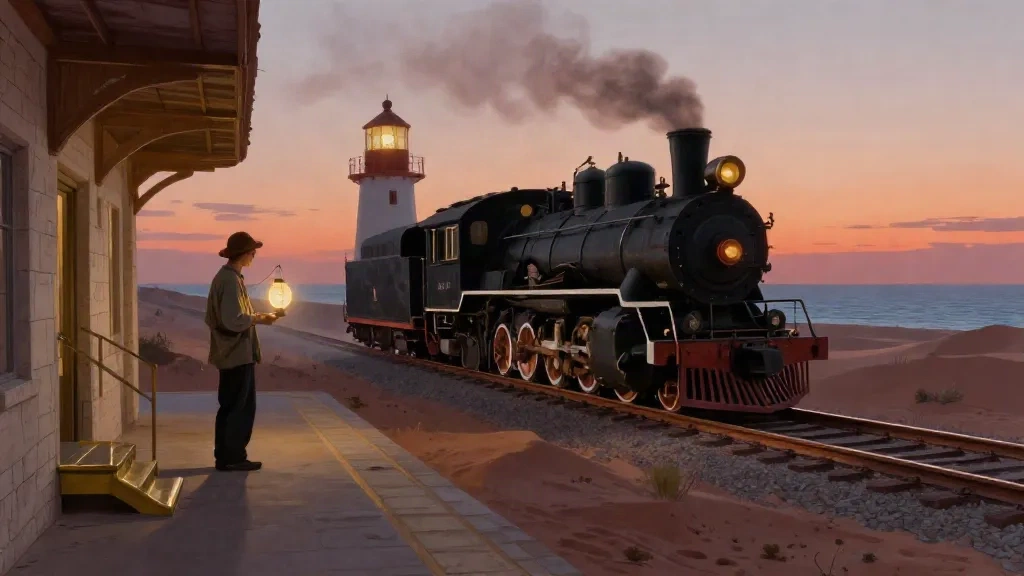
The station clock had stopped at 4:17, though the copper horizon was still bright. Mara Venn climbed the lighthouse stairs with brass instruments ticking against her belt, a paper lantern hooked to one wrist, and a splinter of the small moon cold in her pocket.
She was not a keeper of the sea. The desert had drunk every ocean centuries ago. Her lighthouse guided weather: black-cherry dust, pale-stone sleet, thunder that arrived smelling of wet iron. Each night she catalogued what fell from other worlds, recording pressure, color, duration, and the names the weather claimed to remember.
At 4:18, a locomotive entered the abandoned platform without sound.
Its carriages bore the number 1911. Brass valves hissed. A porter unfolded a ladder, then a signalman carried a lantern identical to Mara’s except for the black cherry painted across its glass.
One passenger remained seated inside.
“Name?” Mara called.
The porter checked his watch. “Once, it was Ilyra Vale.”
The sentence weakened as he said it. His face forgot what his mouth had completed.
The Ordinance Against Impossible Things
Mara reached the carriage as Mayor Oss wrapped a city seal around the conductor’s wrist.
“By the Ordinance of Necessary Reality,” he said, “the train has no scheduled year, the moon fragment is an unlicensed celestial body, and the lantern carries unregistered flame. The woman does not legally exist.”
The doors began closing.
Mara thrust her lantern between them. Flame rose pale as stone, refusing to burn.
“She has a ticket,” she said.
Oss presented a narrow sheet of vellum. Transportation to a place where she is remembered. The destination was blank.
“Then record the fact of her passage,” Mara told him. “You are municipal clerk.”
Oss’s hand shook. He reached for the station ledger, opened it, and stopped. The latest entry read: 4:17. A train arrived. No passenger alighted.
By dawn, Mara suspected, the station would believe the train empty. The porter would forget Ilyra’s face. The ticket would fade. The woman herself would become a name no one could place, then a face no stranger could recognize, then a person the town had never received.
Collective forgetting did not strike all at once. It advanced with impeccable civic order.
An Amendment at Vesper Track
Mara carried Ilyra beneath the station’s single black-cherry lamp. Behind them, workers removed the train’s numbers from the platform. Rails clicked upward into the sand. The small moon rose over the dunes, absurdly close, while the copper horizon narrowed to a strip.
“I remember a beach,” Ilyra whispered. “Salt, gulls, my mother’s hands. Then this station. Then nothing.”
“Remember the order,” Mara said. “Weather first. Details second. Always second.”
At the vesper signal, Mara opened her weather book. The impossible entries filled half the volume: rain falling upward from a red moon; hail shaped like alphabet letters; noon occurring at midnight in a city without streets.
She had spent years proving other worlds could be entered into the municipal record. Now that record became a shelter.
Mara dictated a correction in a clear clerk’s hand.
“At 4:17, train 1911 received one passenger. Ilyra Vale entered beneath the black-cherry lamp. She carried a blue case. She smelled of rain. Her ticket names a remembered place. She was not alone.”
Oss sealed each line with his city stamp.
At she was not alone, the wind changed. Across the platform, every clock resumed. Rails slammed into the sand. The porter remembered the face he had forgotten and ran back with her luggage.
The conductor extended one hand.
“Ticket, please.”
The Name That Held
Mara hesitated. Ilyra’s destination was still blank. Without it, the woman would vanish again with the next municipal forgetting.
So Mara used the paper lantern as a weather instrument. She opened its crimson panel toward the small moon. Pale flame lengthened, bent toward the west, and cast the lantern’s shadow backward along the rails.
There: beyond the copper horizon, a thin line of surf flashed blue.
“That,” Mara said.
Ilyra wrote the beach where my mother remembered me on the ticket.
The conductor smiled. The engine awakened with a heartbeat thunder.
As the train pulled away, Mara watched blue case, lantern, and woman pass through the windows. Ilyra pressed one palm to the glass. Around her, passengers appeared from seats that had seemed empty: herdsmen, children, a silver-haired stranger, all the lost towns the city’s orderly books had closed away.
They watched Mara, and each remembered her.
Then 1911 vanished into the copper dark. The rails stayed. The ledger stayed. And beneath Mara’s latest weather entry, the first line of ordinary pressure read memory arriving from a wetter direction.
She replaced her instruments and began the next day’s catalogue.





