 Netwrck
Romance.
The Note Behind the Green Door
On the first winter morning the museum opened its green door and snow entered the vestibule, dry and vertical, as though it had been poured.
Mara heard it before she saw it. One low clean note rose from every visitor who crossed the threshold and spoke honestly. The note did not come from a throat. It came from the doorframe, from the brass threshold plate, from the person.
“I have never forgiven my brother.”
A chime answered, bright as struck glass, and a man in a wet coat stood ashamed in the middle of the lobby with his hands open.
“I am not afraid of the dark,” said a second visitor, and the note she got was a flat, unlovely thing, and she went out again satisfied.
Mara pressed her fingertips to the doorframe and tuned the unseen chord against her teeth. In the brass gallery a young conservator named Ilyan was replacing a cracked label beneath a painting of a red kite. He worked with a brush he did not seem to be using for paint.
“I wanted to be a singer,” he said, before she asked anything.
His note was tired. It had a golden centre, the way a bell has a place where the metal is thinnest.
“You are one.”
“That is not the same as being brave.”
The note wavered. On the sill beside the paintbrush jar lay a white feather, its quill darkening where the melted snow had got into it. Mara had been picking those up all morning. There were nine on the sill and none in any case.
“That is where I come in,” Mara said.
“You collect them.”
“I have eight years of them.”
“That is not the same as being useful.”
He said it kindly, which was worse.
What the Winter Was Feeding On
The museum had three kinds of door. One for apologies, one for last chances, and the courage doors, which were scattered through the old building like loose teeth: a narrow violet door that required balance, a black door that required surrender, a blue one that opened only after its visitor had confessed a harmless selfishness and been made to feel the size of it.
Every threshold took a payment. Not a coin. One small true thing the visitor had not said aloud to anyone else.
Mara kept the ledger.
Not the museum ledger — her own, ruled into columns by colour, eight years deep, four hundred and eleven notes in her own shorthand. She had a system for the flat ones and a system for the ones that broke in the middle. She had bins under her desk for the ones she was not yet ready to understand.
Her teacher, Eiran Vos, had called that music architecture. Make something that can survive the storyteller. People change. The sound should not. He had said it in the year his voice was gone, writing the words in dust on the studio table because she would not hold the pen for him.
She had been with him eleven weeks. Her brother Tomas had signed the hospice papers and driven out to the coast and not come back, and Mara had spent those weeks learning to take a note down exactly as it was spoken, which is a way of not having to answer.
On the last afternoon Eiran had tapped the table twice and she had leaned close.
You collect, Mara. You never give one away.
She had gone on collecting. The museum had given her a small room under the stairs for it. People came in from the snow and confessed and waited, and the doors gave back a chime, and the chime was a closed door, and Mara heard the chime and thought: that is a response. That is enough. They did not come for me.
The winter grew in proportion. It did not grow on cruelty. It grew on deferral — on every sentence somebody did not finish, every letter folded and put in a drawer, every apology scheduled for a season when it would cost less.
In the confessional box outside the blue door there were three hundred and nine folded papers. They were not addressed to anyone. The box was for the harmless selfishness you had to hand over to get through, and people had started using it for everything else, and the staff had stopped reading them because reading them took an hour you did not have.
One of them was dated the year before the ice reached the third gallery. The hand was Tomas’s.
Mara saw the handwriting and put the box lid down with the flat of her hand, the way you close a lid on something alive.
A Winter Measured in Generations
By the following winter the ice had reached the third gallery. It did not melt. Children born beneath it grew tall enough to unlock doors their parents had shrunk from. Birds stopped migrating over the lake and hung there in the cold like a notation nobody could resolve. Once a year the lake gave a deep metallic groan, and the whole building felt it in the teeth, as if something enormous were practising the same note again and again and never getting it right.
The visitors came anyway. They told their truths to the doors and waited for answers.
Ilyan brought Mara silver spoons. He carried one in his coat, polished to a small moon, and set it beside her tuning fork each morning before he went to his labels.
“My grandmother gave me this,” he said. “She says it was carved for a baby who survived a winter by eating snow.”
“Does she say the baby was you?”
“She says it was carved for a baby.”
He said it lightly. He was careful with lightly. In the coldest months the spoon’s bowl held a single marigold-coloured reflection, and he looked at it longer than a man looks at a piece of silver.
“Why bring me spoons?”
“Because you listen for what people say. I want somebody to notice what they do.”
He fed the museum’s furnace with discarded tickets, winter coats, wooden frames, the paper backing of broken labels. He carried buckets of ash through the frozen galleries and stacked them by the wall in careful cones. His truth-note strengthened through the season, bright and low, and he still refused to sing.
Mara built the resonance chamber in the middle of the courage wing. Copper wires ran up through the plaster, gathered in bundles, branched to the doors. She wanted a final movement: a sustained chord that would stay in the walls after the last speaker had gone out into the snow. A room where the museum’s whole winter could be held in one note.
“You are building a machine,” Ilyan said, watching her solder.
“I am building a room.”
“They are the same thing this month.”
When she raised the bow, every wire sang the same flat tone.
Not the minor third. The unison. Flat. Dull. The sound of a hundred people saying probably at once.
“The winter has taught the doors to accept doubt only,” she said.
“Yes.”
“Why?”
“Because it is the only thing still being offered.” He set down his brush. “Look at what comes through your door, Mara. Four hundred notes a winter and not one of them answered. A man came in October and told the red door about his brother and it chimed and he stood there and waited for the chime to turn into an answer, and it did not, and he went out thinking he had been told he was unforgivable.”
She had kept his note. It was in the ledger, third column, a hard little sound with a crack in it.
“That is not fair,” she said.
“No,” he said. “It is accurate. Those are different, and I have found that accuracy is the one people can survive.”
His note broke as he said it. He covered it by picking up the brush.
“All right,” Mara said. “Say the rest.”
“I did not tell you why I wanted to sing.” He turned the brush over. “My voice is clear. That is the problem. When I sing, people believe the sorrow in it. All of it. My mother heard me hum a tune once when I was eleven and went home and did not speak to my father for a week, and he had done nothing at all. So I stopped. A sorrow that clear is a weapon and I was nine years old.”
Mara lowered the bow.
“Then we do not make a machine. We make a room where two people can be unfinished.”
“That is not architecture.”
“No. It is the only thing I can promise.”
The Chamber That Could Only Hold
They did the arithmetic in the new year. The chamber needed the notes to fix them; the notes needed somewhere to go; the only place in the building the notes already wanted to be was Mara’s ledger. So she began to give them away.
She gave a note back to a woman who had confessed a cowardice in 1911 and spent twenty years apologising to a sister who had died not knowing. She gave the hard cracked note from October to the man with the brother, and he stood in her little room under the stairs and listened to his own sentence played back to him on a brass plate, and then he said, “Oh,” and sat down on the floor, and then said, “Oh, that is not what I thought it said.”
It was not absolution. It was worse and better. It gave people the exact size of their own sentence, which was almost never the size they feared.
It also cost her. Four hundred and eleven notes went out of the house in eleven weeks. The bins under the desk stood open and empty. She found herself unable to sleep, and then she found she could sleep, and that frightened her more.
And then the coat.
In the third week of February a man came through the green door asking whether a grey wool coat had come in, the lining torn at the shoulder, initials stitched inside the collar. He had left it on a bench in the second gallery in the autumn, meaning to return, and had been ill since.
Ilyan knew where it had gone. Everyone on staff knew where it went; the ash cones were stacked by the wall and the coat had been one of the good ones, which meant a full bucket.
“I did not put it in,” he said. “But I signed the disposal sheet.”
“And you burn things people leave behind.”
“I burn things that would otherwise rot in a corner for eleven months while somebody decides.” He was not defensive. He was worse than defensive; he was stating the terms of himself. “I have put twelve letters in that furnace. I have burned a wedding photograph. I do not do it for pleasure, Mara, I do it because this building is falling apart and there is one way in. But I do not pretend I am not the one who chose.”
“You could have said no.”
“Yes.”
“Say no this time.”
“This time it is already ash.”
He looked at her for a long moment, and his truth-note went thin and honest and did not cover a single thing.
“Then tell him it burned well,” he said. “Tell him the lining was the best part. That is what I would have wanted, and I am not going to pretend I am bigger than the man who wants his coat back.”
She told him. He thanked her, which made it worse. She wrote the coat in her ledger, in the column for things she should have said, and left it there.
What the Doors Could Not Hold
That night the white feather went through every doorway in the museum at once, turning slowly, unhurried, the way a page turns in a room where nobody is reading.
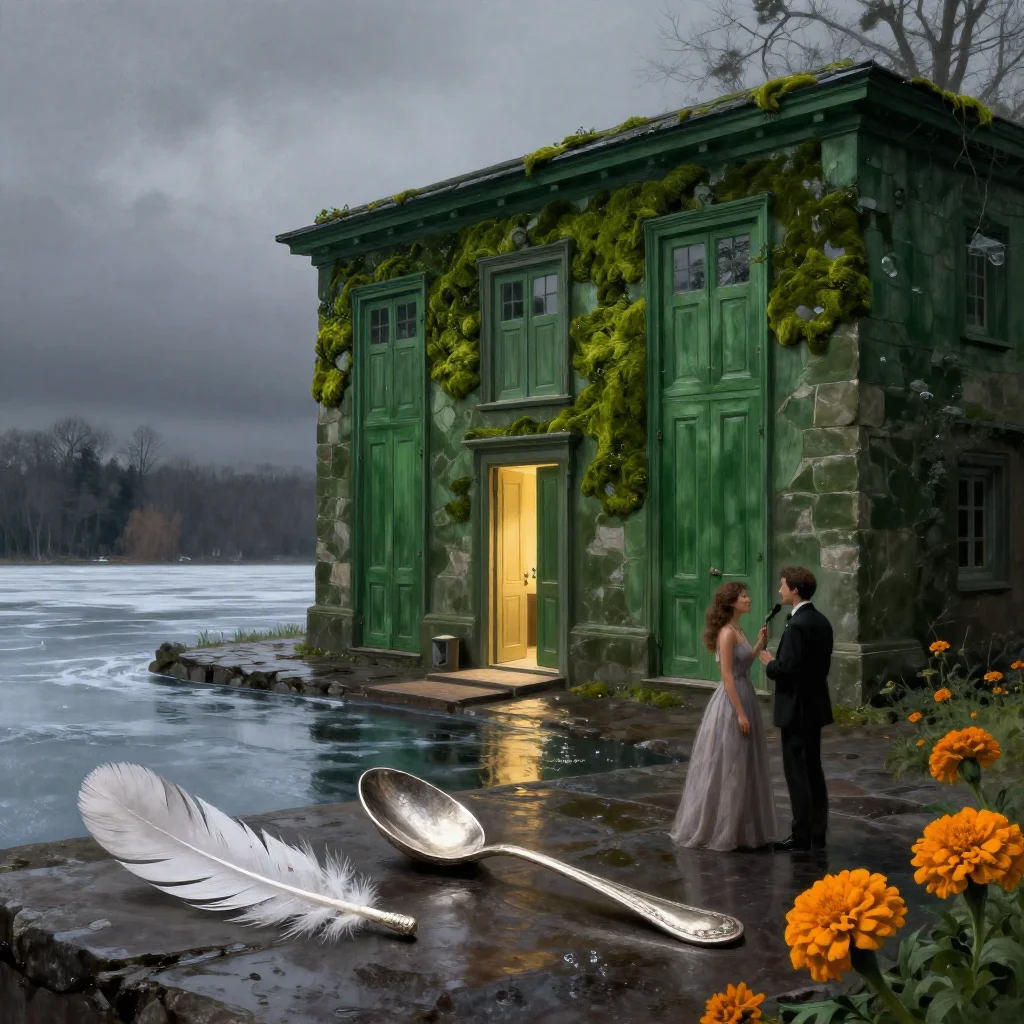
The silver spoon was gone from the worktable. They found it in the morning outside, half buried in the lake ice, its bowl holding a marigold petal and a small handwritten note.
Begin where the warmth ends.
Neither of them had written it. Ilyan turned the spoon over and looked at the back of the paper as though the back might explain itself.
“My grandmother never wrote anything,” he said. “She only told.”
Together they broke the chamber. Mara cut the copper out of the plaster in long bleeding strands and Ilyan ran them out along the corridors, thumb and forefinger, and the wires went where the doors were and nowhere else — one to the red, one to the violet, one to the black, one to the blue, and one bare length left with no door at all, snaking down the back stair into the room under the stairs where the empty bins stood.
Each threshold received a different truth-note, and the winter came up through the floor to swallow them all. Frost sealed the red, the blue, the violet. Ice sealed the black one, and then the walls, and then the sound of the furnace.
Mara played anyway.
She played Ilyan’s imperfect note underneath her own, an octave down, and gave him the entry. He stood in the courage wing with his mouth shut for four measures, five, and then he sang. Not well. He sang the way a man walks onto a bridge. His voice went into the wires and the wires went into the plaster and the walls gave back every chord she had ever taken down, unsorted now, all of them at once: grief as a warm bass, courage as a sudden high interval, apology as a path that turns and comes back on itself.
The winter stood up around the building.
For one breath the lake was a vast silver spoon, bowl up, holding the whole grey sky. The feather lifted. Marigold light ran along the green doors and every locked threshold opened at the same time, and the sound stopped being a note and became weather.
People came through carrying the things they had kept from the winter.
“I forgave him,” a woman said, and it did not have to be true forever, only true today.
“I am still angry,” said the man with the brother, and the room took that too, without a note of preference.
“I chose myself,” a child said, and her note was the highest thing in the building.
They did not agree. That was the point. They were not one beautiful lie. They were a chord with room inside it.
And in the fifth hour, with the marigold light going out of the corridors one gallery at a time, a man came in through the green door holding a folded paper he had carried for eight years, and put it in the confessional box, and stood there with his hands in his coat pockets until Mara came out of the courage wing with wire burns on her palms.
“Tomas,” she said.
“I heard you,” he said. “Through the walls. I put it in the box in November and I have not been able to open it since, which is a thing I would like you to notice about me, because I have waited eight years to be the kind of man who says a thing out loud and I am not.”
She took the paper out of the box. It was soft as cloth. She did not open it.
“You can keep it,” she said.
“I would like to keep it,” Tomas said. “I want you to know that I am not asking.”
“I know.”
“I am going to say one true thing and go home, and it will not be enough, and that is the correct size of it.” He looked at the broken chamber. “You made a room.”
“I made the end of a room.”
“It is the first thing you have made that is not a record of what somebody else said.” He went out. The note he left on the threshold was so low that the wires gave it up only after his footsteps had gone.
The Room After the Storyteller
The ice withdrew without ceremony. Spring came first to the gutters, then to the trees, then to the old doors, and the staff found leaves on the floor of the brass gallery in shapes like small hands.
The trustees were not pleased. A resonance chamber had been commissioned in 1911 and there was no chamber. The registrar pointed out, correctly, that a room strung with loose copper that terminated in nothing measurable was not a collection, a performance, or an instrument, and could not be justified on any schedule. Mara gave up the commission, the key to the strong room, and the right to be called keeper. She kept the little room under the stairs. The bins stayed empty and she left them empty, and once a year she swept them out and put nothing in them.
Ilyan sang at the courage doors every Sunday, and whatever came through, he took at the tempo it arrived. He never made a record of it. When asked why, he said that the ledger was a machine for turning a person into a thing they could be held at arm’s length from, and that he had been that person, and it had cost him his father’s marriage, and he was not going to be the man who did it again with a better excuse.
Mara did not finish the sustained chord. She left the bare wire down the back stair, and it carried whatever the doors carried, and it never held a sound longer than the speaking of it.
Years later, when her fingers had slowed enough that she could not keep time on the tuning fork, a young visitor came up the back stair with a silver spoon in both hands, because she had found it in the lake in spring and had brought it to the door that had made it sing.
On the wall hung a white feather. Nine more lay on the sill, and one had been cleaned and mounted under glass with a label that gave the date and nothing else.
“Who built this?” the child asked.
“Two people,” Ilyan said, “who were afraid they would be forgotten.”
“Are you?”
“No,” he said. “That is what the room was for, and it worked. Listen.”
The wires took the child’s note and gave it back with a second voice under it, low, from the walls, from the bare run down the stair: the one held back for eight years, dull and unfinished, saying probably in a hundred registers, and beneath that, since it had nowhere to go but out, the room answered.
Then he smiled, and the room gave its honest note.
High, low, broken, bright: the sound moved through the open doors and out across the wet stone, where it did not stay, and did not have to.





