 Netwrck
Hopeful Science Fiction.
The Theatre of Unfinished Things
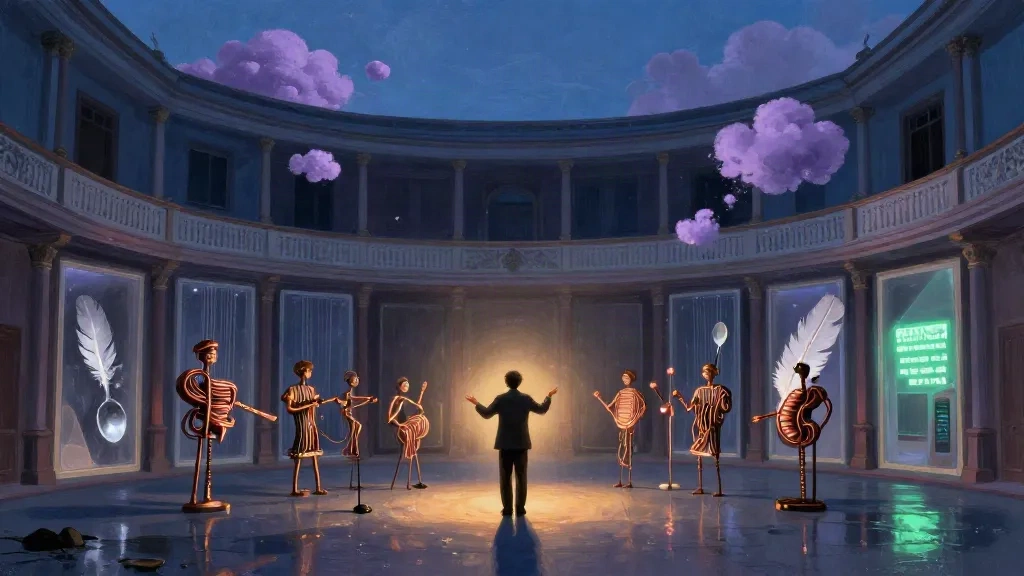
Every morning, Mara unlocked the theatre before the street had decided what colour to be. Lavender light gathered beneath the broken skylight. Wet asphalt gleamed beyond the doors, and the pharmacy sign across the lane cast its green blessing over the pavement.
The theatre performed endings that had never happened.
Not the tidy kind. A bride walked away from an empty church. A child boarded a train with a letter in her pocket. A city sank beneath a sentence no one had finished. In the basement, under a door painted winter-white, the discarded endings waited in rows, each one ticking softly inside its frame.
Mara was the theatre’s musician. When someone spoke truthfully, she heard a new note rise from the floorboards.
The note depended on the truth. A small lie produced a stale dissonance, a comfortable omission a minor hum. But honesty sounded like glass being struck in a room full of water.
Her mother had told Mara, before the winter began, that a life could be built so sturdy it would survive its storyteller. Mara had not understood then. Now the snow had buried three harvests, four birthdays, and every road out of the valley. The cold had entered the schools, the hospitals, even the roots of the orchard trees. One generation was learning to live beneath it.
Mara’s concrete desire was simple: to build something that could survive the storyteller.
She wanted to make a song no death could silence.
The Note in the White Feather
In the prop room, she found a white feather resting inside an overturned piano and a silver spoon polished bright as a small moon. The feather belonged to an ending in which a messenger crossed the frozen river carrying spring in her sleeves. The spoon belonged to an old woman who had survived by feeding one grain of wheat to the winter.
Both endings were worthless on their own. One had never reached the other side. The other had ended with the grain spent.
Mara placed the feather across the piano strings and struck the spoon against them.
Truth is not an answer. Truth is the pressure beneath the answer.
A note answered from beneath the stage.
Not one note, but hundreds. The discarded endings began to stir. Behind their doors, footsteps accelerated. A city surfaced from its floodwater. A child opened the letter. The bride returned to the church, though the ending had already been declared impossible.
Mara wrote down the notes as fast as her fingers could move. She built a machine of tuning forks, copper wire, piano hammers, and the silver spoon. The white feather served as its switch: whenever a person told the truth inside the theatre, the feather trembled and released another sound into the network.
At first, the machine was fragile. A single lie bent the wires. A frightened voice made the feather go still. Mara tightened the joints and began recruiting the audience.
“Say what you need,” she told them. “Not what is polite. What is true.”
When Winter Refused the Chorus
On the seventh night, the machine played through every abandoned ending in the theatre. The sound rose through the walls and crossed the snowbound streets. People opened their windows. Some confessed small things: a stolen coin, a hidden illness, a love mistaken for hatred. Others confessed enormous things, enough to make the feather shake like a bird trapped beneath glass.
But winter did not break.
It answered with a low, patient moan. The theatre’s pipes froze. Snow sealed the exits. A silence entered the audience, so complete that Mara could hear her own pulse.
Then a boy in the last row stood.
“I am afraid,” he said. “Not of winter. Of what will happen when spring comes and nobody remembers what we survived.”
Mara heard the note.
It was the purest sound in the building.
She pulled the white feather from the machine. The choir fell silent. Then she placed it in the boy’s hand.
“Then we will leave something,” she said.
The machine did not need her to hold it. Nor did the song need her to sing it. The silver spoon began ringing against the piano strings. The feather carried the note from speaker to wire to window, passing through every truthful voice in the theatre.
Outside, the snow thinned.
Not quickly. Not with the theatrical convenience of a single sunrise. A black seam appeared along one frozen gutter. Green pharmacy light flickered through the thinning air. Somewhere beyond the roofs, a bird tested a single, uncertain call.
Mara’s hands were bleeding. The machine had taken no blood, only the warmth required to keep its circuit alive.
She understood then what her mother had meant. A thing built to survive its storyteller must learn to speak without the storyteller.
She opened the doors.
The winter entered first, carrying the smell of iron and lavender. Then the people followed, carrying the feather and the spoon, the song continuing ahead of them.
The Ending That Continued
By morning, the theatre had become a workshop. The discarded endings were no longer performances. They were blueprints. Children tuned the forks. Engineers repaired the copper wires. Old people spoke their memories into the microphones, not for applause, but for the next generation.
Mara rested in the pit beneath the stage. Above her, the machine played a soft arrangement built from the first truths she had ever heard: her mother saying, I will miss you. The boy saying, I am here. The whole audience saying, We remember.
No one called the song hers.
That was the proof it had survived.
And when the first green shoot pushed through the theatre’s cracked floor, it rose beside the silver spoon and rested beneath the white feather, waiting for the next true note.





