 Netwrck
Hopeful Science Fiction.
The Note Under the Floor
At the desert observatory, every truth had a pitch.
Mira heard it first when a courier confessed that the government had sealed the western road. The lie beneath his words arrived as a grinding whisper, but the truth was a bright C, sudden and clean as struck glass. She wrote it on the observatory floor with chalk. By sunset, three more notes had appeared beneath the dunes, carried by people who had stopped pretending.
The observatory had been built for stars that sent messages. Its copper dishes pointed upward through the dry violet air, while its sleeping quarters crouched below ground against the heat. For three hundred and sixty-five nights each year, Mira’s small team listened for patterns in the static. On the three hundred and sixty-sixth night, the stars began sending the same seven notes.
Then winter came.
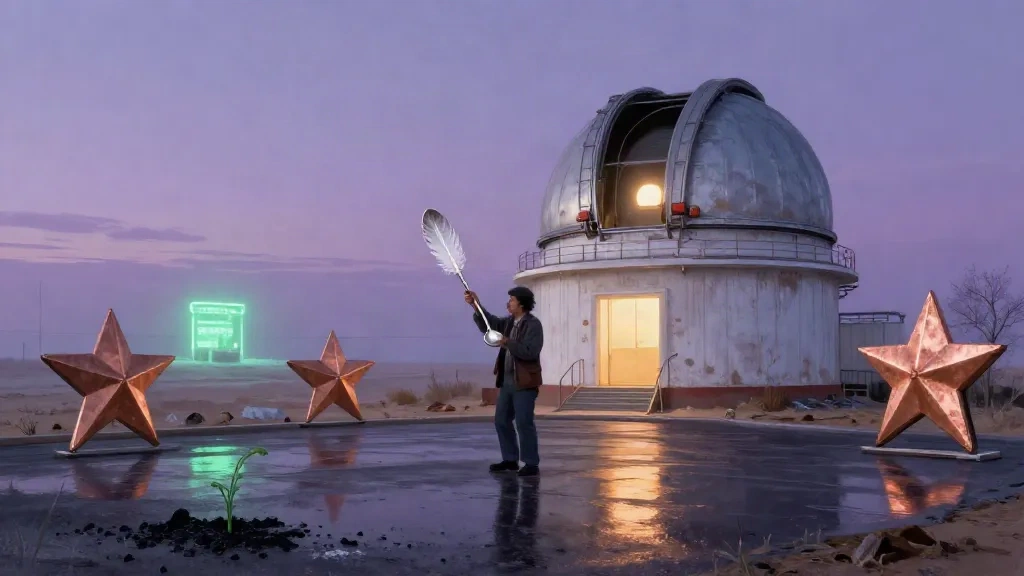
It did not arrive as snow. Frost silvered the observatory rails overnight and filled the wells with black ice. The desert turned wet beneath the lamps, asphalt-dark, and beyond the fences the dunes froze into enormous motionless waves. Planters shut their pharmacy signs, though the green neon still glowed through the dust.
An Instrument for the Missing
By the first spring, nobody remembered spring. By the second, the youngest children believed winter was the world’s original condition.
Mira’s hearing had changed. Truth still made music, but lies now pressed against it from every side: lies about grain, about fuel, about the stars. Her body shook with the effort of sorting them. She had one idea, stubborn and practical.
She would build a machine that could remember the truth without her.
Not a recorder. A sounding archive: forty-eight tuned metal reeds, each connected to a pressure membrane. When a person spoke a truth, the machine would isolate its note and hold it in resonance. A child could touch the reed years later and hear the words as music, clear enough to understand.
She began with a silver spoon from the mess hall, bending its bowl into a delicate resonator. A white feather from the aviary had lodged in the ventilation grate; she fixed it beneath the spoon’s handle so it would tremble with each note. The combination looked accidental. It was not. The feather caught the faintest truths, while the spoon multiplied what the winter tried to muffle.
By the sixth generation of frozen children, the machine had three thousand voices. Farmers spoke of buried wells. Nurses spoke of fevers. A shy mechanic confessed that he had been too afraid to repair the greenhouse furnace.
The Winter’s Long Silence
Then the stars went quiet.
No more messages. No more seven-note warning. The observatory’s dishes turned beneath a lavender sky, searching empty space. Winter tightened. The green of the pharmacy signs reflected in the ice like small infected wounds.
Mira knew the machine was not built for this. The archive could preserve truth, but it could not make water, heat, or wheat. As she adjusted the reeds, she began to hear lies inside the old truths: the courier had told the truth about the road but lied about the reason for sealing it. The farmer knew where the wells were but had hidden one from everyone else. Even love arrived carrying its small concealments.
Her youngest assistant, Niko, asked whether an honest song could survive an incomplete singer.
“No,” Mira said. “That is why we need witnesses.”
She set the instrument beneath the largest dish and played every saved note into it. The sounds rose through the observatory, across the frozen desert, and up where the stars ought to be. The machine could not mend the world. It could only insist, in a hundred thousand voices, that the world had once been different.
What the Spring Heard
On the three hundred and sixty-fifth day, Mira opened the observatory door.
There was no thaw. The air remained white with frost, and the asphalt shone beneath the purple moon. But from the buried gardens came a sound she had no name for: a crack, a gasp, one green shoot forcing its way through frozen soil.
Behind her, the machine began to ring. Not with one voice. With all of them.
People emerged from shelters and schools, carrying cups, tools, and ledgers. They touched the reeds one by one. The courier heard his confession and wept. The mechanic heard his own hidden fear. Children laughed at the strange, stubborn music of the past, then carried it toward the gardens.
Mira opened the white feather and silver spoon one last time. The spoon reflected the lavender sky. The feather trembled in a wind no calendar had recorded.
Then the first warm rain struck the observatory roof.
Mira did not believe the machine had survived her. She believed she had taught it how to survive everyone, including the truth-tellers who would come after.





