 Netwrck
Hopeful Science Fiction.
The Note Under the Bridge
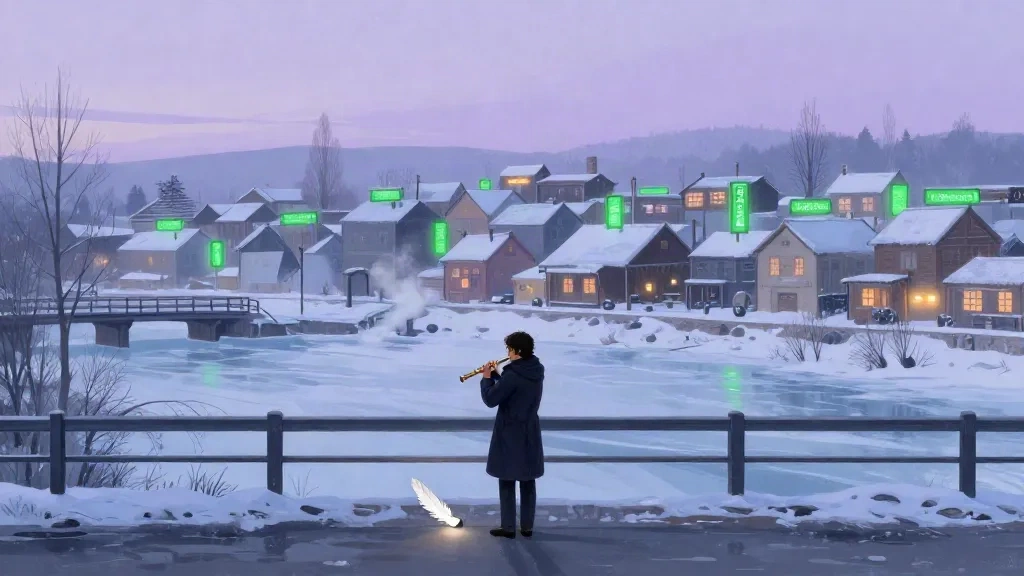
On the morning the winter failed to end, Mara Venn crossed the Sallow Bridge with a white feather tucked behind her ear and a silver spoon in her pocket.
Every bridge in Bellwether was a promise made visible. Iron ropes held the wish of one neighbor to another. Stone arches remembered the hands of builders long gone. Below them ran the Witness, a brown river that seemed to keep everything the town had promised and failed to keep.
The river had frozen for eleven months. Snow packed the roofs of the pharmacy and turned the green of its signs into pale, underwater stars. No train had crossed in a generation. No child had grown tall enough to inherit the orchards behind the hill.
Mara carried a bone flute and a leather case of tools. She was a musician, though these days people came to her for a different kind of listening. Whenever someone told the truth, she heard a note.
A confession in the bakery rose through the floorboards, bright as struck glass. A widow admitting she was lonely made the kettle shiver. At the bridge tollhouse, a constable said, “I was afraid,” and the air around him rang with a low silver chord.
Those notes had no place in a song. They appeared only when the lies had been stripped away. Mara had begun collecting them in a battered ledger, though she could not explain why.
What Winter Allowed
The old warming hall had a boiler with a cracked heart. The town’s last working engineer, Ilyan Sore, said its fire would last until the next thaw. No one under thirty believed there would be another thaw.
“We need something that can survive the storyteller,” Mara told him.
They were standing beneath the pharmacy’s green lights, watching sleet harden on the bridge railings. Ilyan looked at the river, then at her case of tools.
“You mean the person telling the story.”
“I mean the voice. I want to build a choir.”
Her plan was simple enough to be foolish. A hidden mechanism beneath the old hall would gather the notes born from truth and turn them into heat. A network of copper tubes would carry that warmth through the walls, under the bridge, and into the frozen houses. When the first thaw finally came, the town would remember that it had not been abandoned by the future.
They worked in shifts, their breath clouding the air. Ilyan soldered junctions. Mara tuned resonators from soup bowls, discarded cans, and the cracked bell of the drowned clock tower. Children carried ice into the basement and watched for shapes in the stone. Old women brought songs they had never performed in public.
Some of those songs were false. Mara heard nothing.
But at the first council meeting, a child confessed that the warming hall had been built over a graveyard. A merchant admitted he had hoarded seeds. The mayor said, without looking at anyone, “We knew the winter was changing. We did nothing.”
Their notes entered Mara’s ledger in silver and blue.
The River’s Verdict
By the second winter, the river had cracked from bank to bank. Wind rose through the gaps with a voice like distant bells. The pharmacy signs were the only bright green left along the avenue.
The choir worked. Not enough. The mechanism warmed one room at a time, and each room became a promise of its own. A nursery stayed above freezing. A bakery kept its ovens banked. In the tollhouse, strangers learned to sleep without dreaming of spring.
Then the river spoke.
It did not produce a note. It produced silence, so complete that Mara felt it behind her eyes. On the opposite bank, the ice opened.
Thousands of tiny black shapes moved beneath the surface. Fish, perhaps. Or the drowned leaves of a remembered forest. They pressed against the underside of the bridge, and every promise the bridge had ever held trembled.
“It knows we made a machine,” Ilyan said.
“No,” Mara replied. “It knows we’re listening.”
She lowered the silver spoon into the water. Its reflection looked like a narrow moon. The white feather in her hair lifted in a wind that came from below the ice.
Then the bank gave way.
Water poured into the excavation around the warming hall. Ilyan shouted for the children. Mara seized the ledger and ran toward the bridge.
The Song Afterward
She played her flute while the river rose.
There was no melody at first. Only breath, then a low note from the confession of a stranger, another from a ferryman who had forgotten how to lie, and another from the mayor, who finally admitted he had been frightened since the first snow.
The choir answered. Copper tubes trembled in the walls. The nursery, bakery, and tollhouse glowed against the storm as their stored truth became heat.
The flood reached the bridge’s highest stones and stopped.
Not because the river surrendered. Because the bridge held.
By spring, Bellwether had a new law: every public promise would be spoken beneath the river’s witness, and every child would learn to record the notes.
Mara did not live to see the second generation finish the work. Before she died, she taught a boy named Tomas to listen for the smallest true sound. He found one in a sparrow landing on the warm bridge rail, one in his mother’s tired breath, one in the river itself.
Years later, travelers came from distant towns to hear the choir beneath the green pharmacy lights. They said it sounded like a promise.
But the one who built it knew better.
It sounded like a promise being kept, long after the voice was gone.





