 Netwrck
Magical Realism.
The Seed’s Sleeping Room
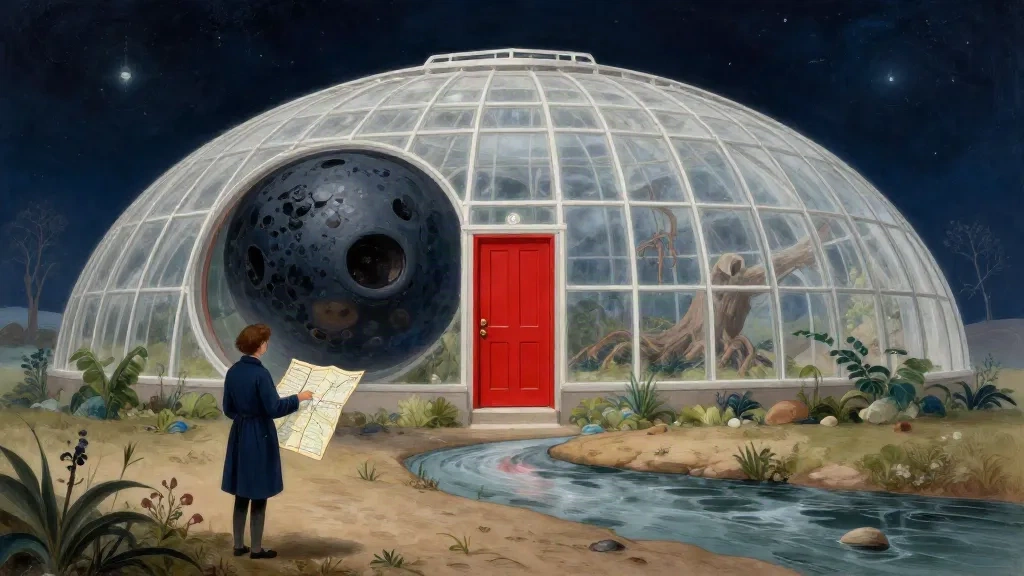
On the night the greenhouse forgot its orbit, Mara found a red door inside the seed vault.
It had no handle, no hinges, no number. Its paint was the only red aboard the station, a narrow flame in the pearl light of the hydroponic galleries. Beyond it, machines slept in rows beneath condensation-bright glass. Each one dreamed in weather.
Mara was paid to translate their dreams for the waking passengers. A machine dreaming of frost meant a sealed pipe. A machine dreaming of birds meant a nutrient line failing. A machine dreaming of open sky meant it had begun to remember the forest before humans learned to name it.
The seed at the greenhouse’s heart was called Vesper, though nobody knew who had given it that name. It remembered extinct forests: cedar forests swallowed by stone, elm forests drowned beneath cities, a yellow birch country erased by a disease that moved through seedlings faster than news.
Mara had received a map of Vesper’s dream. The map showed neat black rivers, green borders, and a blue basin where no basin had ever been recorded. It was beautiful, exact, and wrong.
Her assignment required a better map than the one received. That was the whole of her private ambition, though she kept it hidden from the station because ambition made the sleep machines restless.
The Promise Under the Bedrock
When Mara translated the oldest machine, it spoke in her mother’s voice.
“We agreed to forget the dry riverbed,” the machine said.
The sound arrived without heat or breath. Mara’s hands stopped above the interface.
Her family had no history of machines. Her father said they had inherited the station from a distant cousin. Her brother said they had purchased it from a bankrupt agricultural company. Her mother said they had built it together, one greenhouse corridor at a time, before Mara was born.
Each version contained the same promise: the family would never speak of the dry riverbed.
Mara found the bed where her mother had slept during the first winter. Beneath its frame lay a strip of dry gray sand. She had thought it spilled from a cargo tray. Now she understood it was riverbed, perfectly preserved in a climate that could no longer produce rivers.
Inside the sand waited a small brass compass. Its needle pointed not north but downward.
The compass led to the unmarked door.
When Mara opened it, she found Vesper’s root chamber. The seed floated in a shell of clear water, enormous and dark, its surface covered with leaves that appeared only when no one was looking directly at them.
The chamber floor was divided into two channels. One held pearl-colored water. The other was dry.
Her father appeared behind her. “Your mother promised we would take the sleeping machines away,” he said.
Her brother stepped from the opposite passage. “You promised to leave the forest to Vesper.”
Her mother stood between the channels, carrying a folded map. “I promised our children a home that would not become a grave.”
They argued until the glass walls began to tremble. Their memories multiplied: the riverbed had been a birthplace, a burial ground, a market, a place where the first settlers buried a machine that would not stop dreaming.
Mara understood then that the promise had been broken every time it was repeated. A promise requiring agreement could be used as a lock. A promise made from several versions could keep everyone inside it.
Drawing the Missing Water
She took the machine’s dream from the root chamber and carried it to the map table. The machine had been running since before the greenhouse was built. Its dream contained no pictures, only pressure and waiting.
Mara lowered the brass compass into the map’s blue basin.
Water rose through the paper.
It did not make a river. It made a line through every lie the family had placed around the dry bed. The red door appeared on the map, then multiplied: one door in Vesper’s chamber, one in the sleeping room, one in Mara’s childhood home, and one beneath the root.
She began drawing by hand. Her pencil traveled over the station’s compartments, recording where the machines had been kept and what they had refused to forget. She drew the extinct forests as roots rather than ruins. She drew the dry riverbed as a living border.
Her father tried to stop her. He said the old map was needed to guide the station through the next orbit. Her brother said the machines would wake if they saw their dreams translated. Her mother only watched the red door in the paper.
“A map is not a promise,” Mara said. “It is a record of what survived.”
She completed the final line as Vesper’s leaves opened. A scent of rain moved through the root chamber, though there was no water in the sky. The sleeping machines began to speak in different voices. Some called her by name. Some called her stranger.
Mara left the last page unfinished where the river should have been. The blank space was not an absence. It was permission for whoever came after her to discover the route.
The Door That Opened Outward
At dawn, the station’s managers arrived and found the red door open. Behind it, the dry riverbed had acquired a thin silver stream.
It did not restore the extinct forests. Magical realism is not restoration. The elm trees did not return. The cedar roots did not climb the station walls. The seed remembered what humans had lost, and memory could not make the world repeat itself.
But the stream moved through the sleeping machines. Their dreams stopped being private weather. A machine once dreaming of frost dreamed instead of the dry bed opening into a blue field. Another dreamed of names carried downstream.
Mara’s family stood on opposite banks. The promises between them had not become true. They had become legible.
She kept the original map folded beneath the new one. Its black rivers and impossible basin remained as evidence of what had nearly been accepted. Then she carried the compass through the red door and stepped onto the stream’s new bank.
Behind her, Vesper’s hidden leaves trembled in the pearl light. Above, the greenhouse wheels turned around a sleeping seed. The map in Mara’s hands was no longer a command to return.
It was a direction.





