 Netwrck
Romance.
The Door Beneath the Dunes
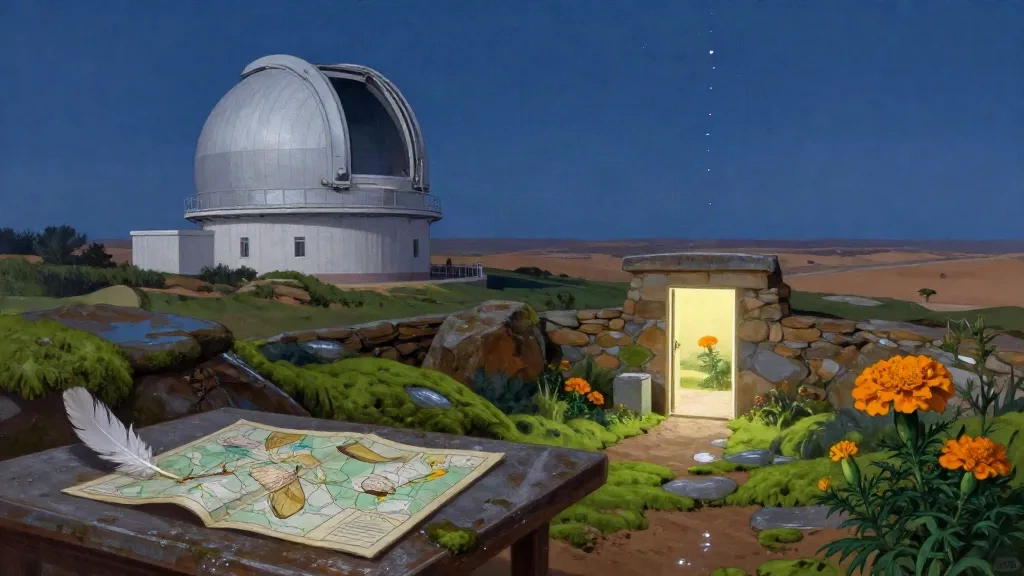
At the edge of the Qarr salt basin, where the observatory dome shone like a half-closed eye, Mara Vale kept a map of places the desert had swallowed.
She had been a cartographer for forty years, tracing roads, wells, caravan routes, and the vanished villages named in old travelers’ records. Retirement had not quieted her hands. Every morning she sharpened her pencils, boiled the brass kettle, and drew until the white sun climbed above the dunes.
Her maps were unlike ordinary maps. On them, she could draw a door.
The door had to belong to a place that no longer existed. She never opened one. The door was only an admission, a narrow threshold through which the lost might return to view.
For three years, Mara had searched for a place where lost things could rest. Her sister’s red scarf. Her mother’s brass thimble. The blue cup broken on the night her family left the valley. She wanted somewhere with shade, water, and no wind: a place for objects that had outlived the hands that loved them.
On the seventh evening, a message arrived in the observatory.
It was written in starlight on the brass plate beneath the telescope. The ink shifted whenever Mara looked away.
COME TO THE MARKET OF TRUE PRICES. BRING ONE THING YOU HAVE REFUSED TO LOSE.
Below the letters lay a pale moth wing, soft as a petal.
The Market of True Prices
The market appeared beyond the western ridge, though Mara had crossed that ground for years and seen only stone. It assembled itself between one breath and the next: awnings of woven black cloth, tables cut from meteor iron, lamps burning with a yellow light that gave no warmth.
The stalls sold memories.
At the first, a woman offered a summer when the river ran clean. At the second, a boy offered the sound of his sister’s laugh. A merchant displayed a silver key that opened a childhood home, though the house had been gone for forty years.
The expensive things were always true.
Mara understood the price before asking. A merchant named Oren sold certainty: the knowledge that a person had loved you, still did, and would remember you when the stars burned out. A vial at the next stall held the final word of a dying language, sealed in blue fire.
“You,” Oren said, stopping before her, “would like a place where lost things can rest.”
His coat was dark green, buttoned to the throat. A white feather was tucked behind his ear.
Mara touched the moth wing in her pocket. “Do you have one?”
“I have the map to it. The map is cheaper than the place.”
He placed a folded square of paper on the table. It showed a low building with no doors, its windows filled with wet stone. A single marigold grew from the roof.
Mara knew the place. She had drawn it once, years ago, after hearing the story of a house that sheltered travelers who had lost their way. Then the river changed, the village vanished, and the house had been erased from every official chart.
“The map is not enough,” she said.
“The map is the price.” Oren tapped the paper. “The place is behind it. Bring the thing you refused to lose, and I will take you there.”
Mara opened her hand. Inside was a white feather, stiff with age, found in her mother’s garden after the funeral.
Oren’s expression softened. For the first time, he looked less like a merchant than a man waiting for a train that had missed its station.
“That feather belonged to your mother,” he said.
“How do you know?”
“Because you have carried it longer than you have admitted.”
The observatory bell began to ring. Across the basin, the stars answered in low, coordinated pulses. The signal was stronger than any Mara had recorded.
On the map, a door appeared where the windows should have been.
A Place That Remembered Her
They crossed the market as the lamps began to go dark. Stalls folded into themselves. True things vanished with the false, leaving only the paper map in Mara’s hands.
Oren walked beside her, his steps uncertain. He had not asked for the feather. He had asked for her map, and she had given it willingly.
At the ridge, the desert opened.
The house stood where the map promised, though it was larger than the paper had shown. Wet stone shone under the moon. Moss covered the walls, and a narrow courtyard held a shallow pool beneath a marigold tree. Lost objects rested there: a child’s sandal, a ship’s compass, a red scarf that snapped gently in air that did not move.
Mara’s mother’s thimble sat on the pool’s edge.
She crossed the courtyard and picked it up. For years she had imagined finding it, but the imagined moment had never contained this silence, this impossible care.
Oren stood beneath the marigold. His coat had loosened. A strip of red cloth showed at his sleeve.
“The market takes true things,” he said. “Not because they are valuable. Because people pretend they are ordinary.”
Mara looked at him. “Your sister?”
“My map.”
“The one that opens every place that no longer exists.”
He nodded. “I lost it when I stopped being sure where home was.”
She understood then that the expensive things were not memories. They were anchors. The market sold the truth people needed to stop wandering.
Oren had been searching for his own map, and she had drawn the door that found him.
“You knew my hand,” he said.
“I knew the line of a missing road.”
He took the feather from her fingers. Their hands touched, dry and warm. Above them, the stars pulsed, and the observatory answered with one bright, deliberate flash.
Mara placed the moth wing beside the thimble.
Oren placed the feather beside the wing.
The pool brightened. Inside it, a small door opened onto a country of vanished houses, each window holding a star.
“Will you stay?” he asked.
“Not here,” Mara said. “But I will draw the way back.”
She took out her pencil. For the first time in three years, she drew a door with a handle on the other side.
The Way Back
They returned before dawn, the map folded safely in Mara’s coat. The market had vanished. Only wet stone remained beneath their feet, darkened by night, and one marigold petal caught in the thorn grass.
At the observatory, Mara pinned the map above her desk. The house was there in green ink, its impossible door marked with a small star.
Then she drew another map.
This one showed a narrow path between two places: the observatory, where the stars sent messages, and the house, where lost things could rest. She gave it no legend. She did not need one.
Oren watched from the doorway. He had stayed for breakfast, then for the first clear view of the southern sky. Now he held the white feather between two fingers, turning it toward the light.
“I thought the map was the loss,” he said.
“It is,” Mara replied. “But not the end.”
She drew the final door. This one faced east, toward the sunrise.
Oren crossed the room and kissed her beside the telescope, where the night was thinning and the brass plate gleamed with one last message:
Bring the living with you.
When they returned to the house, the pool had widened enough to hold a boat. Moss softened the courtyard stones. A white feather floated on the dark water beside a marigold.
Mara left her mother’s thimble on the pool’s edge. The red scarf stirred. Somewhere inside, a child laughed.
She took Oren’s hand.
“This is the place,” she said.
“For lost things?”
“For whatever comes home.”
The stars brightened above the desert. Mara opened her map, and beneath the figures of the vanished places, she wrote a single new name:
Here, together.





