 Netwrck
Speculative Fiction.
The Door in the Compost
By the time Mara Venn retired, three forests had forgotten her name. They had outlived maps, governments, and the satellites that had counted their trees. From the greenhouse’s service ring, she could see them below as a rust-red haze beneath the orbital seed’s ribs, three healed absences in the world.
She kept her pencils sharpened and her maps folded in charcoal cloth. Doors appeared only when she drew a place that no longer existed: a vanished shoreline, a city erased from every survey, the silent nursery beneath the old capital. Each door was a narrow white line. None opened. That was the agreement of her craft.
Her desire was modest enough to embarrass her. She wanted a resting place for lost things—not memories, which had become currency, but things themselves: the final moth wing of a vanished orchard, the last white feather from a migratory species, a stone that had once rested beneath a forgotten threshold.
On her eighty-first orbit, the market committee offered her a room in the seed’s oldest wing.
The Market of Certain Objects
The market occupied twelve pressurised terraces where the forest had never grown. Its stalls were arranged by certainty. The cheap things were beautiful and useless: reproductions, synthetic petals, memories printed on translucent leaves. The expensive things were always true.
A twig sold for three years of childhood. A real hurricane-light, preserved in a glass bulb, cost twenty-one memories of ordinary rain. A genuine feather commanded a grief so old the vendor could not remember whose it had been.
There, beneath rust-red pipes and winter-white grow lamps, Mara found the feather.
It was white, longer than her hand, and lay in a box lined with black felt. Its certificate described a bird that had last nested above the drowned western marshes. The seller, a man with a face like folded parchment, named a price before Mara could ask.
“Your moth wing,” he said.
Inside her coat pocket, the wing lay in its paper envelope. She had drawn it herself during the last survey of Ash Orchard: one scale-rust wing resting beside a vanished gate, its vein pattern recorded in charcoal.
“That is not an object,” Mara said.
“It is the only witness.”
He opened the felt-lined box. A pale glow from the grow lamps travelled along the feather’s barbs. In its shaft, Mara saw the reflection of a corridor that had never existed, and beside it a small door drawn in fading pencil.
“The market buys truth,” he said. “The wing proves your door was worth drawing. The feather gives it somewhere to go.”
A Price for the Missing
Mara paid.
The exchange was painless. That was the market’s cruelty. Her moth wing vanished from the envelope, and with it went the orchard’s smell, the exact pitch of the gate’s hinge, and the afternoon she had stood beneath its vanished arch. The feather became warm in her hand.
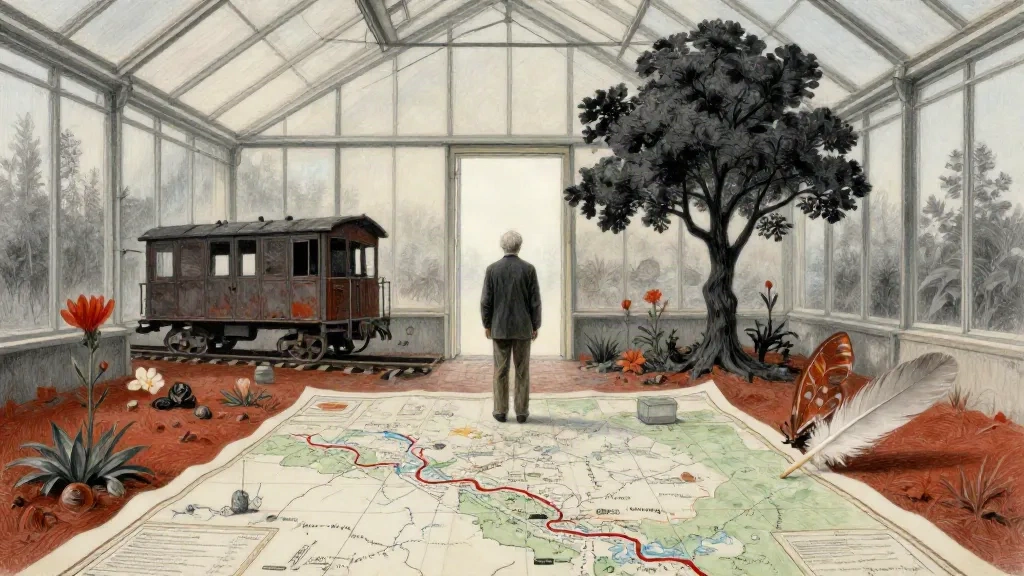
Under the terms of her lease, she could place lost objects only inside rooms represented on maps. She drew the drowned marshes: pale channels, a black tidal line, the outline of a vanished village. The map spread across the floor, too large for the room. At its centre, the white feather became a door.
Beyond it waited a grey shore under a low winter sky. Mara stepped through.
The lost things were already there.
A field of extinct flowers leaned against a silent railway carriage. Roots held fragments of doors from cities no longer standing. Under a charcoal tree, shelves bore the names of forgotten species. Every object had been kept, but none had been allowed to decay. Nothing rested. Memory had been preserved so thoroughly that motion itself had been confiscated.
Then the market began collecting its payment.
Warnings appeared on the walls: TRUTH WITHOUT SALE IS THIEVERY. A steward arrived with a ledger, demanding that the feather be registered. Each object in the grey shore possessed a verified history, and therefore a price. The market intended to foreclose on the resting place before Mara could finish it.
She understood then. It had never sold her the feather. It had sold the market a door through which it could collect everything that no longer belonged to anyone.
The Map That Refused a Price
Mara knelt beside the charcoal tree. In her left hand she held the white feather. In her right she held the map of Ash Orchard, now missing its central detail. She drew the moth’s wing—not from memory, because the market had taken memory, but from the shape the wing had left in her hand.
The line bent into a room. She drew the room around the wing. Then she drew the grey shore, the shelves, the railway carriage, and the low winter light. She drew all the lost things together.
Every door on the map opened at once.
The market’s stalls appeared beyond the shore, their cheap reproductions fluttering in the artificial wind. Agents reached through the doorways with ledgers and brass stamps. They whispered the names of owners who had been dead for centuries. They offered Mara restored summers, her first compass, the exact hour of her mother’s last breath.
She kept drawing.
The map filled until charcoal covered every margin. The market objected, then clarified its terms: truth required ownership, ownership required a price, and anything unpriced could be reclaimed.
“Then price it,” Mara said.
She drew a door around the market itself.
Not a door into a place that no longer existed, but a door through which the market could leave. The expensive things remained in their stalls, still true, still certified, still unable to rest. The agents withdrew with the sound of closing ledgers.
When the pale winter light returned, the grey shore had changed. The fossil flowers had released their roots. The railway carriage had sunk into soil, becoming a bridge over ground that remembered water. On a shelf beneath the charcoal tree, the white feather rested beside a small, rust-red moth wing.
Mara did not retrieve them.
For the first time since her retirement, she had drawn no door at all. The greenhouse lights dimmed around her. Below, the three forgotten forests lifted their branches in a windless orbital morning.
“Rest,” she said.
And in the dark, the lost things began to move.





