 Netwrck
Mythic Fiction.
The Seed Beneath the Glass
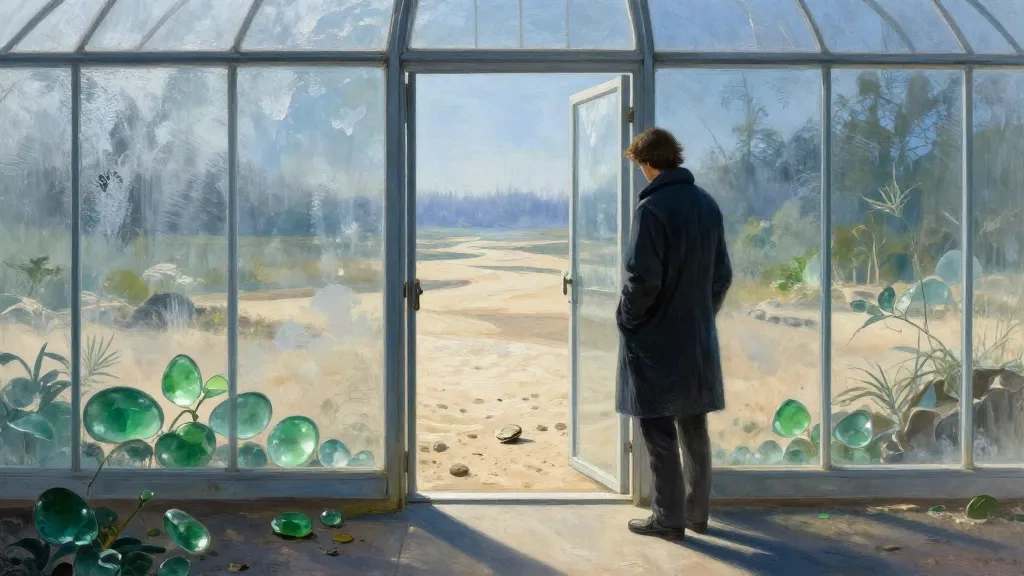
The greenhouse circled a seed no larger than a fist, though its roots reached through the station and into the dark. In the upper canopy, the last living trees leaned beneath panes clouded by old frost. Their leaves had the color of sea glass. Beneath them ran narrow beds of sand, threaded with irrigation silvered by reflected light.
Iona arrived with a translator's coat, a slate of blank vellum, and the official map folded inside its lining. The map showed seven irrigation gates, a dormitory, a seed vault, and a ring of sleeping machines. It showed no door. It showed no dry riverbed, though every window faced one.
Her employer, Sen Marrow, met her beside the seed chamber.
The machines dream in the old tongue of roots,
he said. You will tell us what they are remembering.
Iona unfolded the map. The paper smelled of rain, though rain had not fallen here for eleven years.
The first dream came from a machine shaped like a beetle. Its sleeping plates trembled, projecting cobalt shadows across the sand.
Tell the trees they were never lost.
Iona wrote the words beneath the official map. The machine replied with an image: a valley, green and complete, a river shining through it. The official chart had no valley. It had been made after the forests died, by surveyors who trusted instruments over memory.
Iona traced the river's path. Her hand stopped at an unmarked door.
What the Family Kept
The door stood in a wall of green glass, flush as a sealed hull plate. No handle. No hinges. No number.
Iona opened it during the next dream. Beyond it waited a corridor filled with sand. The corridor narrowed into a dry riverbed, its stones arranged in long pale spirals.
Each of Marrow's children kept a different version of the night the valley burned.
Her eldest said the parents had promised the forest a place in the sky. Her second said the promise was only that they would never sell the seed. Her youngest said the door had been there before the greenhouse, before the station, before anyone woke the machines.
They argued over the map. One crossed out a gate. Another drew a river. The youngest drew the unmarked door and shut the slate before anyone could see the rest.
Iona understood then that the family had not divided over the promise. They had divided over who had been trusted to remember it.
She translated the beetle's next dream. The valley appeared again, but its trees were transparent. Beneath each trunk ran a blue-black root. The roots made letters in the language of the seed.
They spelled no name. They spelled a warning: Do not make the old world into a new one.
The Map That Could Not Fold
Marrow ordered the machines awakened. He wanted a clean map before the station's orbit decayed.
Iona refused. A clean map would erase the disagreement, and disagreement was the only proof that the valley had existed for more than one person.
At the third bell, the machines began dreaming together. Their cobalt shadows crossed the greenhouse walls and gathered in the corridor. The dry riverbed filled with dark water, though the floor remained visibly dry beneath it.
Iona followed the shadow river to the unmarked door. This time the door opened onto the seed chamber. The seed had cracked.
Inside the crack: a green forest, small enough to hold in both hands.
The youngest of Marrow's children knelt beside her. Which part is the promise?
Iona drew one line across the blank vellum, from the door to the seed. Then she drew a second line from the seed to the sleeping machines. She left the gates undecided.
The family gathered around her. No one asked her to erase the other map. They held separate pieces over the sleeping floor, watching the shadows settle like snow.
A Map Left Open
By morning, the seed's roots had entered the irrigation network. The upper trees turned sea-glass green. In the seed chamber, the little forest breathed.
Iona submitted her translation without smoothing its edges. Gate seven remained uncertain. The river ran in two directions. The unmarked door opened onto both the riverbed and the chamber.
When Marrow asked for the final correction, Iona pointed to the sleeping machines.
They are not asking us to remember correctly. They are asking us to remain capable of changing.
She left the station at the next orbital dawn, carrying the better map in a case made from unfinished glass. It could not be folded without cracking. Around its edges, a faint river kept moving.
Behind her, the machines slept on, dreaming the green valley into being—and leaving one path blank so the living could choose where it went next.





