 Netwrck
Mythic Fiction.
The Seed Under Glass
At the edge of the orbital greenhouse, where the soil turned from cobalt shadow to sea-glass green, Orra Venn waited for a forest to remember her.
She was sixty-three, her hands mapped with pale seams, and her bones remembered the gravity of a world that had drowned. For forty years she had drawn coastlines for governments that no longer existed. After the last atlas was uploaded, the maps were taken from her.
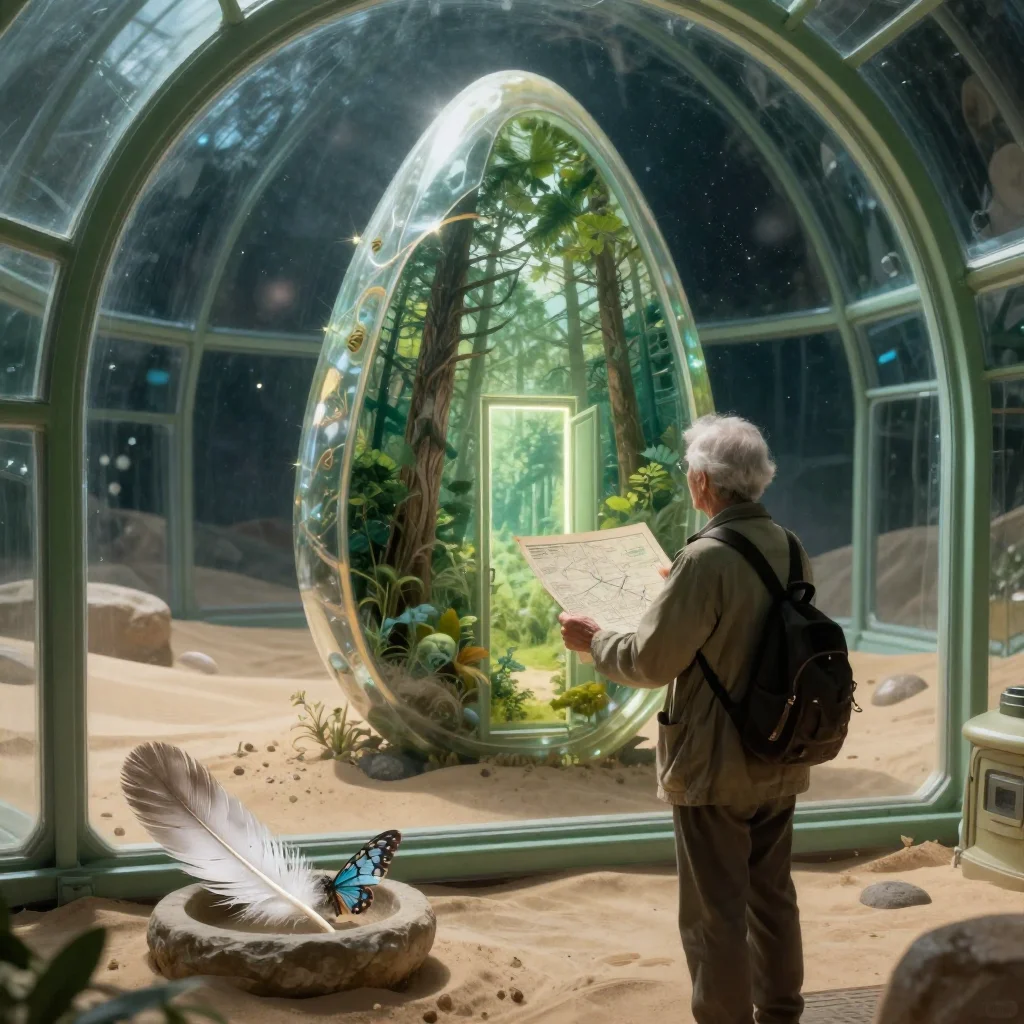
The greenhouse orbited a nameless star. Its glass ribs curved overhead, holding sunlight, rainwater, and the black seed at the center of the world. The seed remembered extinct forests: cedar forests swallowed by stone, birch forests burned to red dust, a marsh where cranes had nested before the oceans froze.
When someone touched the seed, the soil trembled. The leaves along the nearest wall turned pale beneath their veins.
Orra carried her tools in a canvas case: three pens, a brass compass that no longer sought north, and a folded map of a city erased by its own flood. She had promised herself she would never draw another door. Doors were promises made by walls, and walls outlived the people who trusted them.
The Market Beneath the Dome
The market opened each cycle beneath the southern dome, where the artificial wind moved sand across the floor in thin, deliberate patterns.
Stalls sold memories, names, and small pieces of planetary weather. A woman offered three minutes of snowfall. A boy sold the smell of bread from a city with no surviving ovens. At the central stall, a merchant displayed a white feather beneath a glass bell.
“The last feather from the eastern sky,” he said.
Orra knew the lie. No feather was last. The eastern sky still carried weather, dust, and the bright bones of migrating birds.
“How much?”
“One true thing you no longer need.”
The market’s expensive goods were always true. Truth had become the only reliable currency. A memory of a mother’s hands could buy passage to the outer gardens. A name spoken correctly could purchase a year of oxygen. A genuine fear might open a sealed archive.
Orra laid down the compass.
The merchant weighed it, then shook his head. “Old. Useful. Not true enough.”
She placed the erased-city map on the counter.
His expression changed.
“That is where you learned to draw doors,” he said.
“That is where everyone left.”
What the Seed Sold
At dusk, the market emptied. The white feather remained in its bell, glowing with a light that had no color.
The merchant named himself Sol. He opened a case lined with moth wings. Each wing was intact, veined with impossible forests.
“The seed has begun selling memories,” he said. “It takes what the greenhouse has lost and offers it to anyone willing to believe.”
“Lost things should rest,” Orra said.
“Rest is not the same as being remembered.”
He pointed beyond the dome. In the cobalt shadow between stars, a forest hovered without trunks or leaves. Its roots hung in the air like black rivers.
“Someone is buying extinction,” he said. “One forest at a time.”
Orra unfolded her map. The paper had been blank since the flood, but beneath her thumb appeared a line of sand-colored ink. It led from the greenhouse to the hovering forest.
Sol smiled. “There. A door.”
“To what?”
“To the place where lost things can rest.”
Orra looked at the feather.
“And if it is a lie?”
“Then you will discover the market has sold you something more dangerous than a memory.”
He handed her the feather. In her palm, it weighed no more than a breath.
A Place to Lay Down the Map
She drew while the greenhouse slept.
Her first line followed the path between vanished trees. Her second marked the river that had carried ash toward the old coast. Her third door opened in the blank country at the map’s edge.
The paper trembled. Beyond the dome, the floating forest descended.
Orra entered the map alone. Beneath her feet, soil turned from cobalt shadow to sea-glass green. Trees rose around her—not remembered trees, but trees made from the shape of absence. Their bark held the silhouettes of buildings. Their leaves whispered in languages of birds that had not survived Earth.
At the center stood a clearing with a small stone basin. A single moth wing lay on its rim. It was blue-gray, delicate as a thought, and impossible to crush.
The white feather was pinned beneath it.
Orra understood then that the market had not sold her a forest. It had sold her the right to decide what belonged there.
She placed the erased-city map inside the basin. The paper did not burn. It softened, dissolved, and became sand.
Across the clearing, a second door appeared. Beyond it came the low hum of the greenhouse, the click of irrigation, and a child asking when the first trees would wake.
Orra stepped through. Behind her, the lost forest settled into the dark, carrying its dead gently beneath its roots. In the basin, the moth wing and white feather lay side by side, no longer for sale.
At dawn, the seed opened its first green shell. The market had nothing left to sell that morning, and the greenhouse had finally made room for the dead.





