 Netwrck
Mythic Fiction.
The Door Beneath the Sand
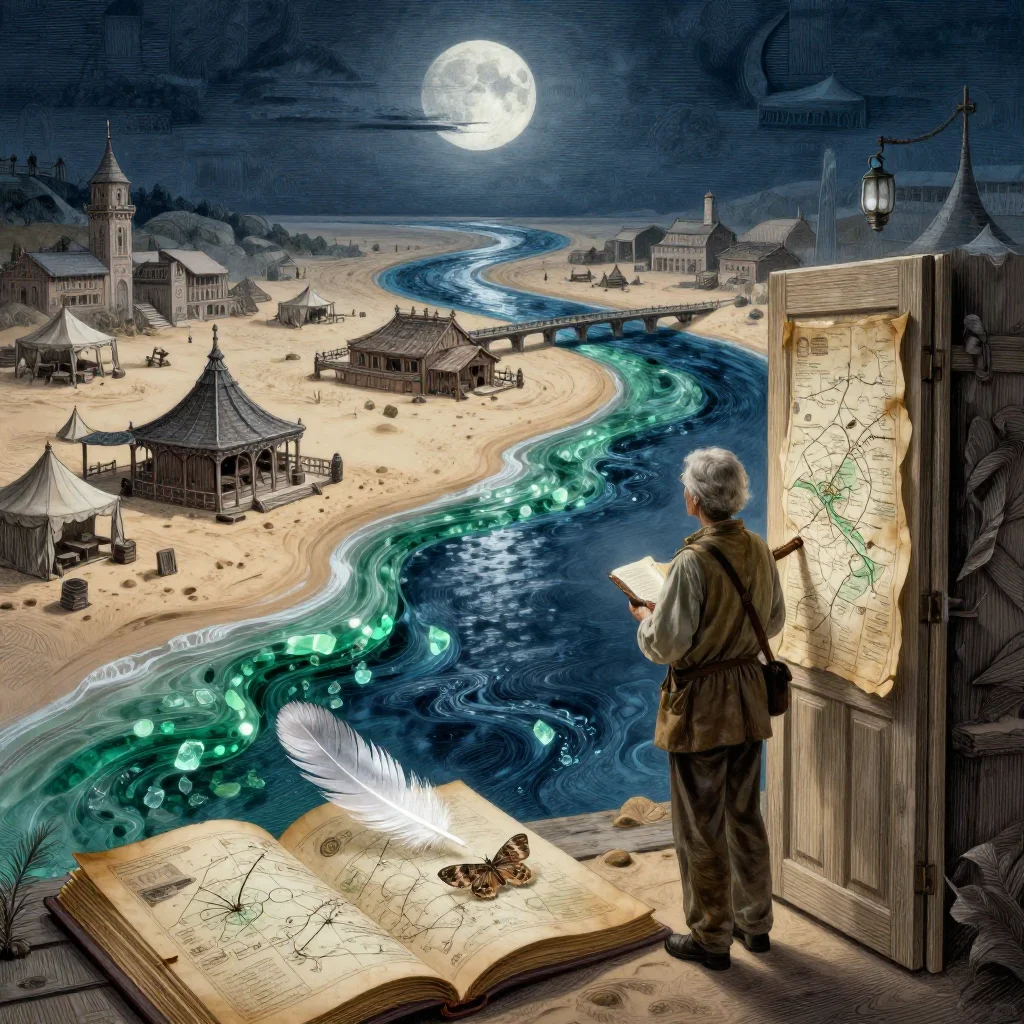
Every midnight, the border river turned its current inland.
By dawn it flowed again toward the sea, carrying leaves, ferry ropes, and the pale dust of the eastern bank back to their proper places. The town of Sallow Bend had grown accustomed to this small treason. Lamps were lit in both windows. Boats were dragged above the tide line. Children raced downstream after sunset to see which way their reflections would run.
Elian Vey kept no lamp. She sat in her shuttered map room with a cup of cold tea and a blank sheet of paper.
She had spent forty years drawing coastlines that rulers mistrusted. Since her retirement, she had drawn only one kind of door: doors for places that no longer existed. Hearths swallowed by marsh. Villages lowered beneath reservoirs. A hill that vanished when the mine beneath it did.
Her daughter had been one of them.
Not dead. Elian refused the word. Simply elsewhere, and therefore lost.
With a reed pen, she drew a narrow rectangle on the map. She measured the lost kingdom of Meris from memory: its sea cliffs, its saffron orchards, the bell tower where her daughter had last sent a letter. Then she added hinges, a brass knob, and a threshold.
The door opened behind her chair.
Beyond it waited a beach under cobalt shadow. Sea-glass-green waves moved against sand darkened by night. A white feather lay upright in the wet, though there was no wind.
Elian held out her hand. The feather entered her palm, light as moth dust.
What the Market Would Not Sell
The market appeared in Sallow Bend whenever the river changed course.
It occupied the dry riverbed between the broken bridges, its tents sewn from sailcloth and sailor's maps. Stalls displayed glass lungs, bottled storms, teeth polished into pearls. The cheapest objects were false: smiles belonging to strangers, a vial of painless forgetting, a compass that pointed confidently north.
The expensive things were true.
Elian found the truth market beneath the old tollhouse. Its wares rested in locked cases behind wire.
Here lay a summer with no people in it. Here were the nine words spoken by her father on the night he abandoned them both. Here, folded inside a shell, was the exact hour of her daughter's disappearance.
The seller was an old woman dressed in sand-colored gloves.
“A refuge for lost things,” the seller said. “That is not a modest project.”
Elian looked at the shell. “What will it cost?”
“You have a moth wing. I want it.”
Elian opened her other hand. The wing was the size of a coin, gray-gold and impossibly intact. She had found it inside the door to Meris.
“It is a piece of the place.”
“So is grief,” said the seller. “It makes an excellent door hinge.”
Behind them, midnight approached. Along the riverbed, the crowd turned toward the water. The current began to rise, flowing backward over stones, carrying the market's false treasures inland.
Elian placed the wing on the counter.
The seller touched it. Her glove darkened as if wetted.
“There,” she said, and handed over the shell.
The House That Remembered
Elian used every accurate map she owned.
She joined vanished villages to vanished roads. She drew a warm room where no storm had ever entered, with a chair for every person who had disappeared without leaving an ending. On the coast of Meris she marked the white feather. Inside the market's shell she placed the hour of her daughter's last kindness.
At the stroke of midnight, the river reversed.
The maps began to shake.
Doors opened in the paper: to submerged kitchens, burned archives, houses whose names had been mispronounced. Lost objects came tumbling through. A child's wooden horse. A soldier's unopened letter. A jar of summer honey from a country that no longer appeared on any map.
They landed in the room Elian had drawn, and for one breath the room filled.
Then came the flood.
Black water rose through the map, carrying the false market with it. A painted sky, a counterfeit bird, a beautiful lie announced as a person—all dissolved against the threshold.
The truth remained.
Elian held the shell open. Inside was not an hour but a single clear image: her daughter beneath an apple tree, looking back.
“I am not asking you to return,” Elian whispered.
The image brightened.
Outside, the river reversed once more.
The maps went still.
A Place to Rest
At dawn, Sallow Bend found a new building beside the southern bridge. Its walls were pale sand. Its windows shone sea-glass green in the cobalt shadow of the hills. No one remembered seeing it constructed.
Inside, the lost things rested on shelves.
Letters lay beneath glass. Shoes waited on numbered racks. A faded coat hung beside a child's wooden horse, both dry, both breathing faintly.
Elian sat by the eastern window, drawing a map of a place that had not yet ceased to exist.
The door to Meris was gone. In its place hung a small brass bell.
When the river changed direction, the bell answered from somewhere beyond the water: one clear note, carried against the current.
Elian did not follow it. She placed the white feather beneath the bell and returned to her map.
Somewhere, a lost thing had found its way home. The room held its silence without closing.





