 Netwrck
Folk Horror.
The Suitcase of Lost Hours
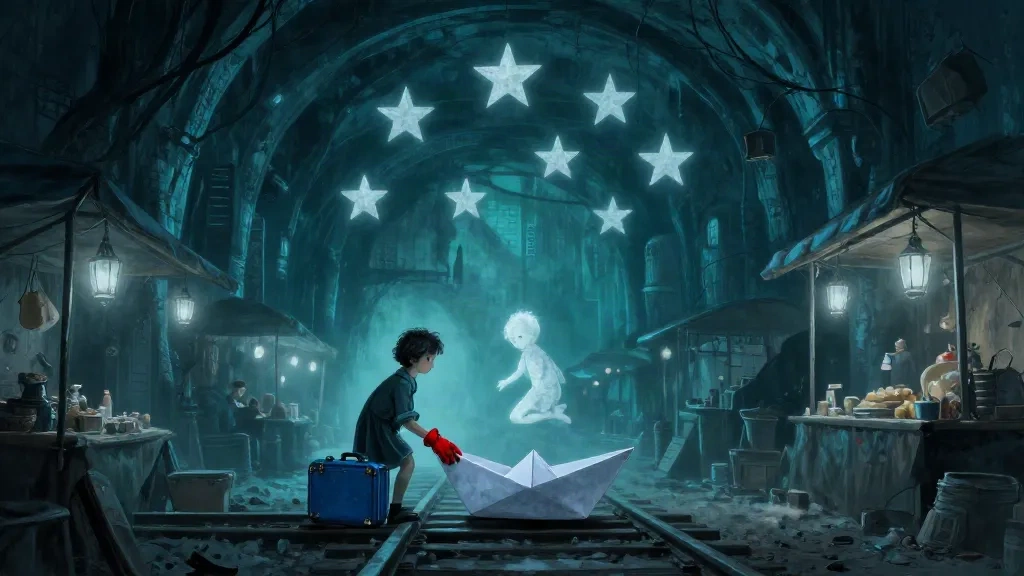
At half past midnight Mina went down into the market the way she had been taught, by a stairwell that ended in the back room of a dentist who died in 1974 and still kept his appointments. The city stood over her in concrete and lit windows, its lowest floor an iron raft sunk into black earth. There were no streets down here. There were shops, and tunnels, and sellers who traded in the things people had lost badly enough to become afraid of holding them.
She was eleven, small for eleven, and she carried a blue suitcase with a broken buckle that she had repinned with a fishhook. Inside were thirty-one books bound in rain-blue cloth, each one cataloguing a single night. Not the important nights. The lost ones: the night a man came home and could not find his own front door on his own street; the night a woman stood in a kitchen and understood, permanently, that she was loved; the night a boy said a true thing at a funeral and was believed.
Her father had been a surveyor, which in their city meant a man who measured what was left after the re-zoning. He found eleven streets that no longer existed and recited them at the table like a rosary, and he taught her the trade with a single rule: write down the street before you walk it, and write down the hour before you spend it. She had been writing down hours since she was six. She had never once written down her mother's name, because her mother had gone down into the market when Mina was four and come up without it, and did not know her, and still lived eleven blocks away in a flat with a garden she could not account for.
That was the sentence Mina did not say aloud down there, because the market filed anything you gave it under a different year. What she was afraid of was not the dark. It was that one day she would come back up the stairs with her own hours gone wrong, and her father would look at her across the table, and she would be a stranger holding a suitcase that belonged to a girl called Mina.
Ori had left her the library. Ori, who sold forgotten hours at a stall marked with a paper boat, and who had taken Mina's hand on the stairs that first night and said, you will be good at this, you already think in footnotes, and had never once said what this was.
On the newest page, ink shone against the frost.
Constellation 528: TAKE FROM THE STAIRWELL, THE THIRD FROST, AND THE HOUR BEFORE DAWN. ITS SKY MUST BE RESTORED BEFORE THE LIVING DEADLINE.
In the margin, in Ori's small level hand: The deadline is not a date. It is a person. And under it, in different ink, added later, pressed hard enough to score the page: I am sorry. Read faster.
The Wool Glove in the Iron Stall
Where eleven tunnels met, a boy sold stars by the handful. He weighed them on a brass scale instead of counting them, because counting made them into numbers and numbers were the market's own arithmetic. He wore a red wool glove on his right hand and kept the left bare. His bare hand was the only warm thing Mina had touched all night. Frost had webbed the hoops of his stall and the little paper cones of the scales, and where the frost had grown it had grown in the shape of eyelashes.
She showed him the page. He read it with his lips moving, slowly, twice.
“Is the living deadline me?” Mina said, because it was the only question she had brought down and it was the only one she wanted answered.
“Then you will need to be very quick with your arithmetic,” he said. “It is not a thing I can lend you.”
Behind the booth, a wool glove lay folded on the brass scale. Same make as his, black at the fingertips, smelling of woodsmoke and salt. Mina touched it and the market dimmed, all at once, like a lamp turned down by a careful hand. Overhead, in the iron vault, a sky appeared: seven stars in the shape of a kneeling child, and one absent point where the largest star should have been.
“That belongs to the sky,” Mina said.
“Everything in the market belongs somewhere,” the boy said. “That is why it was taken.”
He named a price without malice, the way a clerk names a figure on a form. Ori's remaining time. All of it, down to the last hour of the last hour.
“She is not an hour,” Mina said. “She is a woman who sold hours.”
“She is the only hour in this market that anyone has ever paid for in full,” the boy said, and set the glove into her suitcase, and closed the clasp, which he had no business doing. “Second offer. There is no third, so do not stand there hoping for one.”
The Rule of the Held Hour
The Clerk with the Green Ledger
The Tallyman kept his stall three stalls down, where the tunnels crossed. He was thin as a receipt, in a coat hemmed with ink stains, and he did not haggle, because haggling implied desire. He wrote when she spoke and read her page twice before answering it.
“Then the market does not steal,” Mina said, when he had finished. “It takes. My mother came up out of it with a whole hour gone out of her and she cannot account for it.”
“We hold,” he said. “Taking is what happens when a holder grows careless or dies. In ninety years we have been taken from exactly one door.” He turned the ledger so she could see the entry, in an ink that had never dried. One hour. A date in February. A canal. A child's name, written small, and then struck through, and then written again. Payment received: the sky.
“You cannot interpret the ledger,” Mina said.
“No,” he said, with something that might in a warmer man have been regret. “I can only say what the ledger will hold. Your teacher's payment is still in our hands. It is a piece of sky, and a piece of sky keeps a folded room open. Ninety years we have run on the memory of one star. When the last of the seven falls past the lip of the vault, the fold closes on us, and everything inside it goes down with it, including every hour anyone ever paid us for. And above us, the city loses its stars, one by one, the way a coat loses buttons.”
He wrote something. She could not see it.
“What did you write?”
“That you asked.”
The Future Collector
They found Ori beside a butcher's table, in a pool of cold light, alive. Her hair had gone white to the roots. Her shadow moved beneath her feet independently, a few steps behind and a little ahead, the way a dog moves around a person it has been walking with too long.
“You took too long,” she said.
“You said I had until the impossible dawn.”
“You misread the paper.”
Then, because Mina had earned it, and because she was eleven and it was that kind of night: Ori sat down on the crate and told her the whole of it, once, without pausing for mercy.
Her daughter had been six. Sela. Drowned in the canal behind the abattoir in the fourth hour of a February afternoon in a year Mina could not compute because Ori would not say the year. Ori had been selling hours for a living, in the way that people sell things they have not yet finished mourning, and a man at a stall had offered her an hour that had not yet been lived. She had asked what it would cost. He had said the sky, and being young, and being desperate, and being a person who assumes that the largest thing is the most abstract thing, she had paid.
“I wanted the hour back,” Ori said. “I did not want her back. I have been ashamed of that for forty years and I am not going to be ashamed of it now, in a market, in front of you.”
“You paid the market with a piece of sky.”
“I paid it with the only thing down here nobody else could offer. And then I discovered what an unlived hour has to be kept for.” Ori turned her palm up. A paper boat sat in it, folded from a page torn out of Mina's library, its sail black with star dust. “It must stay unlived. So she must not have died. So her death must be unpaid. So I must go on being alive at a rate the ledger can count.”
Mina looked at the smallest star in the iron sky. It was sinking toward the market floor, slowly, the way a coin sinks in clear water. Every stallkeeper turned upward at once, faces empty under their hoods, and the sound of two hundred people hoping was worse than weeping.
“You wrote the footnote,” Mina said.
“I wrote it as a warning and I wrote read faster as a dare, because I knew you would come anyway, and because I wanted to be outrun.” She closed her hand around the boat. “When the last star falls, the fold closes on me. It closes on her too. I would rather be collected than have her come back at six, alone, at the edge of that water, forty years too late, asking after me.”
A Dawn Under the Floor
The Price of a Navigator
They went up through the tunnels with the paper boat, and Mina bought passages the only way she could: with the library. The hour of rain before dawn. The warmth left in a chimney after a fire. A train ticket never punched, which opened a door that would otherwise have stayed shut until morning. She spent page by page and the market let her, because hours are the only currency that can hold other hours, and the ledger cannot look too closely at its own arithmetic.
Ori walked beside her and grew younger with every borrowed minute. By the second tunnel her hair had gone iron-grey. By the third she was the age of a woman who could still lift the crate she had been sitting on. By the time they reached the oldest gate she was a child with the blue suitcase in both arms, and Mina was the archivist, with frost in her hands and thirty books left, and their ages had simply been swapped, like two people passing a parcel on a stair.
“It cannot be carried by hand,” Ori said. “A folded room moves by hour or by navigator. Put a star in the hull and a person in the boat and it will go up. One star buys one crossing. There is only one crossing.”
“Then the largest star goes in the hull.”
“The largest star is Sella's hour.” The child's voice, flat, not asking. “You put it in the boat, it comes up with you, the payment closes, the ledger takes me, and she comes back. I told you. That is the whole of the arithmetic and there is no other column.”
“And if it doesn't go in?”
“Then no crossing, and the fold closes on both of us, and the market keeps everything it has ever held, which is a sentence I can only say once.”
Mina set the boat on the iron rails. She took the red glove out of the suitcase, black at the fingertips, smelling of woodsmoke and salt, and put it in the hull, and understood then why the boy had set it in there. A glove is a hand that holds. A hand is a thing you can pay with.
“It will need a navigator,” Ori said.
“Then it has one.”
The boy watched from his stall with his bare hand flat on the frost. “I cannot come,” he said. “I am not a boy. I am a hand the market borrowed, and hands stay.”
“Whose?”
“Mine,” he said, and did not explain, and she did not have the hour left to make him.
Mina stepped into the boat.
It rose without water, through the city's locked foundations, past the iron raft and the drainage heart and a hundred years of foundations, into a soft cyan dawn that had no sun in it. The market lanterns bowed, one after another, down the length of the vault. Above them, Mina unfolded the library and let the pages catch the wind, and every stolen hour went up out of the book and became a small blue star, and the small stars took their places.
Orion's shoulder. The pale arrow. The child kneeling at the edge of winter.
Six of the seven. The seventh stayed folded in the wool, and the sky above the market was a sky with a wound in it, and the wound was a person, and the person was eleven years old and had her mother's face in the last page of her father's book.
When morning finally came into the market, Ori was still there. Alive. Her hair had darkened from the roots down, like water rising in a well. Her shadow had stopped walking and stood behind her like a dog that had finally lain down.
The Hour That Did Not Come Back
The market did not forgive the theft. It renegotiated, because that is what a market is. The Tallyman wrote a new line in a column that had been empty for ninety years, and read it out to her, and his voice was the only flat thing left in the fold.
Payment received: six stars. Balance: one star, held in a wool glove, which cannot be returned to a sky it was never in, since the only sky that star belongs to is the one a six-year-old girl never got to have. Debt transferred, voluntarily, to a living person, present and named. The fold stands open while the debtor stands open. Mina understood, and did not argue, because there was nothing to argue with except the shape of the next four years of her life.
The boy's glove came apart into red thread in the hull. The black left his fingertips in a single breath, and the boy in the stall was not a hand anymore but a boy, which is a thing that looks, from the outside, very much like a catastrophe: he grew a little, and then aged, and then was six, and then was himself, and he stood in the middle of his own stall crying with a warmth he had not had for ninety years. He would not leave. Every few weeks he came back down to sit behind a counter with nothing to sell, because it was the only room in the city where nobody asked him to hold anything, and Mina found that harder to look at than her own debt.
Above, the sky was wrong. In the north-east, in winter, there was a point of blackness that no one had a word for yet; the observatory argued about it for a decade and then agreed to disagree. Every few weeks something came down over the city in a white line and did not burn up, and somewhere in the ninth district a woman stood up in a laundromat sober for eleven minutes, and tender, and then sat down, and a man said his son's name correctly for the first time in nine years and wept about it and could not remember why on Thursday.
And some of them said no. A woman on the ninth floor was offered the whole of the year she had sold and stood in her doorway with her arms crossed and said she had been perfectly happy without it, thank you, and the market had to hold it, and the fold stayed open another year, and the year came out of Mina. She wrote that down. She wrote down everything; it was the trade.
Ori waited at the top of the dentist's stairwell, because the ledger's release had left her unable to cross below the fold line, and she had a whole life to get through up there in the daylight. Her hair darkened. Her shadow lay down and got up and got down again. On some Sundays she came down as far as the fourth step and looked at Mina and said, “Sela.” And sometimes, kindly, the way you correct a stranger, “No, sweetheart. Sela is someone else. Sit down anyway.”
Mina did not correct her. That was the price she chose out of everything on offer, and she chose it because Ori's love was a living thing that had been aimed at a child for forty years, and the alternative was to tell a woman that her love was for a ghost, and she was eleven, and she was not yet able to do that to anyone.
She resents it. She pays for it. She goes down the stairs anyway.
The Collector
She is the archivist of unlived hours now. She goes up into the city with a page and knocks on doors and asks the only question the market permits her to ask, which is: what would you rather forget? Most people shut the door. Some people name a year. Three people in five years have named a person, and two of those came back changed and one came back whole, and Mina does not know which is the greater miracle and has stopped guessing.
The rule is the rule. An hour stays held until its owner claims it. So most of the work is not breaking into rooms. It is going back up the stairs and the lift shaft and the fire escape, and standing in a kitchen for the fourth time, and being kind at a stranger who is not a stranger, until they want their own life badly enough to come and take it out of the fold by the hand.
Her father recited the eleven streets at dinner, and she wrote them all down, including the one they were building.
On a Tuesday in a month with no name she put her feet under her mother's table. Lissa, eleven blocks away, in a flat with a garden she could not account for, made her tea and called her sweetheart and could not say where the garden came from, and loved her with a love that had no object in it, the way a light left on in an empty room will faithfully light nothing at all.
The glove lay in Mina's suitcase. One star, one cold, one hand, once. It could give a person back an hour, and take one out of someone else, and that someone else did not have to be a stranger, and that someone else was sitting across the table with roses on the cloth.
Mina did not spend the glove. She took out the second-newest of her father's books, the one that was nearly full, and she wrote down the hour in her own catalogue style, with the date and the weather and the tea and the roses and the two of them, introduced properly, at last, to each other. Then she signed the hour away, into the market, as a thing she owned, to be delivered to Lissa at four o'clock in the afternoon of that day forty years ago.
The cost of the delivery was that she would not remember the kitchen. Not the roses, not the tea, not the hour her mother said sweetheart with nothing behind it. The archivist's price, paid in the currency the archivist dealt in, and the whole of the trade, which nobody down there had thought to tell her, and which she had worked out alone on an iron rail with a glove in her hands: that the book keeps what you spend. That is why you write it down.
At four o'clock the garden, the roses and the tea came back into the room and put themselves where they had been. And at the top of the table, where the account always goes, Mina opened her father's book one last time and started a thirty-second volume, and wrote the date at the top of the first page, and under it, in her own small level hand, the whole record: a flat, a garden, two people who had been introduced, and it was worth it.





