 Netwrck
Fairy-Tale Fiction.
The Greenhouse That Remembered Trees
Orison Vey had spent forty years drawing coastlines that no longer existed. She drew them in black lacquer, sealing each vanished harbor beneath a thin layer of gold dust. The maps were not souvenirs of grief. They were locks, each one cut to fit a particular absence.
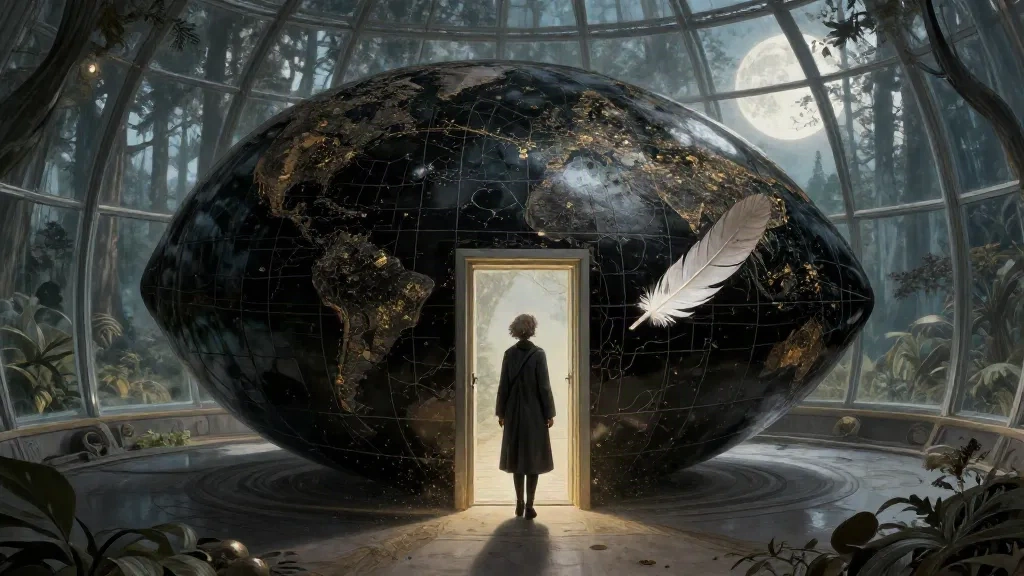
Now she lived beside the Arbor Crown, an orbital greenhouse wound around a seed the size of a house. The seed remembered extinct forests: cedar, hornbeam, ash, and a red-barked tree no living botanist could name. Its roots curved through blackened soil, lifting transparent tubes of water into the dark. Beyond the glass, cold moonlight moved across the Earth.
Every night, the greenhouse produced doors that led nowhere. One opened above a drained lake. Another showed the entrance of a railway station demolished before Orison was born. She touched them only with a glove. A hand drawn door, she had learned, opens both ways.
Her desire was simple and nearly impossible: she wanted to make a place where lost things could rest.
The Market of Expensive Truths
The market arrived once every thirteen years, traveling in a silver elevator with no cables. Orison descended with the other buyers: collectors of vanished names, heirs of drowned houses, children carrying the unfinished letters of dead parents.
On the first counter lay a moth wing, white and enormous, veined with black. The vendor said it belonged to the last moth seen over a city that had sunk beneath a lake. The wing remembered the moonflowers of that vanished city and unfolded whenever someone spoke a lie.
On the second counter lay a single white feather. It had fallen from a bird whose species survived only in old children’s songs. The feather cost less than the wing, though the vendor would not say why.
“Everything here is true,” the vendor told Orison. “That is what makes it expensive.”
At the final stall, a map lay beneath a bell of black glass. Its title had been scraped away, but the coastlines were familiar. They matched every place Orison had failed to save. The map had a blank interior.
“This can become your rest,” the vendor said. “Draw the final door. Give me the truth of where it opens.”
Orison understood the price. The truth was not an answer. It was the memory that made the answer true.
The Door Beneath the Seed
She bought the map with her last year of work, a white feather, and the memory of her mother’s voice. The cost was exact. The voice vanished before the transaction ended, leaving only the knowledge that it had once existed.
Orison drew beneath the greenhouse, where the seed’s roots dipped into a pool of still water. Her charcoal moved carefully: a lintel, two hinges, a threshold worn smooth. She gave the door no destination. Then she drew a small room behind it, with shelves, low chairs, and windows looking onto forests that had never grown.
The expensive truth emerged at once.
The room would preserve every lost thing, but it could not receive them without a living person to remember them. Lost things, it seemed, were also lost memories. Without a witness, even the vanished would dissolve.
Orison’s hand shook. She had spent her life preserving places by remembering them for strangers. Perhaps this was only another map. Perhaps the place she wanted could exist only by remaining empty.
She opened the door.
Behind it stood every vanished forest at once. The white moth circled beneath black-limbed trees. The feather drifted through branches that shone like wet gold. Doors from Orison’s maps opened in the distance, each one leading to a room no one had ever entered.
Then Orison remembered the room she had left behind.
A Place That Remembered Her
She did not draw herself. She opened her atlas and placed it beneath the moth wing. The wing unfolded. The feather lifted. Both crossed the threshold.
At once, the lost places began to settle. Their edges softened. Their lights became steady. A drowned harbor filled with patient stars. A demolished station received its absent passengers. The red-bark tree unfurled a single leaf above the greenhouse, and the seed beneath Orison’s feet gave a deep, green knock.
One door remained closed. Behind it, someone knocked three times.
Orison knew the rhythm. Her mother had used it when calling her home from the fields.
Orison placed her hand on the black lacquer handle. She could not hear the voice, but she remembered the shape of the love inside it.
“Rest,” she whispered.
She opened the door, and the room remembered her.
Outside, the cold moonlight fell across the greenhouse, black and silver and pale as a feather. The lost places no longer needed a cartographer to keep them from vanishing. They had found a witness who had finally come home.





