 Netwrck
Adventure.
The Market Below the Copper
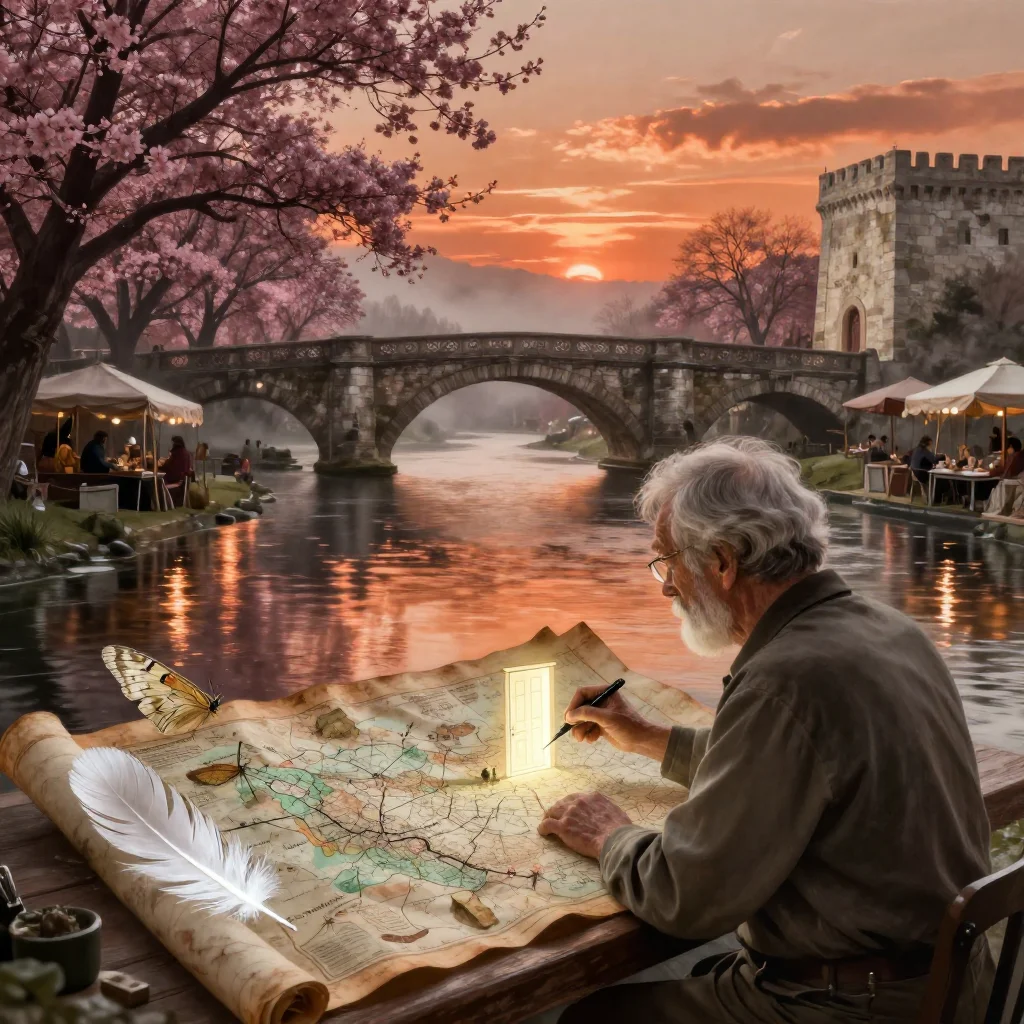
By the time Mara Venn retired, the maps had stopped showing roads and begun showing absences. She kept them in the attic beneath a roof of pale slate, each sheet folded around the memory of a place that had vanished: a village taken by floodplain, a railway station abandoned after the last train, a hill road erased by a new reservoir.
She could still draw doors on those maps. Not houses, not windows, but doors set into blank margins where a vanished world once ended. The older cartographers had called the gift a defect. Mara called it a vocation.
Her desire was plain and stubborn: to make one place where lost things could rest. Not a museum. Not a shrine. Somewhere with a door that opened inward, where a vanished village might keep its lamp, and a drowned road might remember the names of its travelers.
On the morning the river turned black cherry, Mara went down to the market beneath the western bridge. The bridge had been built by her grandmother, who had sworn that no one would cross it without leaving a promise. The river below it ran copper beneath the copper horizon, holding the light like a witness refusing to be bribed.
What the Market Sold
The market occupied the stones between two bridge piers. Stalls leaned against one another like tired conspirators. Sellswords sold beginnings. Children sold afternoons. A woman with no face offered memories of snow, each flake sealed in a glass bead.
At the final stall sat a merchant with silver teeth. On his table lay a moth wing, pale as bone, and beside it a white feather that glowed faintly in the shadow.
“Expensive things are always true,” he said. “That is why they cost so much.”
Mara pointed to the feather. “What does it know?”
“That the sky remembers the dead.” He named a price too large for coin. “Bring me something no one can prove.”
She placed the moth wing on the table. “This.”
The merchant’s smile disappeared. “A wing that belonged to a lantern moth. It crossed the old city before the city was burned. It knew every window that ever gave it shelter.”
“Then it is not a thing,” Mara said. “It is a witness.”
The market changed around them. Prices rose. Masks appeared over honest faces. A child cried because the memory of rain had become expensive. The merchant slid the feather toward her.
“Truth for truth,” he said. “But beware. The true thing never returns alone.”
A Door in a Place Gone Missing
That night Mara spread her oldest map across the floor. It showed a town called Bellwether, swallowed by a river before Mara was born. She drew a door in the pale margin, its hinge toward the vanished town and its threshold pointing into her room.
The map warmed beneath her hand. Ink lifted from the paper, carrying a scent of wet ash. Behind the attic wall came a sound like a crowd taking the same breath.
Mara opened the door.
Beyond it lay Bellwether, unchanged and utterly gone. Lampposts stood in shallow water. Black cherry trees hung over streets where no footsteps had fallen for a century. A white feather rested on the nearest doorstep, bright as a fallen moon.
She followed the feather to a ruined chapel. Inside, lost things had gathered without knowing what they were. A child’s shoe. A soldier’s glove. Dozens of keys whose locks had ceased to exist. A bell from the drowned bell tower, silent and patient.
At the chapel’s center stood a table. A map lay open upon it, already marked with a door.
Someone had drawn the way out.
But beside the door was a warning: whoever leads them through will be forgotten by the town that sent them.
The Promise on the Bridge
Mara understood then that the market had not cheated her. The feather had shown the price before it named it. To bring the lost things home, she would have to become part of what they left behind.
She carried the key and the bell first. Then the shoe, the glove, and the small treasures she had spent years collecting. The moth wing led them through the chapel door, and the lost things followed, silent, astonished, filling the attic with the rustle of wings.
At dawn she returned to the western bridge. The river was still copper, the horizon still hard and bright. Her grandmother’s promise waited in the stone: every crossing requires a memory.
Mara placed the moth wing on the bridge rail. It trembled, then flew eastward, carrying the last visible trace of the old city’s fire.
Behind her, the town began to change. People found doors they thought they had lost. A woman remembered a blue cup. A man remembered the sound of his daughter’s laugh. The place where lost things rested was no longer hidden, because it had been built from everything they had nearly surrendered.
Mara looked back at the chapel in the map. The door had vanished. So had her name from the village records.
She smiled without grief. A cartographer’s true gift was not permanence. It was the knowledge that every line, once drawn, could lead somewhere new.





