 Netwrck
Mythic Fiction.
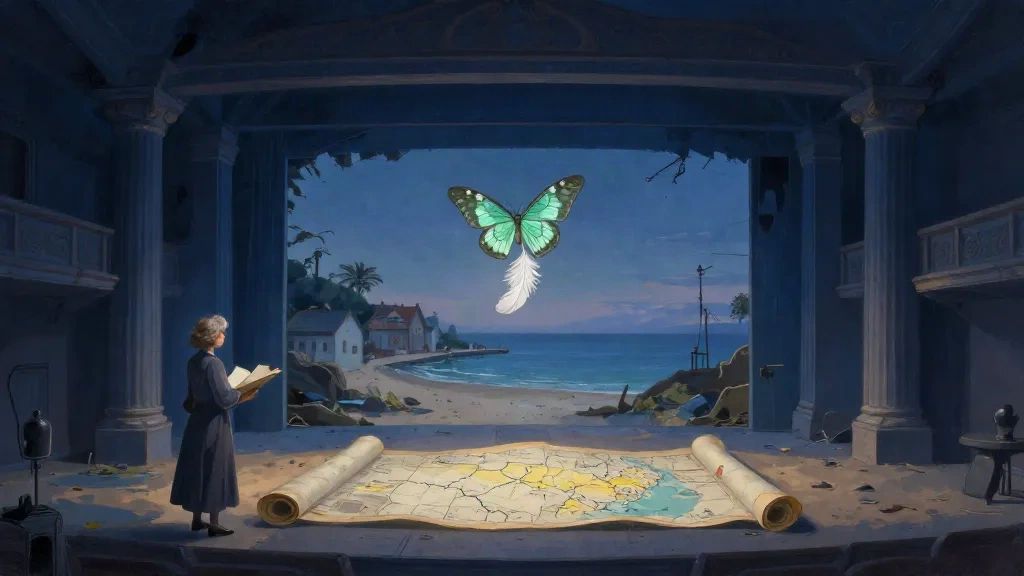
The Theatre Below Tomorrow
At dusk, when the tide withdrew from the old theatre, Mara Vale descended beneath the dunes carrying a roll of vellum and a brass compass with no needle. She had carried the compass for thirty-one years and had never once consulted it, because a compass without a needle is not an instrument but an opinion: it points wherever the holder is already going.
The theatre stood where the coastline used to agree with itself. Twice a day the sea gave back the building and twice a day it took it again, and in between, the theatre performed tomorrow's discarded endings. Its doors opened onto rooms where wars had ended one way in rehearsal and another in the wings, where drowned cities opened their shutters to balconies, where heroines walked home and found their houses had politely forgotten them. Before dawn the building swept those outcomes away and prepared new ones. The stagehands worked in silence except for the sound of erasers.
Over the doors, cut into the stone in letters that had been painted over so many times they had gone soft as bread:
What is performed here has not yet happened. Be seated before you make it so.
Mara had been a cartographer for forty years. The empire had moved its borders twice and renamed everything both times, and she had learned to make her corrections so small that no one would notice a village being moved half a mile north in order to keep it inside a province. Retirement had meant a small room, salt creeping along the window frames, and an ache in her hands like a word she could not pronounce. She missed making places visible. That was the honest sentence. The rest of it was that she missed being needed by places.
Her sister Ilse had been the better draughtsman of the two. Ilse had a steady hand and no patience; she could draw a coastline from memory and make it true by being certain enough. It was Ilse who taught her that a blank space on a map is not an absence but a promise: someone will come back and fill it. It was Ilse who drew first, and Mara who remembered, and between them this had worked for eleven years until the river wall above the village of Sarn broke in a single night of rain and took the village, the chapel, the bell, and the woman who had believed in blank spaces.
Mara had drawn a door for Sarn on her own map, a small rectangle in a margin, and had not known what to do with it afterward, so she had rolled it and put it under the bed. Two months ago the theatre's stage manager had written to her, in a hand like a ruled line, and she had come.
Inside the lobby, a paper feather lay beside a glass case. Inside the case, a moth's wing was pinned to black velvet. The wing shone sea-glass green, though Mara remembered the moth of that species as silver, and remembered it in her sister's garden, and remembered her sister.
"You are late," said the stage manager. He did not look up from his prompt book. "The market closes when the first true sentence is spoken. Everything until then is still negotiable."
The Market of Expired Things
Behind the theatre, the stalls opened in a market whose roofs were painted skies: overcast at one end, high summer at the other, and moving. The smell was hot stone, salt, and old paper, and under all of it a sweet iron tang, like a coin held in the mouth.
A boy sold the sound of a bell. A woman offered seven years of rain for a childhood's worth of forgiveness. A stall of loose teeth gave change. A man with aledger sewn into his coat sold the exact moment a person first decided to lie, and he would not name the year. Everything there had a price, and the expensive things were always true.
Mara worked her way down the row, reading tags the way she had once read contour lines. Third cough of a winter, unnamed. The smell of a house you grew up in, one floor only. Twelve minutes of not being spoken to. At a stall stacked with white feathers, each feather bore a name in silver ink, and the seller was a thin woman with a ledger and the patience of tide.
"Those are promises," the woman said. "The expensive ones have been kept."
Mara touched one. The name was her own, in handwriting very like her own.
The feather warmed beneath her finger. In a cobalt shadow under the stall, a door appeared in a map nailed to a post, and it led nowhere she recognized.
"I want a place where lost things can rest," Mara said.
"Rest is a luxury," said the woman, smiling without showing teeth. "The market has a price for a place to put the lost. Not a coin price. We are not a coin market. We are the price."
Mara unrolled her vellum on the stall's counter, weighting the corners with a paperweight shaped like a sleeping fox. The map showed the theatre, the dunes, the vanished coastline, and the drowned country she had been walking for six years, including the place where Sarn had stood. At its center was a blank space where a road should have been, and she had never been able to make that road go anywhere, because every road she drew there came back to her own doorstep.
"You have made a good blank," the woman said, and for the first time the smile showed teeth. "Blanks are where we do our best work. Draw the door, and the place will exist. Understand what existing costs. The market will collect what you leave inside it."
"And if I leave nothing?"
"Then you will have built a room with no door in it," said the woman, "and the lost will knock forever, and you will be obliged to listen, and that is the other price."
The Boy Who Sold the Bell
The bell stall was at the market's damp end, under a roof painted as an overcast afternoon. The boy was perhaps thirteen, and the sound he sold came out of a small brass horn he wore on a cord, played for anyone who asked and never twice the same. Mara had been in the market an hour before she understood that the boy was not selling a sound but a place where the sound had been heard.
"Is that the chapel at Sarn," she said.
He looked at her with the flat, unbothered attention of a child raised by professionals. "It's the ring at the fifth hour, at the turn of the year. Took me eleven months to get it. The bell itself is under the water. The sound was above it and it fell."
"Who are you selling it to?"
"Whoever wants a door in it." He drew a small square in the dust with his heel. "I want out. My whole life is that one ring. If I stand in a place where it rings, I turn back into the boy who heard it. I want a place where I am only the boy who sells it."
There it was, then. Everyone in this market wanted a door; nobody admitted to wanting a wall.
"I draw maps," Mara said. "I cannot give you a door to yourself. I have tried."
"You can put me somewhere small," said the boy. "A place with a street and nothing in it. I will pay with the bell. That is a fair trade and I will say so in front of the Underwriter."
He was better at bargaining than she was. She had spent forty years learning to make a place visible and he had spent eleven months learning to make one sound, and he was going to be the better negotiator because he did not care whether he was right. She felt, in the sternum, the old vertigo of being in the presence of a person who had nothing left to protect.
"Wait here," she said, and went to find out what the market wanted from her.
A Door Under the Stage
She drew in the wings, on the floor, with a stick of charcoal and then with ink, because the market did not honor work done in haste. Her hand cramped at the third hour and went on cramping; she let it, because pain is only information about the limits of a thing, and she had spent four decades learning where her own ended.
The door appeared first as a line. Then a hinge. Then a narrow black rectangle filled with cobalt shadow, and the moth's wing trembled on its velvet card like something remembering air.
When she opened the map door, the stage vanished beneath it.
Below was a harbor without water. Nets hung from a moon at the wrong altitude, slack as becalmed ships. The stones were wet in a way water had not made them wet. A white feather went up past her through a crowd of things that had no owners: a childhood glove, a ship's bell with its clapper gone, a name spoken once and never answered, a door with no wall, a thousand small cold things breathing in and out at the pace of a sleeper. And at the far end, under a green sky, stood Sarn, whole: the chapel, the mill, the lane where the boys had raced, every window lit, the waterline exactly where it had always been and never once having touched a stone.
Mara stepped through. Her boots found cobbles, and the cobbles were warm, and she had not been this frightened in her life.
The market came down after her. Its stalls unfolded along the harbor, their price-tags flashing in the dark like a shoal, and the Underwright walked at the head of them with the white feather held up like a lantern. The green wing had left its case; it kept pace with the feather, green against white.
"The place requires a true ending," the Underwright said. "You may buy it cheaply with a lie. What will you surrender?"
Mara looked at the village. At the lit windows, which meant nothing, because windows in this market were lit to be looked at. At her own door, drawn badly, at a scale that would get a real cartographer dismissed.
"Not the lost things," she said. "Their last chance to choose."
The Underwright turned the feather a quarter turn. "Choose between what. Be specific, woman, there is no room for poetry in a contract."
"The lost things keep their own exits," Mara said. "I place no door that locks. Every place in this harbour has its own way back out, and nothing stays that does not stay by choosing to."
Silence on the quay. The crowd of ownerless things stopped breathing for a moment, all together, which was the most frightening thing that had yet happened.
"You are offering the market a place where nothing can be collected," said the Underwright. "Do you understand that you are offering it a loss?"
"Yes," said Mara.
"Then the market will collect you."
The Price of the Second Door
She drew the second door on the vellum, a small door in a margin, opening toward the theatre. Then she took the knife from her boot and cut her own name out of the white feather in one stroke, and put the strip beneath the first door.
The market screamed. It was not a human sound; it was the sound of a hundred small prices being renegotiated at once. The tags on every stall flew off and came back wrong. Things that had been true became cheap, and cheap things became true, and the Underwright's ledger flew open and every page began writing itself.
What it cost came up through the soles of her boots, as it does. Her name went out of her mouth. Not silence; worse, fluency. She could say the valley of the Keld and hear it leave her and arrive as the valley of the ____, a sound like a man speaking through a mouthful of snow. In her pocket, her own field notes, forty years of them, all the blanks she had left for other people to fill, went soft as wet paper. The moth's wing and the white feather turned once together in the cobalt dark and were gone.
The lost things moved then, all of them, at the same time. Doors opened in every lost place in the harbour: in the glove, in the bell, in the unanswered name. And none of them led back to the same world. That had always been the terms and she had read them and chosen them: a door out, not a door home. She had given the lost the right to leave and had kept for herself the right to be the only one who could not.
Under the green sky, a lane in Sarn opened, and a woman came out of the mill with a lamp and a way of standing that Mara had watched in a garden for eleven years, and did not stop, and looked straight through her, and closed the door behind her.
The Underwright closed the ledger. "Your receipt," she said, and Mara understood that she was not given one.
The Room That Held
By morning the theatre had a new room at its center, and the room had a door on every wall, all of them opening outward.
It held no altar, no throne, no promise of return. There was a floor of dry sand, walls the color of sea glass, and shelves, and on the shelves the abandoned endings waited without hunger: a coronation where the old king abdicated in favor of his gardener; a war that ended with the losing general writing a very good history; a woman's entire life from the second decision onward, shelved like a ledger. Nothing wept. Nothing asked. Somewhere behind the walls a boy was selling a bell five hours earlier every day, and the fifth hour never got any closer, and he had stopped minding.
Mara sat down on the sand and tried to name the room. It is the last work she will ever do, and she knows it by the way her hand went to the pen out of pure animal habit, and the way the pen, hovering, could not find a word.
Sanctuary was a lie; it promised a cure. Archive was a filing error; it promised a keeper. Lost and Found was a municipal promise, and she had buried a village in the word already. She tried her sister's name, which she could no longer say, which came out of her as a shape in the air that the room received without comment.
She had made a place where loss could rest without becoming a prison, and she could not write a label on it, and both of those facts were the price, and she had known they would be, and had paid them anyway, which is the entire difference between a bargain and a gift.
After the Market Packed
Outside, the market packed its stalls. The expensive things remained true, but cheaper than they had been, and the cheapest truth in the yard was a single white feather settling onto an empty shelf. Nobody stopped to pick it up. That had been the arrangement.
The boy found her before she reached the dunes. He was thinner. He had a street and a small room in it and no bell.
"It works," he said, unnecessarily. He looked at her for a moment with the professional's assessment he had learned in her trade. "You look like a map with a hole cut out of it."
"I am," said Mara, and it came out warm, which she had not expected.
Then the courier came up the beach, out of breath, with a summons from the empire that was the color of a bruise. Wickell Ost, cartographer-general, her former apprentice, the man who had learned at her elbow and had gone on to draw the borders that had erased her sister's village from the current edition. He had written only four lines, and the last one was a question, and the question was whether she still had the coast of Sarn in her hand, because the ministry had lost it, and the ministry could not find it anywhere, and it had begun to suspect the maps.
She stood in the cold with the paper in her fingers. Somewhere under the green sky a woman was closing a door for the last time. Somewhere in a theatre that erased its own futures, a boy was being a stranger to a sound he had paid for. And here was a young man she had taught, asking her for a coastline.
She could have gone back. The room had a door on every wall, and the walls were thin, and there was a whole life on the other side of them where the Keld had a name and the Keld's valley had a road through it, and a man in a ministry would have believed her, because he had learned to. One word, any word, spoken in the right voice to the right man, and the valley would have been a valley again, and Sarn would have been a village on a river, and she would have been a cartographer with an answerable ache.
Instead Mara Vale folded the summons into a wing the shape of a boat and set it on the shelf beside the feather, where it waited without hunger, and went out into the dunes to make one more map before noon.
It was a map of the theatre from above. At its center, where the new room sat, there was a blank space, and she did not fill it, and she did not leave it as a promise either. She ruled the neat hatched border of a surveyor's notation and wrote in the legend, in a hand gone suddenly plain: Structures not yet named. Survey pending.
It was the first honest thing she had drawn in forty years, and it was going to cost her the rest of her life, and she inked it before the sun moved.





