 Netwrck
Surrealism.
The Theatre of Discarded Endings
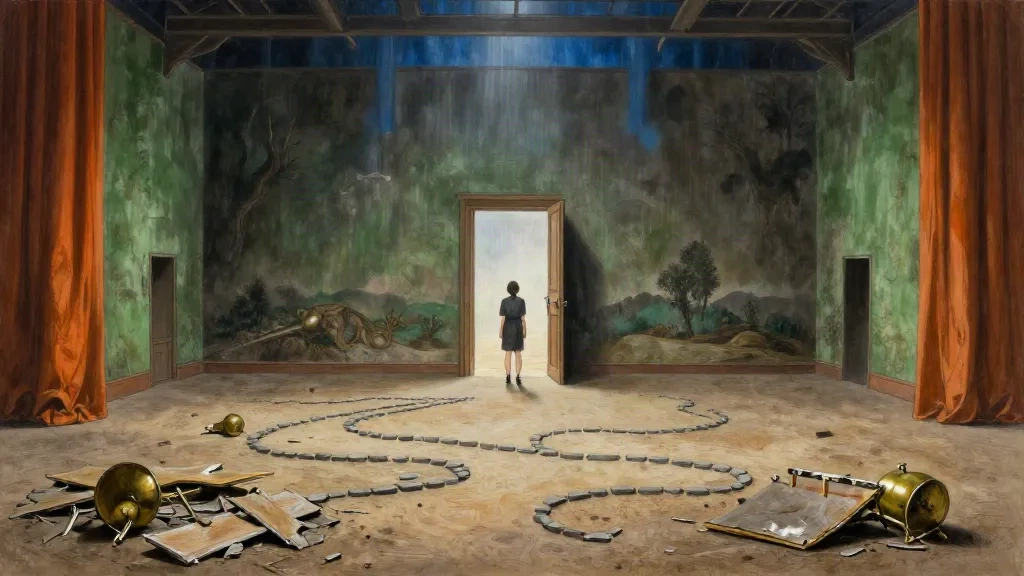
At dawn, the theatre opened its mouth and released yesterday’s endings into the street. They came out as scraps of weather: a bride walking through a wall of blue rain, a city sinking politely into a bowl, a man turning into a door just as someone called his name.
Mara collected them. She was the translator, paid by the hour to decipher the dreams of sleeping machines before they woke and forgot. The machines lay beneath the stage in rows of brass ribs and black glass, breathing through copper pipes. Their dreams arrived as static, blue storm-light, and Mara translated them into endings the theatre could perform.
Her preferred ending was always the same: a train carrying everyone home.
<That morning, the machines gave her a dry riverbed instead.
The Unmarked Door
It appeared behind the third row of seats, a plain door with no handle, no number, no hinges. The stage manager said it had always been there. Mara touched the wood and heard her mother’s voice on the other side.
“You promised we would leave together,” her mother said.
Mara removed her hand.
Her family had divided around that promise for nineteen years. Her father remembered a boat. Her brother remembered a house with blue shutters. Her mother remembered only the word afterward, and refused to say what came before it.
The machines had sent Mara here. She knew this because their sleep-patterns had aligned beneath the stage, all of them dreaming of the door. She followed it into the theatre’s backstage labyrinth, where burnt-orange costumes hung like flames and lichen crept along the walls.
Behind the door was the dry riverbed.
What the Stones Remembered
It stretched beneath a low sky, pale stones arranged in lines that might have been a map. Mara kneels, though the bed is dust, and places her palm on the nearest stone. A map arrived inside her palm—not drawn, but remembered.
On it, her family stood at four different crossings. At each crossing waited a different child. One held a brass key. One held an empty bowl. One held the sleeping machines’ black-glass faces. One held no face at all.
“Which one is true?” she asked the riverbed.
The stones answered by changing.
Her father’s map said the promise was departure. Her brother’s map said it was shelter. Her mother’s map erased every road except the one she had already taken. Each map was accurate. Each map betrayed the others.
Then the blue storm-light began to leak from the sky. It pooled in the riverbed, filling the lines between the stones, and the dry river became briefly a river. Four maps floated on its surface.
Mara understood. The promise had never been one event. It was the family’s refusal to let one person’s memory become the whole landscape.
A Better Map
She drew no new roads. Instead, she marked the crossings in different colors: burnt orange for departure, lichen for shelter, storm-blue for the truth that could not be owned.
When she returned to the theatre, her father was waiting beside the stage, her brother behind the curtain, and her mother seated in the last row with a ticket marked afterward. The sleeping machines stirred. Somewhere beneath them, the machinery of discarded endings began to turn.
“We have to choose,” her brother said.
“No,” Mara said. “We have to remember together.”
Her mother rose. Her father crossed the stage. Her brother stepped into the blue light. One by one, they placed their hands on the unmarked door.
It opened onto the riverbed, now green with lichen and shining like held breath. They walked in separately, not together, not alone. Mara followed with the maps folded inside her coat. The theatre filled with the sound of doors opening everywhere.
At dawn, the machines dreamed of a road. Mara translated it carefully. It was not the train home.
It was a path wide enough for disagreement, and marked well enough to be found again.





