 Netwrck
Fairy-Tale Fiction.
The Door in the Cartographer's Hand
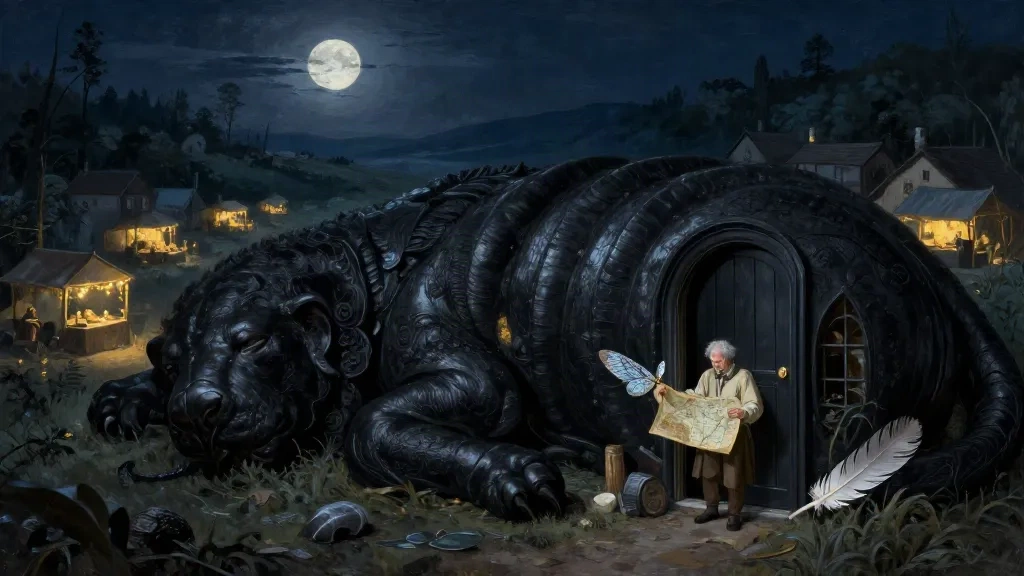
At the end of the village, where the black-lacquered ribs of the sleeping giant rose like the ribs of some vast overturned ship, Mira kept a room with no windows.
She was a retired cartographer, though no one used the word retired. They said she had stopped traveling, or softened, or finally admitted that maps were only lies with better handwriting. Mira said nothing. She had drawn coastlines that had drowned, roads erased by wars, and villages whose names had been scraped from every official record. Her hands still remembered the old borders.
Her gift had narrowed with age. She could draw a door only on a map of a place that no longer existed. The door did not lead to the vanished place. That was the cruelty in it. A door should be a beginning, but hers opened upon a memory.
Every evening she spread her oldest maps across the floor. On one page, the Black Orchard waited behind a door. On another, a vanished ferry waited beneath a door marked with a blue knot. She drew them small, then larger, until the room filled with thin black rectangles.
Behind each one was a lost thing: a child's shoe, a wedding veil, a brass button, a sparrow's nest, a name spoken once and never again.
Mira wanted one place where all of them could rest. Not a museum. Not a shrine. A refuge, she called it, though the word felt too large for her little room.
The Market of Honest Things
The market arrived the morning the giant sighed in his sleep.
It unfolded between two ribs, stalls made of black lacquer and shelves dusted with gold. Ordinary objects sat beside impossible ones: a winter without snow, a child's laughter in a sealed jar, a road that led to the house someone had burned.
The market's rule was simple. Everything had a price. Ordinary things could be bought for ordinary coin. Impossible things, true things, had prices that never diminished.
Mira found a stall where a moth's wing lay beneath glass. It was larger than a hand, silver-blue and veined with gold dust. The seller, a woman whose face was hidden beneath a hood, said, “This is the wing of the moth that guided Saint Orra home.”
“Saint Orra never existed,” Mira said.
“Then it is especially valuable.”
On another stall lay a white feather. The seller said it had fallen from the wing of the giant's first dream. Mira knew that was false. She had seen the giant's dreams: a field of blue smoke, a moon without a sky, a child holding an enormous key.
“How much?” Mira asked.
“The truth of your first map.”
Mira looked down at her hands. Her first map had shown a village that did not exist. She had invented it after her mother's death, giving the woman a home with red shutters and a garden full of winter pears. The map had been beautiful because it was a lie.
She could not pay.
The Price of Shelter
The market laughed whenever someone complained.
They carried her toward the largest stall, where a contract lay beneath black cloth.
“Build your refuge,” the seller said, “and the market will furnish it. Rooms, shelves, doors. Only one thing must be surrendered.”
Mira read the contract. The lettering appeared as she looked at it, silver on black lacquer, each word precise as a star.
The lost things must bring one memory. Not their owner. Not their sound. One memory from the life they had left behind.
That was worse than destruction. A shoe could forget a foot. A veil could forget a wedding. But a memory knew how to open its own door.
Still, Mira signed. The market filled her room with gold-dust light. Shelves rose from the floor. The thin doors in her maps trembled, and from beyond them came a rustle, a cry, the chime of a distant bell.
The moth's wing arrived first. It settled beside a white feather, both glowing in the cold moonlight that entered through the cracks between the giant's ribs.
Then the lost things began bringing their memories.
A drowned village remembered rain. A vanished railway remembered a whistle. A door remembered the hand that had once closed it. Mira's refuge filled until the walls were wet with borrowed lives.
The Sleeping Giant Opens One Eye
At midnight, the giant stirred.
The market's stalls rang like struck bells. Gold dust lifted from the black lacquer and hung in the air, while the cold moonlight bent toward the village like a searching finger.
Mira realized the truth before the sellers did. The market had not chosen the giant's ribs for shelter. The giant had dreamed this place into existence, then forgotten it, as people forget the rooms where they were happiest.
Every lost thing was a piece of that forgetting. Every true thing carried the giant's dream with it.
“What is the payment?” Mira asked.
The hooded seller touched the white feather. “One person must stay awake when the giant sleeps again.”
Mira understood then that the contract had never demanded payment from the lost things. It demanded payment from the one who made room for them.
She could not draw herself into the maps. The places she knew how to open were all gone. But beneath the feather, pressed into the gold-dust stall, lay a small map blank enough to become anything.
Mira drew a door.
It opened not onto a memory, but onto the sleeping giant's heart. Cold moonlight spilled through the ribs. The market began to empty as all the true things turned toward that inner dark.
Mira stepped through last. Before she did, she set the moth's wing and white feather side by side on the threshold: one reminder that guidance could be fragile, the other that dreams could be immense.
Then she closed the door behind her.
In the morning, the village had vanished, and the giant slept deeper than ever. In the place where Mira's room had stood, a small black door appeared in the earth.
It opened only for those who had lost something. Beyond it waited shelves, gold dust, cold moonlight, and a place where every lost thing could finally rest.





