 Netwrck
Surrealism.
The Door That Opened North
At midnight, the river changed direction with the solemnity of a page being turned.
In Bellwether, the eastern bank dried into a pale, cracked trench, and the western bank filled until its roofs reflected upside down beneath the moon. Lanterns burned orange on both sides. Lichen climbed the locked customs house in delicate green letters. By morning, everyone pretended the streets had not been rearranged.
Mara Venn translated the dreams of sleeping machines for the border authority. Her workroom occupied the second floor of a narrow building beside the river, where brass cylinders breathed through their vents and kept one another company in low mechanical whispers. Machines came from the mills, the rail yard, and the hospitals. They dreamed in diagrams, pressures, passwords, and the names of places they had never seen.
Her employer paid her by the sentence. She received a map each year, stamped by the Cartographic Office, and was expected to return it improved. She wanted to leave behind one map that did not lie. More than that, she wanted a map with enough blank space to admit what nobody knew.
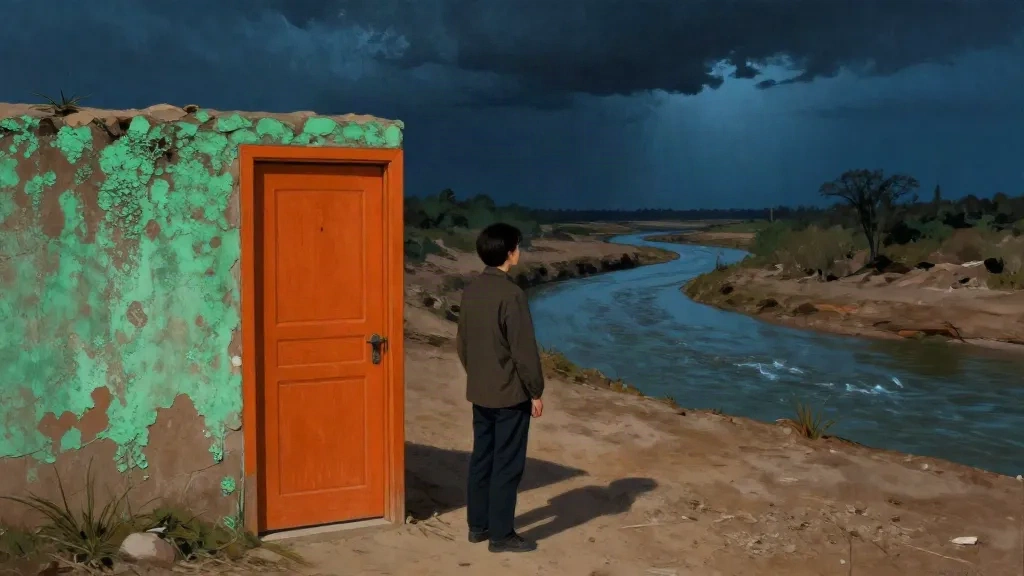
That night, a machine called the Night Ferry had dreamed of a door. It was not in any registry: no hinges, no number, only a rectangle of blue storm-light standing in the dry riverbed.
“It says the door opens north,” Mara told her assistant.
“Doors don’t open north.”
“This one remembers the other side.”
Four Versions of One Promise
At the Ferry’s foot, the dry riverbed smelled of rust, rain held underground, and cut grass. The unmarked door waited halfway between the former banks. Its paint had been burnt orange once; now storm-light leaked around its edges.
Mara had received a map from her mother before crossing to Bellwether. Across its border someone had written: When the river turns, we will meet where the water remembers the promise.
Her mother remembered a promise to return the stolen bridge plans. Her brother remembered a promise to leave Bellwether before the river turned. Mara remembered only the phrase where the water remembers, and had spent twenty years mistaking that absence for a fact.
When she touched the door, the Night Ferry’s dream spilled into the trench.
She saw her family assembled beneath a blue sky. Her mother handed the map to a customs officer. Her brother tore it in half. Mara herself carried a bucket of dry river stones toward the northern sky. Each version ended with the same declaration: The promise has been kept.
Then the voices argued over which promise had been broken.
The door opened. Beyond it stood the opposite side of town, but only as a map drawn by someone who had never left the room. Streets ended in labels: mother’s house, brother’s house, the place where you chose not to ask.
A Better Map
Mara understood then that the machine had not shown her a place. It had shown her the country produced by the family story.
She took out her newest map. At its center, Bellwether appeared twice, facing opposite directions. A thin black line joined them, and the words promise kept had been written over the crossing.
She crossed them out. Beneath them she wrote the four claims in separate colors:
Mother: return what was taken.
Brother: leave before the river turns.
Mara: remember where the water remembers.
The machine: open the unmarked door.
The blue storm-light brightened. The map paper warmed beneath her fingers. Somewhere behind the door, her mother began to speak, but the river interrupted her, carrying the sentence in the wrong direction.
Mara did not choose a true version. That would have been another form of concealment. Instead, she drew a narrow path between the conflicting accounts and labeled it family testimony: unresolved.
Then she marked the door on every section of the map and gave it a name: possible exit, not official border.
After the Water Turns
When the river changed course, the storm-light folded itself into the rising water. The door remained.
Mara returned it to the Cartographic Office with the rest of her improvements. On the first page, beneath the official seal, she left a single dry riverbed drawn in blue.
Her brother later claimed she had erased the past. Her mother claimed she had preserved it. Both were partially correct, which made the map better.
In the years that followed, travelers came to consult it. They asked where the border ended, and Mara showed them the blank spaces. She taught them that a boundary can be a fact of geography, a promise, a memory, or a mistake made loud enough to become law.
At midnight, the river turned again. The unmarked door opened toward the town, though no one agreed which town that was.
Mara left the door off the map. She had already learned where it was.





