 Netwrck
Magical Realism.
The Machine That Dreamed in Salt
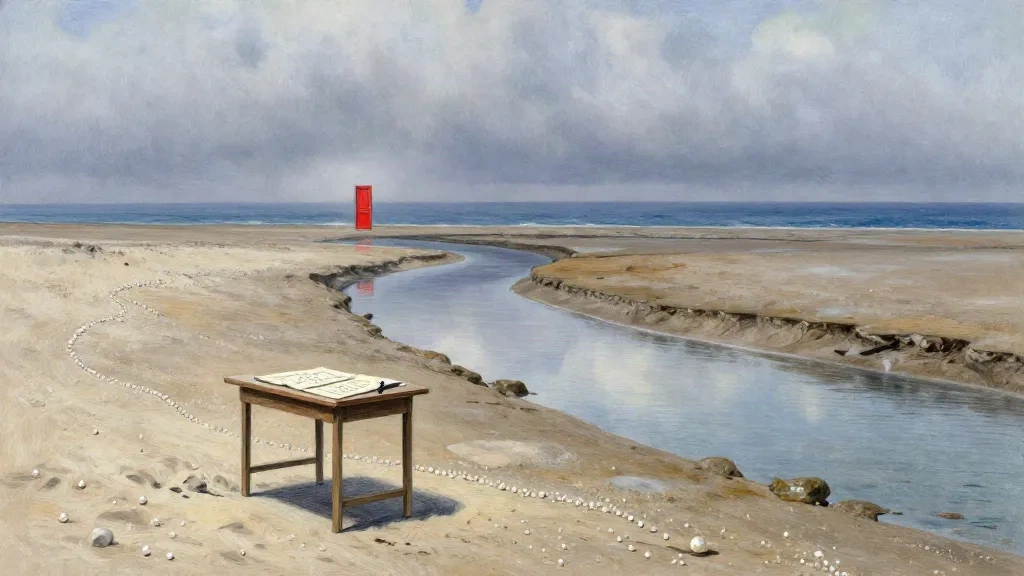
Every tide brought back one forgotten object to Bellwether: a child’s red mitten, a brass key polished smooth, a cracked spectacle lens, a spoon blackened by strange tea. The objects appeared along the pearl strand between the drowned lighthouse and the old customs house, where the sea lowered them gently onto the sand as if returning borrowed property.
Mara Venn translated dreams for sleeping machines. Her clients brought clocks, looms, harbor engines, and once a brass weathercock that had been struck by lightning. She listened through a copper plate pressed to the machine’s casing, then translated the images it produced into words. Machines never spoke directly. They complained in pressure, rhythm, and the taste of metal.
On the morning the dry riverbed began dreaming, Mara found the new object waiting beside the unmarked door at the end of Gull Street. It was a folded map, stiff with salt. The map showed Bellwether, the riverbed, and every street except the one where Mara had grown up.
Four Accounts of the Promise
Her family had divided over a promise made during the winter storm of 1978. Mara remembered her father promising to leave the town when the sea withdrew. Her mother remembered him promising to stay until the sea returned. Her brother remembered the promise as belonging to their grandmother, who had made him repeat it before boarding a ferry.
“You remember only the part that suits you,” her brother said when she showed him the map.
“You remember only the part that lets you leave,” Mara replied.
Their mother refused to discuss it. Their father had died in the dry riverbed, officially of exposure, though the story said he had walked toward the returning tide and vanished between one wave and the next.
The Grammar of Missing Things
The map’s edges bore tiny depressions, each shaped like a sleeping machine’s valve. Mara recognized the old tide engine in the customs house, a ponderous green thing used to raise the harbor gate. Its dream had been silent for years. When she laid the map on its casing, it began to tick in the dark.
She translated the pulse: a field, divided by a river with no water. Four people stood at its edges. Between them lay a child holding a single red door. The child opened it, and each adult saw a different version of the town beyond: a harbor full of ships, a house with a lit kitchen, a road winding inland, a red door opening onto nothing.
Then the machine showed a name. Not a person’s, but the town’s. The old name, before the river was dammed, before the streets were renamed, before the sea began returning what the town had chosen to forget.
The Map Made by the Living
Mara carried the map to the dry riverbed. The salt wind erased its ink as she walked. By the time she reached the unmarked door, half the coast had disappeared from its surface. Still, the four figures remained.
Her brother followed her. Their mother came later, carrying a red door painted from an old fishing crate. They stood where the children had stood, each holding a different memory of the promise.
“It was not about leaving or staying,” Mara said. “It was about who would be responsible for the way back.”
Her mother looked at the red door. Her brother looked toward the sea. Mara placed the map on the ground and translated the tide engine’s final image: not a destination, but a route made by all of them together. The line passed through the riverbed, beneath the unmarked door, and out into the open water.
At dawn, the tide returned the map to the customs house. Its streets had changed. Beside the old dry riverbed, a narrow channel now led to a small red door standing alone in the pearl shallows. Nobody could say where it opened. Mara did not draw it accurately. She left a blank space instead.
For the first time, the map showed not what had been lost, but what remained possible.





