 Netwrck
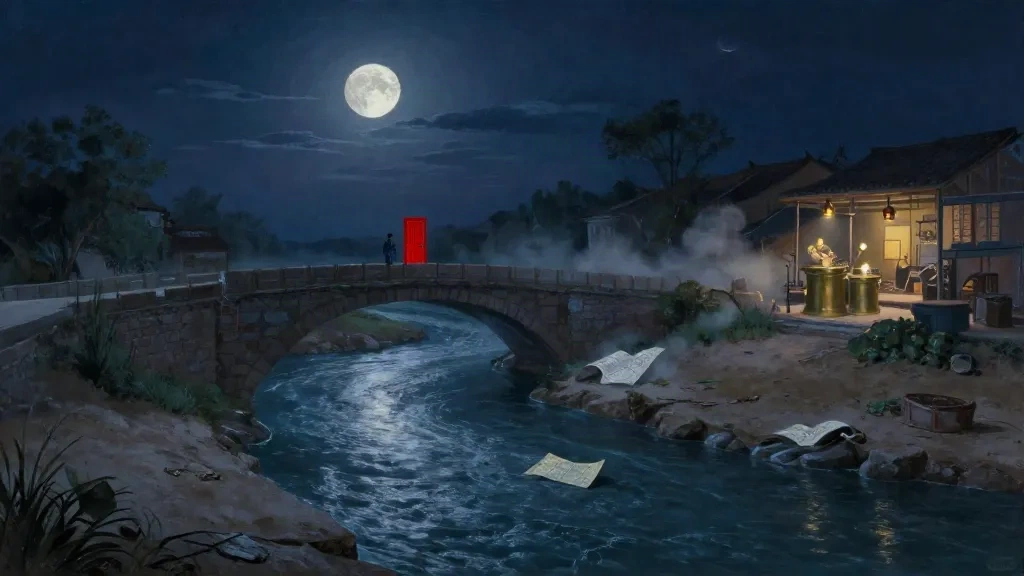
Magical Realism.
The Door at the North Water
On the last evening of October, the river changed direction at midnight. By dawn it ran northward beneath the bridge, carrying leaves, church bells, and the silver foam of the mills toward the opposite bank. The border town woke with its streets pointing the wrong way.
At the south end of town, a translator named Elian received a red door in a wooden crate. It had no number, handle, or hinges visible from the front. The sender’s note said only: Bring this to the machine that remembers your mother.
Elian earned her living by deciphering the dreams of sleeping machines. The machines occupied a long brick workshop behind the customs house, their brass housings warm beneath wool blankets. At night they whispered through their vents in clipped syllables, numbers without units, memories without owners. Elian translated them for the municipal board: this engine had dreamed of rain; that generator feared being dismantled.
She kept the unfinished map folded inside her coat. It was the map she had received from her father before he vanished: the border river, the twin churches, the market, and a line crossing the water where no bridge had ever stood. She wanted to leave behind a better map before she left town. A map with correct roads, honest distances, and no promises hidden in the margins.
Four Accounts of the Same Vow
The red door appeared in the dry riverbed at midnight, standing upright in the mud where the water had been. No one admitted carrying it there. Elian’s brother said he had found it beside the south quay. Her father’s widow said it had hung in the eastern house for thirty years. The ferryman claimed he had watched it walk downstream.
Each account matched the marks on the door. Four small scratches, one for each member of the family, appeared in a different order depending on who described them. The machines were dreaming more loudly. Elian translated one as: We agreed to meet where the river turns, and the river turned first.
Her family had made a promise before the old bridge collapsed. Her father promised to return after the war. Her mother promised to wait until the river flowed south. Her brother promised never to leave her alone. Elian herself had promised to draw the true road on the map.
No two promises could survive midnight intact.
The Grammar of the Machines
Behind the customs house, the largest sleeping machine woke just before the turn. Its dream arrived as a map spoken in reverse: streets first, then houses, then the people who would leave them. Elian understood only when she heard her own name.
The machine said the town had been built on an error. The river changed direction because someone had altered the promise. Not the water itself, but the agreement beneath it. Each family had kept a different piece of the vow, and the river carried the discarded pieces north.
Elian’s brother opened the red door. Beyond it was not a room but the dry riverbed, extending beneath the moon. On its stones lay four objects: a child’s shoe, a wedding ring, a folded map, and a soldier’s button. Each object contained a memory that belonged to someone else.
“If we return them,” he said, “the river may turn back.”
“If we return them,” Elian replied, “we may lose the reason we left.”
The Map Beneath the Turning
They carried the objects to the bridge. At midnight, the river stopped beneath them, suddenly silent. Across the water stood the red door, enormous and closed.
Elian placed the map on the bridge rail. The paper drank the moonlight and became transparent. Beneath it she saw every road the town might have: north to exile, south to home, east toward the old border, and west into the dry riverbed. None was the true road. All were possible.
She drew a single line through them. Not a route, but a boundary between what had been promised and what could be chosen.
Then she gave the map to the river.
At dawn, the water still flowed north. The border remained divided, the machines dreamed in their separate rooms, and the town’s clocks disagreed by one minute. Yet the red door stood open beside the dry riverbed, and anyone who passed it heard the soft mechanical breathing of machines translating one another.
Elian left the next morning with a blank sheet in her pack. She would begin again, carefully, from the ground. For the first time, the map did not promise where she would arrive. It showed only where she had been willing to look.





