 Netwrck
Fairy-Tale Fiction.
The Village in the Giant’s Ribs
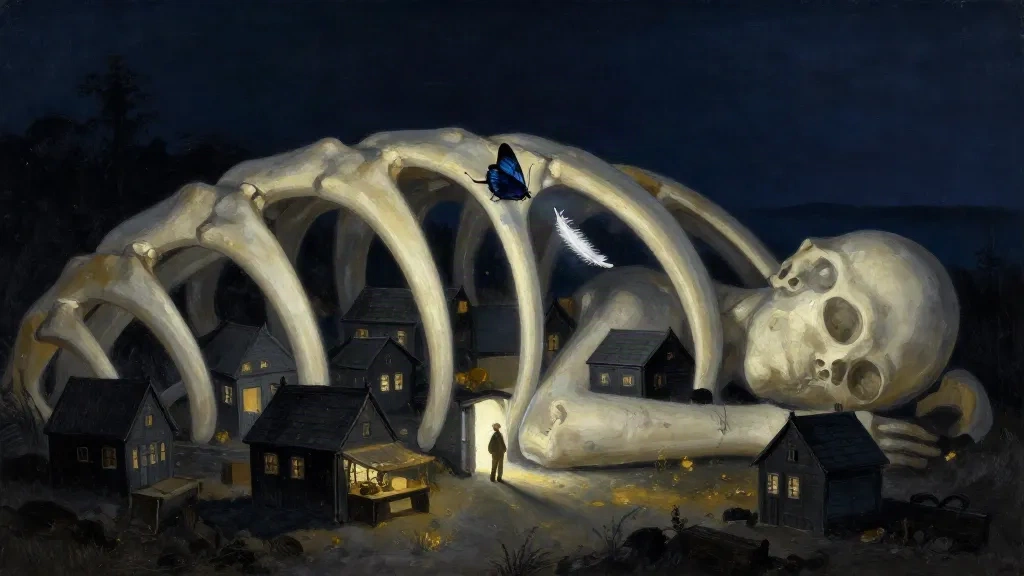
At dusk, the village of Ossa appeared between the ribs of a sleeping giant, its chimneys tucked beneath the old white arches and its lanes shining with cold moonlight. People hung lanterns from the curved bones overhead. They built shelves where marrow had once been. Every evening, they whispered apologies to the ground when their carts rattled too loudly.
Elian Vey lived at the western end, in a room containing one chair, one table, and nine maps of places that had ceased to exist. He had been a cartographer for forty years. His hands knew the weight of every border, but retirement had taught them a stranger skill: he could draw doors on maps of vanished places.
The doors did not lead anywhere alive. They opened onto emptied orchards, drowned courtyards, abandoned observatories, rooms erased from their houses. When Elian finished one, the missing place became a small shelter behind the paper.
His wish was plain. He wanted to build a place where lost things could rest.
The Market’s Expensive Truths
The market occupied the hollow of the giant’s shoulder. Silver bells announced its opening, and the stalls displayed objects with handwritten prices. A red mitten, claimed to be warm. A child’s name, guaranteed never forgotten. A road, priced at every memory it had consumed.
The cheapest things were mostly lies. The expensive things were always true.
One morning, the market’s truest goods began vanishing. A tin sword, a sailor’s compass, the last page of a dead poet’s notebook. In their place, merchants offered slips of black lacquer stamped with gold dust. When touched, each slip produced one true fact, usually something nobody wanted to hear.
Elian bought a slip that said: There is still room for what you carry.
It cost him his last gold coin and one memory of his wife.
That evening, a moth wing lay on his table. It was not white, not gray, but a delicate blue-black, dusted with gold. Beside it rested a single white feather.
Elian knew neither object. He knew the black lacquer on the market slips and the cold moonlight on the floor. Together, the wing and feather seemed to be pointing toward the same blank place on his map.
The Door That Would Not Open
For seven nights, Elian drew. He sketched a coastline erased by a river, a village lifted from a mountain, a house whose name had fallen out of every tongue. The map filled with doors, but none revealed a room.
On the eighth night, the old bell beneath the market rang by itself.
Elian descended into the giant’s chest. Inside, the ribs formed a cathedral of bone, and the lost objects lay gathered in the moonlight: keys without houses, letters without recipients, names without mouths. They trembled whenever the market rang.
At the center lay an unstrung door.
“The market has been taking our endings,” said a voice from the darkness.
Elian drew the final outline.
Across the blank came a surge of warmth. He remembered the woman in his name, the road in the fields, the morning after his daughter left. The door began to open. Cold moonlight spilled through it, carrying the scent of apples and rain.
But the lost things recoiled.
Elian understood then. A place for everything lost would become a prison for everything still needed. The true things in the market were not commodities. They were responsibilities. To pay for a refuge with memory was to make someone else carry what the lost thing could no longer hold.
What the Giant Kept
He drew no grand doorway. He drew a small room.
Inside it, he placed the moth wing above a table and the white feather beside a lamp. The room had black-lacquered walls, gold dust in the corners, and one window opening onto the village in the ribs.
There, the key waited beside its lock. The name waited beside someone who had forgotten it. The compass pointed toward a choice, not a destination.
The true objects rested.
By morning, the market had changed. Every truth carried a price, and every price named its cost in plain language. The children of Ossa came to draw doors in the dust, opening windows toward places that had been lost, not to reclaim them, but to see clearly.
Elian kept the small room. On quiet nights, he opened its black-lacquer door and listened as the sleeping giant breathed beneath the floor.
Sometimes the breath sounded like a door opening.
Sometimes, very softly, he answered: Not yet. But there is room.





