 Netwrck
Hopeful Science Fiction.
The Work Below the Glass
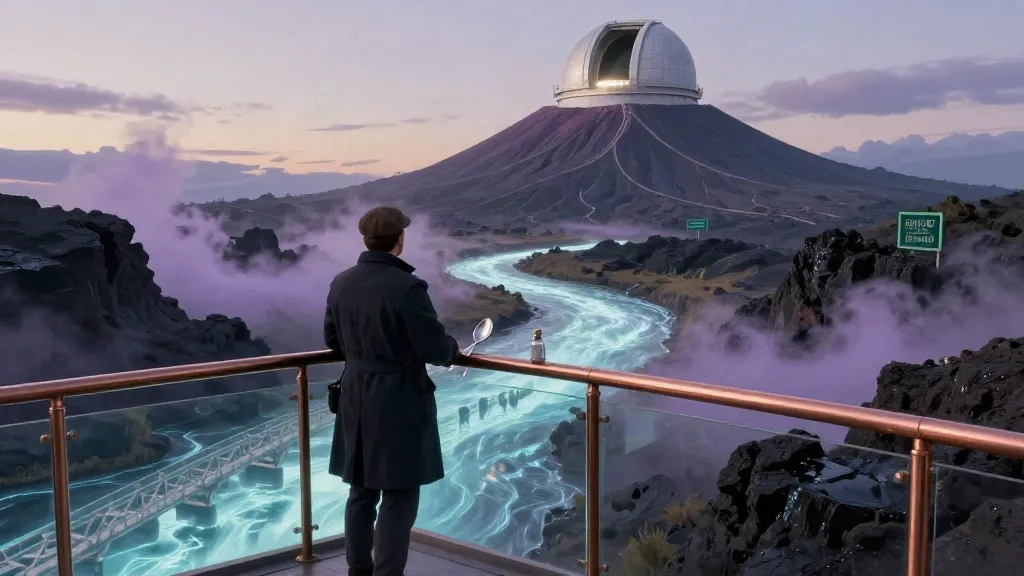
Every morning at two minutes past six, Mara Venn lowered herself onto the copper rail above the observatory’s floor and began her private ritual.
The river moved beneath the glass floor: not the mountain’s cold meltwater, but a narrow channel carried down from a chain of hot springs. Its surface never held the same reflection twice. Lavender under cloud, wet asphalt after rain, and the green flash of a distant pharmacy sign appeared among currents that looked almost solid.
Those were the colors of grief, Mara had learned. Lavender for the long forgetting. Asphalt for anger packed down by ordinary traffic. Green for the irrational wish that the world remain kind.
She mapped them with silver chalk, drawing coastlines where sorrow narrowed and islands where hope rose toward the surface. The maps vanished before noon, carried away by water that belonged to no river Mara knew.
Her desk held two objects that did not belong to any instrument: a tarnished silver spoon inherited from her grandmother and a salt jar sealed with wax.
The spoon was for measuring the river. The salt was for remembrance.
For eleven years, Mara had performed the ceremony alone. Before leaving, she would place one grain of salt on the spoon, hold it above the channel, and whisper the name of a bridge she wished the world had kept.
Most were small: a footbridge over a flooded road, a hospital crossing, a plank bridge that vanished with its village. Mara knew only the stories passed to her. The river knew the rest.
Names Beneath the Mountain
The complication began when the river began returning the bridges she had not asked for.
On the first morning, the water lifted a dark arch beneath the glass. Its stones were arranged in the shape of the observatory’s original entrance, a path that had been sealed when the mountain began to wake. On the second, it carried a silver suspension bridge through the pharmacy-green shallows. On the third, the bridge had no name, only thousands of handprints pressed into its surface.
Mara traced them with her spoon. Each print held a different emotion: fear, relief, defiance, homesickness. The river, she realized, did not merely remember bridges. It remembered everyone who had crossed them.
Then the salt jar began trembling.
She opened it. The salt had become a clear liquid, fragrant of rain and hot stone. At the bottom lay a narrow strip of black basalt, carved with the names of the observatory’s vanished workers.
Among them was a name she knew: Ilyan Vale, chief engineer, missing since the winter avalanche.
Mara had crossed his footbridge every morning for six months without learning that he had designed it. Now, beneath the green water, she saw the bridge’s outline stretch toward a tunnel in the mountain wall.
The tunnel was opening.
A Public River
At sunset, Mara climbed to the public gallery. Below, the observatory floor had filled with townspeople. They had come because the mountain’s warning lamps were flashing, and because the river had begun sounding like thousands of bells beneath the building.
“We cannot open the crossing,” said the magistrate. “The mountain is unstable.”
“It is not unstable,” Mara said. “It has been waiting to be addressed.”
She placed the salt jar on the rail. Beside it rested the silver spoon.
“This river has kept a private archive for centuries,” she told them. “Tonight, we will read one page aloud.”
She dropped the spoon into the channel.
Water closed over it, then rose as a luminous column. The pharmacy green brightened. Lavender currents unfolded. Wet asphalt turned into a dark bridge spanning the gallery, each step formed from a memory.
The first figure to cross was Ilyan Vale. He carried no tools, only a handrail sawn from the old observatory. Behind him came a woman Mara had never met, then a child, then a procession of engineers, teachers, ferrymen, and strangers.
They were not ghosts. They were records—proof that every act of crossing had left a public claim on the world.
Mara climbed onto the bridge.
The mountain groaned. A seam of red light opened beneath the glass, not flame, but the steady pulse of a sleeping heart.
At the far side, the figures waited beside a new footbridge spanning the warm river. It was small, practical, built from local stone. No magic made it. People carried stones from the lower path while Mara measured the water and called the depths.
By dawn, the mountain was quiet. The observatory’s sealed passage stood open, and the public river ran beneath it without swallowing a single handrail.
Mara left the spoon on the threshold, salt jar beside it. The ritual had become a public act, but it had not become less tender.
What the Water Holds
Years later, surveyors came from distant cities to study the moving surface. They learned that every emotion had a current, every crossing a bridge.
Mara taught them to read without fixing the water into a permanent picture. She insisted on the spoon and salt, not as instruments, but as reminders that memory should be handled carefully.
When asked what the river had taught her about hope, she placed a grain of salt on the spoon and watched the mountain’s reflection appear beyond the moving surface.
“Hope is not a map,” she said. “It is a crossing someone else made possible.”





