 Netwrck
Speculative Fiction.
The Survey of Moving Water
At dawn, on the ninth day of the month of Cold Salt, Sister Ilyra lowered the silver spoon into the river and watched the surface tilt toward her.
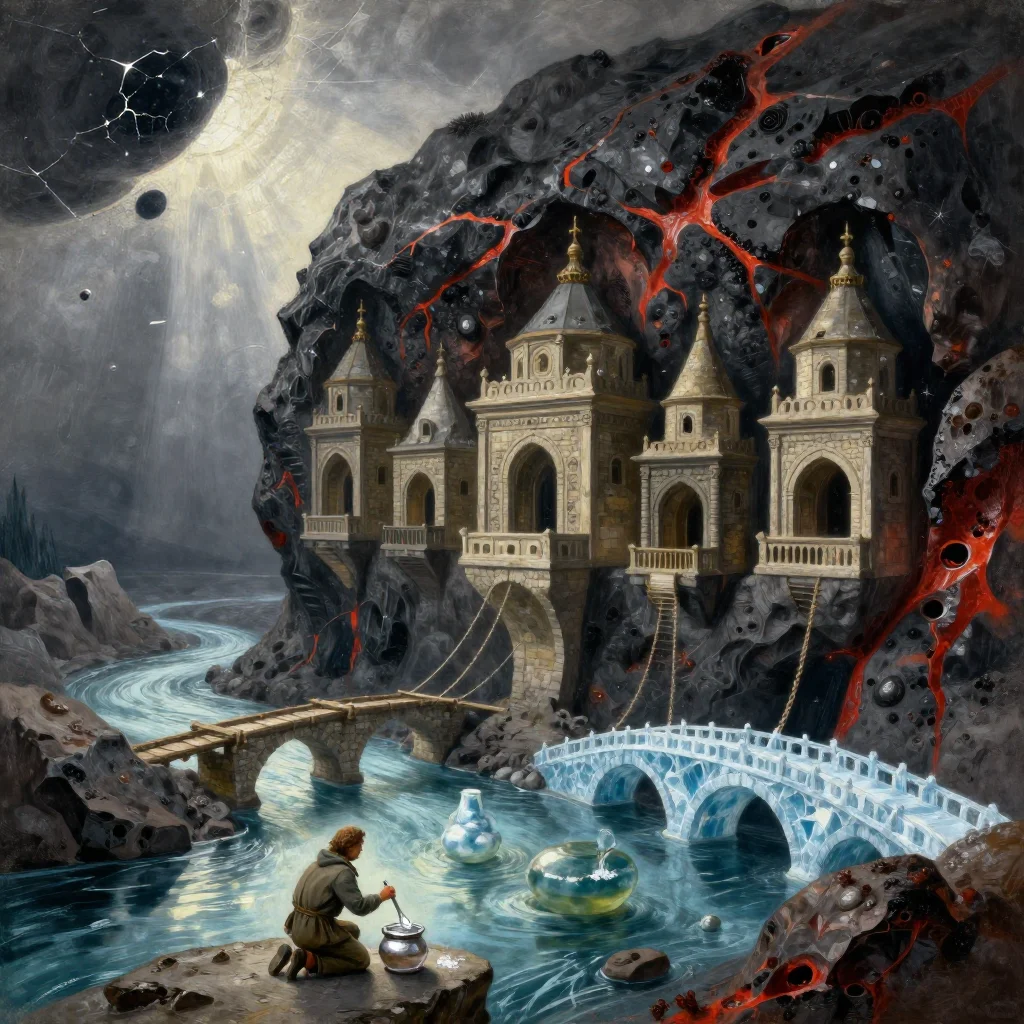
The river ran through the monastery’s spine, black and quick beneath a shell of ice and a lid of rusted iron grating. It moved because the comet moved. Twice each year the comet turns, and twice each year the whole monastery goes a few handspans west, the nave drifting over new ground like a hand slid across a table. Nothing stayed where it was put. The refectory wall was once a chapel door. The cloister walk had a window in it until the comet showed it a different season. Even the saints had been redrawn by the drift, their painted faces now oriented toward rooms that no longer held the bones they belonged to.
Ilyra was the monastery’s river surveyor. She mapped feeling as it moved: grief as a dark braid travelling under the surface, desire as bright seams beneath a skin of foam, fear as a stone that sank without sound. Her instruments were a brass compass that never pointed north, a tray of powdered charcoal, a stoppered jar for samples, and the small silver spoon she had inherited from her mother, who had held the office before her and who had died at this bank without ever once being seen to cry.
She knelt and read the current the way other sisters read a psalter. It carried the monastery’s old reserve of patience, worn smooth and grey as a paving stone. It carried the private anger of Brother Tal, who had gone missing eleven days ago and come back four days ago without a word. It carried the embarrassment of the choir, who had sung one interval incorrectly for nineteen years and corrected it only in their dreams, and who woke each morning with the taste of a wrong note in the back of the throat. It carried Sister Vessa, who had drowned in the survey channel on the second day of Cold Salt, and it carried the particular silence of everyone who had signed the roster that put her there.
Ilyra held the spoon under the water and counted. The water came up black, and colder than it had any right to be in a room with a floor. It came up the way water comes up when it has been asked a question it will not answer honestly.
A river will carry what you give it. A river will not carry it for you. Those are two different sentences, and only one of them is a kindness.
Her mother had said that, standing in the exact place where Ilyra knelt now, with the same spoon in her hand. Her mother had also said, later, in a doorway, with her hand on Ilyra’s wrist: And if you cannot carry it, salt it. Do not give it to the water. Give it to the salt. Salt takes a thing and makes it bright and puts it somewhere no one can drink from.
Ilyra had been fourteen. She had not yet understood that this was a way of saying: do what I could not do.
The Habit of the Salt
Each evening after compline, when the others had retired and the comet-light through the chapterhouse window had gone from grey to the colour of a bruise, Ilyra carried the salt jar down to the bank and named one feeling she had hidden that day.
Not described it. Not confessed it. Named it, the way you name a star you are giving up the right to look for again. The envy I felt when Brother Dunstan was made oblate. The relief I felt when Vessa fell.
The second one was true. That was the discovery of the year: that relief was a thing you could salt, and that salting it did not make it not have happened. The salt made the water brighten in a spreading ring, a brief white bloom that the current smoothed and swallowed within a breath. By morning the river held no evidence. That was the whole of the practice. Nine years of it, three hundred and forty jars, and the river had never once been brighter in the morning.
No one else knew. That was not the point, though Ilyra had told herself for a long while that it was. The point was that a public act requires witnesses, and a witness turns a feeling into a fact. Facts get recorded. Recorded things get answered. She had watched her mother confess a single sorrow at the abbot’s table and spend the following eleven years being comforted by other people’s grief, which is a way of being told, in eleven languages, that your sorrow has become furniture.
So: the salt, the bank, the empty stair behind her. And the small, cold pride of being the one person in the building who never had to be forgiven for anything, because she had never, in front of a single human witness, done a single wrong thing.
She was not aware of this as pride. She was aware of it as a kind of tired arithmetic.
The Record of Every Crossing
On the ninth day, the river changed.
It ran clear from bank to bank, and in its surface Ilyra saw bridges. Stone arches under winter light. A timber span slick with rain, its planks swollen and touching. A rope bridge over black water, thin as a nerve. A bridge of ice that had been a bridge only once. A bridge of ships, lashed hull to hull. A bridge with no visible far end, going out through the vault wall and returning by a different door.
Each one carried a mark. Not the feeling of the people who walked it: that was still there, braided and gleaming, ordinary. The marks were older and colder. Every promise made standing on a span. Every betrayal finished in the middle of one, where there is no bank to flee to. Every bridge ever built anywhere, polished by use and time into a single current, and all of them, Ilyra understood with a clarity that felt like a blow to the sternum, in the water under her knees.
She dipped the spoon. The river rose in its bowl, bright as a mirror, and did not spill.
“What are you?” she whispered.
It showed her the monastery before the comet: a village on a warm shore with children shouting from a sandbar, then a basilica built out of the village, then a fortress built out of the basilica, then a long administrative quiet in which the river had been deliberately forgotten, bricked over in one place and rerouted in another and left, where it wanted to be, running underneath. In every age, someone had stood above that water and asked the crossing to hold. Not for me, she saw. For whoever is behind me. That was the record. The bridges had been keeping a ledger of an argument nobody still living was making.
Then the spoon showed her the last bridge, and her stomach went out from under her.
Its stones were the monastery’s own walls. Its piers were the refectory arches. And across it, in single file, walked a procession of people carrying salt jars, and at the front of the procession walked Ilyra, aged perhaps nine, holding a jar in each hand.
Behind her in the vision, a woman stood at the near bank with a silver spoon in her hand, saying nothing, letting her go.
The vision ended with Ilyra standing on the far side, holding a piece of charcoal.
Brother Tal’s Account
She found him in the dry archive under the scriptorium, which was where he had been sleeping, according to the porter, for four days. He had a lantern and a broken lamp and the posture of a man who has been sitting with a decision rather than making it.
“You came back,” Ilyra said.
“I came back to say a thing and could not find the shape of it.”
Tal was fifty, or looked it, with the raw hands of a man who had worked rope before he had worked theology. He had gone missing on the night Vessa drowned. Everyone in the chapter house had watched the water carry him southward with his pack on his shoulder and his anger in it like ballast, and the reading had been unanimous and wrong: that he had left.
“I was sent to the ridge,” he said. “Nine days before. The abbot sent me. Written, sealed, in the abbot’s hand, and I have it here, because I am a coward who keeps paper.” He set a folded sheet on the crate between them. “I was to take the night watch on the survey channel and I was not to take it. I was to be on the ridge, and I was to be silent about having been on the channel, and I was to be the man who was never there.”
“Why?”
“Because I had been in the dry stores drinking and singing, and Vessa had reported me once already, and the abbot decided the cheapest repair was not my chastisement. It was my absence.”
Ilyra stood very still, because the room had begun to make the sound a room makes when a thing that has been sitting in it for nine days finally gets up.
“I knocked,” said Tal. “That is the shape of it. There is a bell-pull at the channel steps and I put my hand on it and I did not pull it, because a man who has just been told to be absent cannot also be the man who raises an alarm. So I stood in the stair and I listened to her knock, and I did nothing, and then she stopped knocking.”
“Why did you not say this on the second day?”
“Who would I have said it to?”
She had the answer ready and it was the true one, and she gave it, and that was the moment she began to understand what the night was going to cost. The abbot, she said. I would have said it to the abbot.
“No,” said Tal, kindly. “You would have salting it by Thursday.”
The Public Crossing
That evening she brought the salt jar to the main chamber instead of the river.
Tal was there, returned or never left, it no longer mattered which. The abbot sat beneath the window shaped like a split crown, and behind him Brother Dunstan stood with his hands folded in a way that meant he had already decided not to be surprised. The novices lined the walls, each holding some grievance like a small animal: the cook who had been passed over, the infirmarian who had let Vessa walk to the channel steps because she said she was not dizzy, the eleven-year choir with its wrong interval.
Ilyra set the jar on the table. It was heavier than nine years of evenings should have allowed.
“This river has been carrying us without our knowledge,” she said, and heard her own voice take the surveyor's flat cadence, the one that reported rather than asked. “It carries every bridge that was ever built, and the promises on them, and the crossings that failed. It also carries one thing of ours. One name. Sister Vessa, and the roster with my hand at the bottom of it, and the bell-pull nobody touched.”
“This is dangerous,” the abbot said.
“So is pretending the water is empty.”
“That is not an answer.”
“It is the only one I have that is true.”
She opened the jar. The salt struck the air like a burst of pale wings, and every person in the room breathed in at the same time, and there was a moment, brief and complete, when the whole chapter house was a single creature with a single pair of lungs.
Then she led them below.
Along the bank, the clear water displayed what nine days of silence had been sitting in: the kitchen brother stealing bread for his sick mother and hiding the flour in his sleeve; the novice who had prayed, in the second week, for a rival’s death and been horrified by how quickly the praying had worked; Dunstan’s letter to his order saying the comet was a sign, drafted, sealed, and never sent; Ilyra herself, at nineteen, pressing her thumb into the silver spoon and swallowing the first grief she had ever mapped, which was her mother’s, which had been in the water since the spring.
“That one is not yours to show,” said the abbot, behind her.
“It is the oldest one I have,” said Ilyra. “It set the method. If I show you Vessa, I do not get to keep her back.”
The river did not punish them. That was the horror of it, and later, alone, with the spoon cooling in her hand, she would find it much worse than punishment would have been: the water held every shape, including the ugly ones, with the same even pressure. It did not accuse. It did not absolve. It held, and it kept moving, and the keeping was a kind of sentence.
At the crossing, each person took a handful of salt and spoke one feeling aloud. The words did not vanish. They joined the current, joining the bridges beneath the comet, joining the old stone crossings no living person remembered building. Brother Tal said: I was there and I chose not to be. Dunstan said nothing for a long moment, and then said, in a voice that shook the iron grating, I ordered a man removed so that the fault would have no witness, and I called it discipline. The infirmarian said: She told me she was not dizzy and I let her say it because saying it made my work easier. The choir sang their interval, the wrong one, deliberately, once, and let it stand there in the open air like a man showing his teeth.
Nine-year-old Pell said nothing at all. She stood with her fist closed in the salt and would not open it, and the water in front of her stayed flat and white and featureless, a patch of it, four feet across, the only part of the river that took nothing. Ilyra marked the place with a stone and did not press her. Some things cannot be made public by the person who most wants to.
By midnight the river had gone rust red, then charcoal, then clear as winter light.
What the Water Kept
The consequences came in the ordinary order, which is to say slowly, and by letter.
The brine arrived first. Nine years of salted feeling had not gone into the channel; it had gone into the aquifer under the chapter house, and a river that suddenly ran clear also ran hungry. Within a month the well by the infirmary turned brackish, and then the well by the scriptorium, and the infirmary had to buy its water from the village on the warm shore, which is four days away by mule and which had no reason to welcome a monastery that had been drinking its memory for a decade without paying.
The dead came up next. With the naming of Vessa, the river began to give back the forgotten: names carved into the refectory wall that had been smooth since the fortress years, a woman called Ansa who had run the ferry for forty years, a boy called Petru who had died at the near bank and been written down wrong. The monastery had a list now. It was not a comfortable list. Two of the people on it had, according to the village, been murdered, and there was no one left in the building old enough to be tried.
The abbot did not resign. That is the thing people will not believe, and it is true: the abbot held. He submitted to the council, he accepted the removal of the sealed letter from the record, and he set down a new rule that no brother or sister in that house might be sent away in silence again, which is worth more than a resignation, and which was arrived at, as everything in that house was arrived at, by letting the water show him what he had done.
Tal stayed. He was made the monastery’s porter, which was a demotion, and he took it, and he told Ilyra on a Tuesday that he had thought about walking south and had not, and would probably not tomorrow either, and that this was not the same as being fine. She said she knew. He said, I know you know, that is what I have learned about you in nine days, and went to carry water.
And Pell’s white patch stayed. Four feet of flat nothing in a river that had become a ledger. The abbot wanted it surveyed and mapped and named as a fault in the confession. Ilyra mapped it. She gave it her own notation, the one her mother had used for water that has taken a thing too large to move: a small circle with a line through it, meaning carried, not here, not yet. The choir boy asked her what the line meant.
“It means we are not finished,” she said.
The Shape of a Shared Bank
At dawn she mapped the new surface with powdered charcoal and a steady hand. The lines ran in no private channels at all. They met at the centre and braided there, a broad open shape like a hand laid flat on the water, fingers spread, palm up.
She compared it, because she could not help it, with the procession she had seen in the spoon: the file of salt-jar carriers, the small girl at the front with two jars, the woman on the near bank letting her go.
She had spent nine years building a bridge out of salt and calling it privacy. It had held beautifully. It had also gone nowhere. It had never once been crossed by anyone, including herself.
The comet turned. The monastery shifted. The river moved.
And the bridges held, which is the whole of the miracle and not more: not because they were repaired, not because anyone had done them a kindness, but because six people had stood on a bank and said out loud the things they had arranged never to say, and the water had taken them, and had gone on moving.
Ilyra placed the silver spoon on the bank and set the salt jar beside it, both within reach of anyone who came down. What had been a private ritual had become a public act, and the difference between the two was not, as she had believed for nine years, the difference between hidden and exposed. It was the difference between a lock and a door. The first keeps things in. The second lets them in and does not decide who.
The Bridge She Had Been Avoiding
Then the river turned its mirror toward her, the way a river does when it has finished telling you something and has one more, and she saw the bridge.
It was not made of stone, or timber, or rope, or ice, or ships. It was made of every road she had taken alone.
She stepped onto it, and it gave exactly as much as she did, and the survey instruments on her belt clinked and did not fall, and the water underneath was not cold.
Under her feet, the bridge did not promise to stay. It had never been able to. It had been built by a woman at a bank, with a spoon, out of a thing she swallowed, and it had held for eleven years without a single other person ever setting weight on it.
It promised to be crossed.
And somewhere behind her on the near bank, at the foot of the stair, a girl with a closed fist was beginning, very slowly, to open her hand.





